Who Owns the Orchard?
David Williams
International residents have become an increasingly important part of Danish society. According to a 2025 analysis by Dansk Erhverv, international workers contributed DKK 361 billion to Denmark's GDP in 2024, equivalent to around 12 percent of the entire Danish economy. They work in Danish companies, pay taxes, start businesses, fill labour shortages, and help sustain economic growth.
Denmark has a total population of around 5.9 million people. Within that, approximately 650,000 people living in Denmark hold foreign passports and fall into the category of international residents with established residence in the country. This group includes EU citizens as well as non-EU nationals who have lived in Denmark for years and are part of the workforce and civic life. (Source: Statistics Denmark, population by citizenship and length of residence, 2025)
Many internationals already participate in Danish democracy. Under current law, citizens from EU countries, Iceland, and Norway can vote in municipal and regional elections. Other foreign residents gain the same right after four years of residence. As a result, tens of thousands of internationals are eligible to vote in local and regional elections.
The question now being asked with increasing frequency is whether their political voice should extend further.
Denmark’s acting Foreign Minister Lars Løkke Rasmussen has recently signalled support for giving internationals a stronger political voice. Some may view this as a matter of democratic principle. Others may suspect a degree of political calculation. As Denmark's international population grows, so does its potential electoral significance.
At the same time, campaigns are beginning to emerge around the issue itself. Simone Giuseppe Uggeri, an Italian citizen who has lived in Denmark since 2016 and leads Billund International, Denmark's first civic list focused on international residents, has become one of the most prominent advocates for expanding democratic participation.
Uggeri argues that long-term residents who contribute to Danish society deserve a greater political voice. As he recently put it to Last Week In Denmark, "We are not just here to pay taxes and observe while our future is planned without us. Let us decide on it together." He has also questioned why internationals are often discussed in political debates but rarely included in them, asking, "From left to right, politicians talk about us, and that’s unfair. Why don’t they talk with us instead?"
The argument is not difficult to understand.
Long-term residents contribute to the economy, participate in local communities, and live with the consequences of decisions made in Christiansborg. Supporters argue that democratic legitimacy is strengthened when those affected by laws have some voice in choosing those who make them.
There is also the question of belonging. Many internationals have spent years, sometimes decades, building their lives in Denmark. They raise families here, purchase homes, learn the language, and invest in the future of the country. Supporters such as Uggeri argue that democratic participation should reflect contribution and commitment, not simply possession of a passport.
Yet there is another side to the debate.
Mikkel Bjørn, the newly elected lead candidate for Dansk Folkeparti in Copenhagen, has argued that "it is a fundamental problem that foreign citizens, who may not have a thorough knowledge of Denmark, have the right to vote."
His concern reflects a broader question about the nature of citizenship itself.
Is voting primarily a right attached to residence, or is it a privilege attached to membership of a national political community?
For many opponents of expanding voting rights, citizenship represents more than legal status. It is a formal commitment to a country and its future. Voting determines questions of taxation, defence, foreign policy, immigration, and national identity. They argue that these decisions should ultimately be made by citizens because citizens are the people who have formally accepted both the rights and responsibilities of membership.
The debate becomes even more interesting when viewed through the people already helping shape Danish civic life.
Alina Protsyk, a Ukrainian-born activist and municipal candidate for Radikale Venstre in Copenhagen, has become a prominent voice on refugee and integration issues through her work with Lastivka, one of Denmark's largest Ukrainian cultural associations.
Similarly, Rajinder Pal Singh Grover, an Indian-born community organiser in Kolding, has spent years helping internationals navigate Danish society while encouraging civic participation through his organisation TEAK.
Their influence demonstrates that participation in public life does not begin and end with voting rights. Community leaders, activists, entrepreneurs, and organisers already help shape Denmark's future every day.
What makes this debate particularly significant is that it extends far beyond Denmark. Across Europe, questions of citizenship, belonging, representation, and democratic participation are becoming increasingly central. As societies become more international, democracies are being forced to reconsider where the line between residence and citizenship should be drawn.
There may never be a perfect answer.
A democracy that excludes too many voices risks weakening its legitimacy. A democracy that completely separates political power from citizenship risks weakening the meaning of citizenship itself.
As a long-term British international with Danish children, it might be surprising to hear that I do not personally support extending voting rights to non-citizens in Danish general elections.
For me, the right to vote carries moral and ethical obligations as well as rights. At its most fundamental level, citizenship includes a willingness to defend the political community against even one's homeland, if circumstances demand it.
That is not a criticism of Denmark. It is simply an acknowledgement of where my ultimate national loyalty lies.
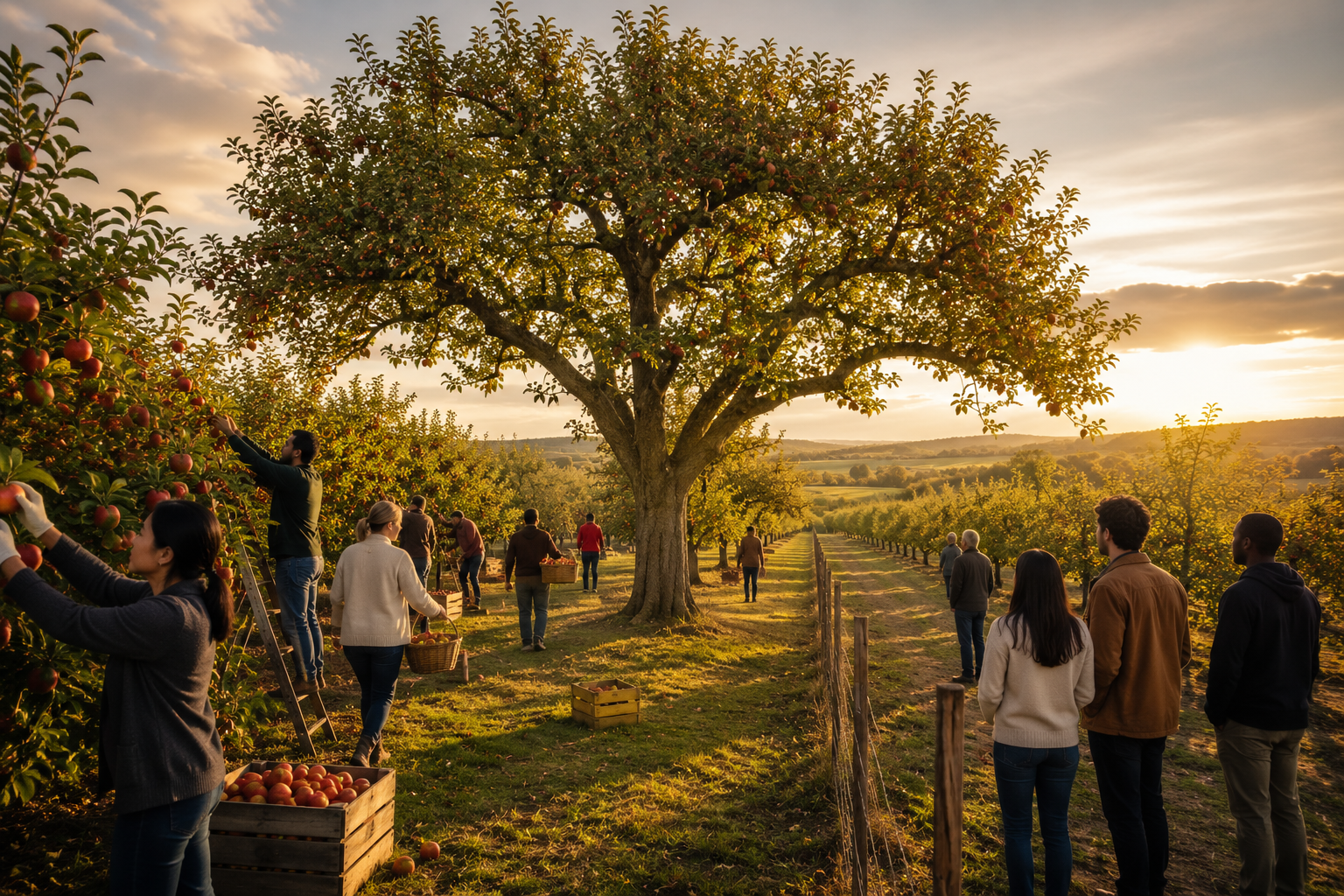
Because of that, I struggle with the idea of participating fully in a democracy whose deepest obligations I would not automatically accept. To me, that feels like enjoying the fruit of an orchard without fully sharing responsibility for its defence and preservation.
Others will disagree, and reasonable arguments exist on both sides.
Ultimately, the question is not whether internationals contribute. They clearly do. The question is whether contribution alone should be enough to grant a voice in choosing a nation's government, or whether that right should remain tied to citizenship.
That debate is unlikely to disappear. If anything, it is only just beginning.
The question of who owns the orchard will ultimately be answered through public debate and democratic choice. Readers are invited to add their own voices to the discussion.
Source: Dansk Erhverv, "Internationale medarbejdere bidrager med 361 mia. kr. til Danmarks BNP" (April 2025). Statistics Denmark, foreign nationals residing in Denmark by citizenship and duration of stay (2025).
Support Sphere Magazine and subscribe to our FREE LinkedIn Newsletter