When the Ground Moves, Preparedness Decides Who Lives
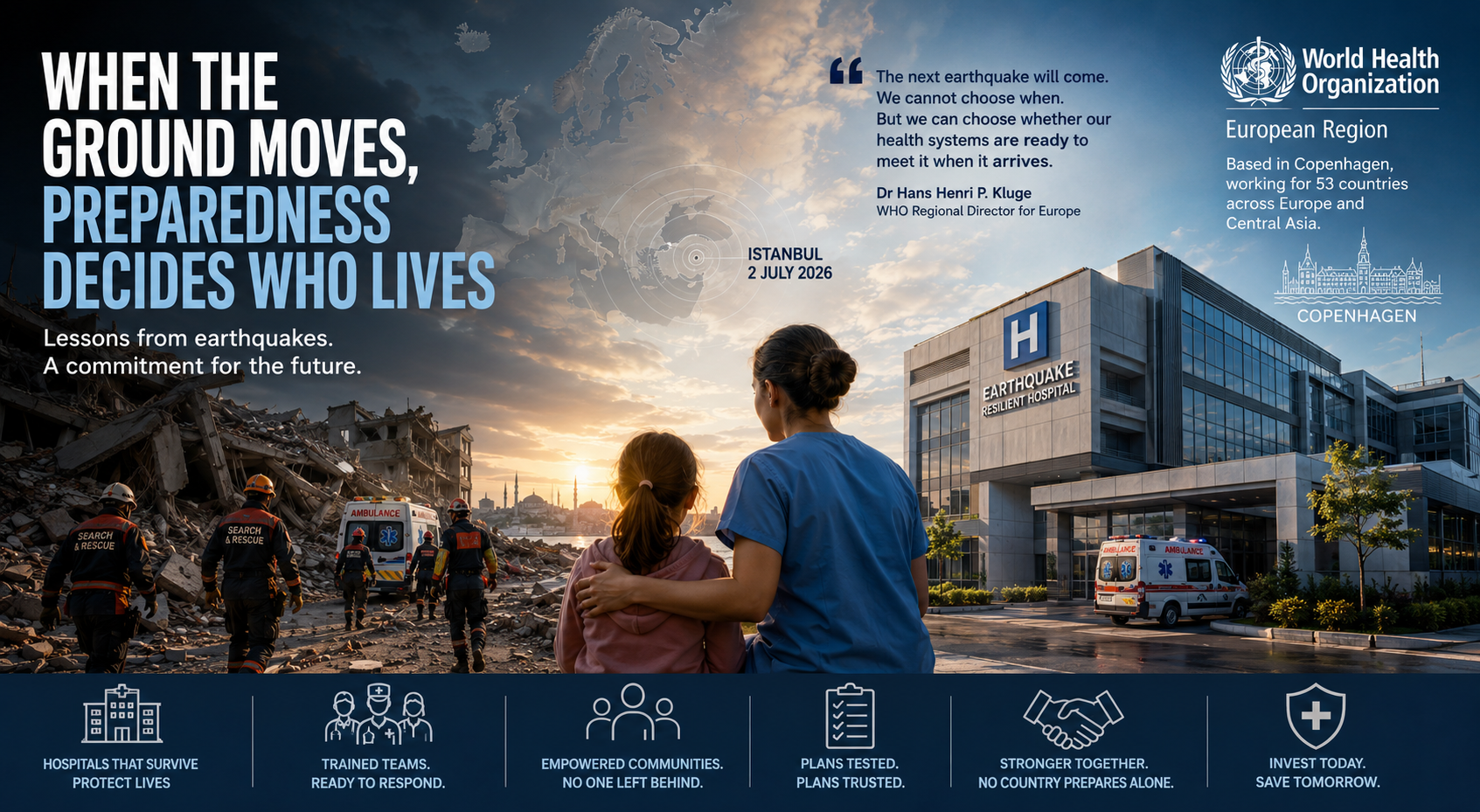
From Copenhagen, where the WHO Regional Office for Europe is based, Dr Hans Henri P. Kluge oversees public health policy for 53 countries across Europe and Central Asia. That detail matters in a Danish context. It means that one of the world's most important disaster and health preparedness voices is not speaking from Geneva or New York, but issuing statements from Denmark's capital, where European health security strategy is coordinated day to day.
By David A. Williams
Kluge, a Belgian physician and senior WHO leader, has become a defining figure in European public health through crises ranging from COVID-19 to the war in Ukraine. His role as WHO Regional Director for Europe places him at the center of planning for exactly the kinds of cross-border emergencies that do not respect national boundaries. When he speaks about earthquakes, he is not describing distant hazards in abstract terms, but operational risks that European health systems are expected to withstand.
Speaking in Istanbul on 2 July at the WHO Ministerial Conference on advancing health security through earthquake emergency management, Kluge issued a statement that was both technical and deeply human in its framing. "The lesson is simple. Preparedness cannot wait for the disaster," he said, as ministers from across the region adopted the Istanbul Outcome Statement, a shared commitment to strengthening health systems before the next major earthquake strikes.
He also pointed to the fragility of the institutions people rely on most in a crisis. "It showed us that when an earthquake strikes, it is a hospital or clinic – the places people run to for help – that may not withstand it," he said, reflecting on the devastating Türkiye earthquakes of February 2023. Those events killed tens of thousands, destroyed critical infrastructure, and forced the global health community to confront an uncomfortable reality. The systems meant to save lives are often among the first to fail.
The timing of his remarks was sharpened by recent earthquakes in Venezuela, which he referenced at the beginning of his statement. That contrast underlined a central argument running through his speech. Disasters may appear suddenly, but their consequences are shaped long before the ground shakes. "The next earthquake will come. We cannot choose when. But we can choose whether our health systems are ready to meet it when it arrives," Kluge said.
A key point in his message was economic as much as humanitarian. Designing hospitals to survive earthquakes, he noted, increases construction costs by only one to four per cent, yet delivers returns many times over by preventing collapse and preserving medical capacity. In other words, resilience is not a luxury. It is a cost-effective public investment.
The Istanbul meeting itself reflected a shift in global thinking. Instead of treating earthquakes purely as emergency response events, governments are now being asked to treat them as predictable shocks that demand long-term preparation. That includes resilient hospitals, trained emergency teams, coordinated government planning, and communities that understand how to respond before help arrives.
The Danish dimension is not incidental here. With WHO Europe headquartered in Copenhagen, Denmark sits close to the administrative center of a system shaping how the continent prepares for health emergencies. It is a reminder that global health governance is not only about faraway disasters. It is also about institutions based in stable countries designing frameworks that may one day be tested under the most unstable conditions imaginable.
In the end, Kluge's message was not about earthquakes alone. It was about political memory and the tendency of governments to invest after a catastrophe rather than before it. The uncomfortable truth is that the ground will move again somewhere in Europe or its neighbourhood. Whether that movement becomes a manageable emergency or a human tragedy will depend less on geology than on decisions already being made in ministries, planning offices and, significantly, in Copenhagen itself.