When the City Becomes a Stage: The Hidden Cost of Copenhagen Distortion
David Williams
I attended the very first Distortion circa 1998. It was held in a small club tucked in by Tivoli, just across the road from Hovedbanegård, Copenhagen’s Central Station. It was a modest, slightly scruffy affair, full of dishevelled Copenhagen trendies with Master Fatman DJing. I still remember one devious participant “accidentally” bumping into me with an empty beer glass, then promptly insisting I had made him spill it and demanding a free pint, probably because I was wearing a suit. I sent him on his way with a fairly colourful verbal barrage. That moment has probably coloured my view of the whole event ever since.
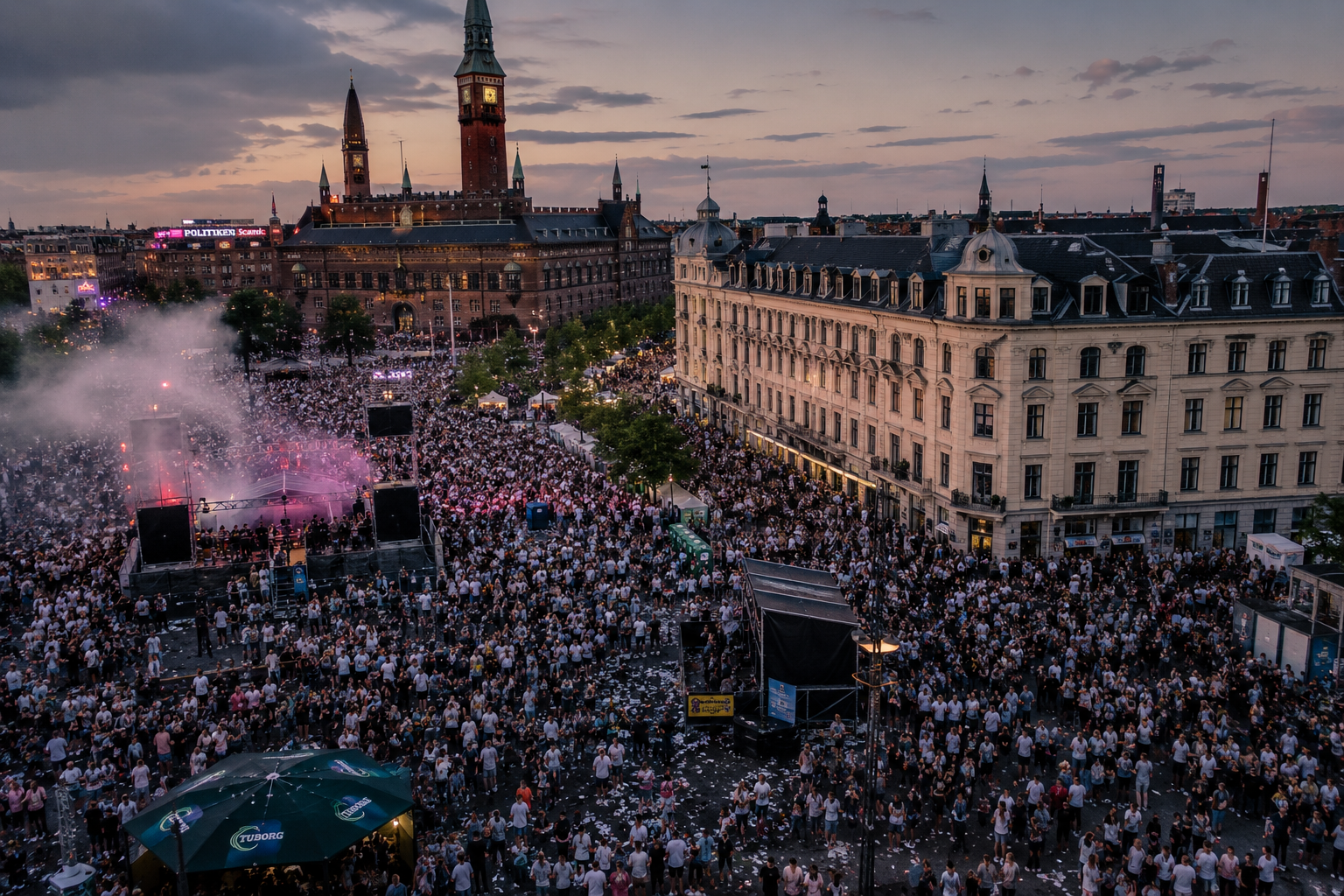
Copenhagen Distortion (3-7 June) is often sold as a celebration of urban freedom. For a few days each summer, Copenhagen stops behaving like a city and starts behaving like a continuous party. Streets turn into dance floors, squares become sound systems, and neighbourhoods like Vesterbro are rebranded as open-air clubs.
On the surface, it looks like cultural energy at its purest. Music in public space, thousands of people mixing freely, a kind of temporary utopia where the city belongs to everyone. But that image only holds if you ignore what is being asked of the city, and who ends up paying for it.
From underground impulse to organised infrastructure.
Distortion did not begin as a polished civic institution. It started as a loose, slightly chaotic expression of Copenhagen’s nightlife culture. Over time, it scaled up, became structured, and eventually turned into a multi-part festival with branded stages, managed street closures, and official coordination with the city.
Today, it is not just a party. It is a system. There is Distortion X at City Hall Square, the Vesterbro street parties, harbour events, and the more contained ticketed environments like Distortion Ø. Each part is carefully placed, scheduled, and controlled.
That shift matters. What once felt like spontaneous urban occupation has become something closer to a managed extraction of urban intensity. The chaos is still there, but it is now designed, permitted, and packaged.
The money behind the noise
The festival’s financing reflects that shift.
It is held together by a mix of sponsorships, alcohol-driven revenue models, ticket sales for later events, vendor arrangements, and cooperation with the municipality. In simple terms, attention and crowd density are monetised, while public space provides the stage.
That creates a subtle imbalance. Private actors benefit from access to the city at scale, while public institutions absorb much of the logistical burden. Cleaning, policing, transport strain, noise management, and infrastructure wear all sit partly outside the festival’s profit logic.
So even if the event is financially viable, it is not clear that all of its costs are fully accounted for in the system that supports it.
The environmental footprint nobody really seesThe environmental impact is often treated as secondary to the cultural experience, but it is built into the format itself.
Waste is the most visible part. Tens of thousands of people consuming drinks and food in concentrated urban zones produce a short, sharp spike in plastic, glass, and packaging waste. Even with cleanup teams, the scale of consumption overwhelms normal urban rhythms.
Transport adds another layer. The festival draws people across the city and beyond, producing a surge in taxis, cars, deliveries, and public transport load. Each of those movements carries emissions that do not disappear just because the event is temporary.
Then there is noise. Not just as an annoyance, but as environmental pressure. Multi-day sound saturation changes how entire districts function, affecting residents, sleep patterns, and even urban wildlife.
Finally, there is the wear on public space itself. Streets, parks, and harbour areas are not designed for continuous high-density occupation at this intensity. They recover, but recovery has a cost, and that cost is not usually part of the festival’s narrative.
The real question is not whether it is fun.
The obvious critique of Distortion is that it is loud, messy, and disruptive. That is true, but it is also too simple.
The more interesting question is why a city like Copenhagen continues to permit and even support this level of organised disruption in its most central spaces.
The answer lies in a broader urban logic. Cities today compete not only on livability but on image, visibility, and cultural intensity. Large festivals function as proof of vibrancy. They signal openness, creativity, and global relevance.
But that signal comes with trade-offs. For residents, parts of the city become temporarily unlivable. For the municipality, public space becomes a negotiated asset rather than a shared constant. For the environment, intensity replaces balance.
So why is it still allowed? Because it works, at least on the surface. It brings tourism, cultural capital, and international attention. It reinforces Copenhagen’s identity as a progressive, youthful, festival-friendly city.
But that is only half the story.
The other half is quieter. It is the resident who cannot sleep. The streets that take days to reset. The waste systems are pushed to their limit. The public space that briefly stops feeling public in any ordinary sense.
Distortion is not an exception to the city. It is a mirror of what the city is willing to become for a few days at a time.
And the uncomfortable thought it leaves behind is this: if a city only feels alive when it is pushed into temporary chaos, what does that say about the kind of everyday life it has built the rest of the year?
Support Sphere Magazine and Subscribe to our LINKEDIN NEWSLETTER