The War Against Ordinary Life
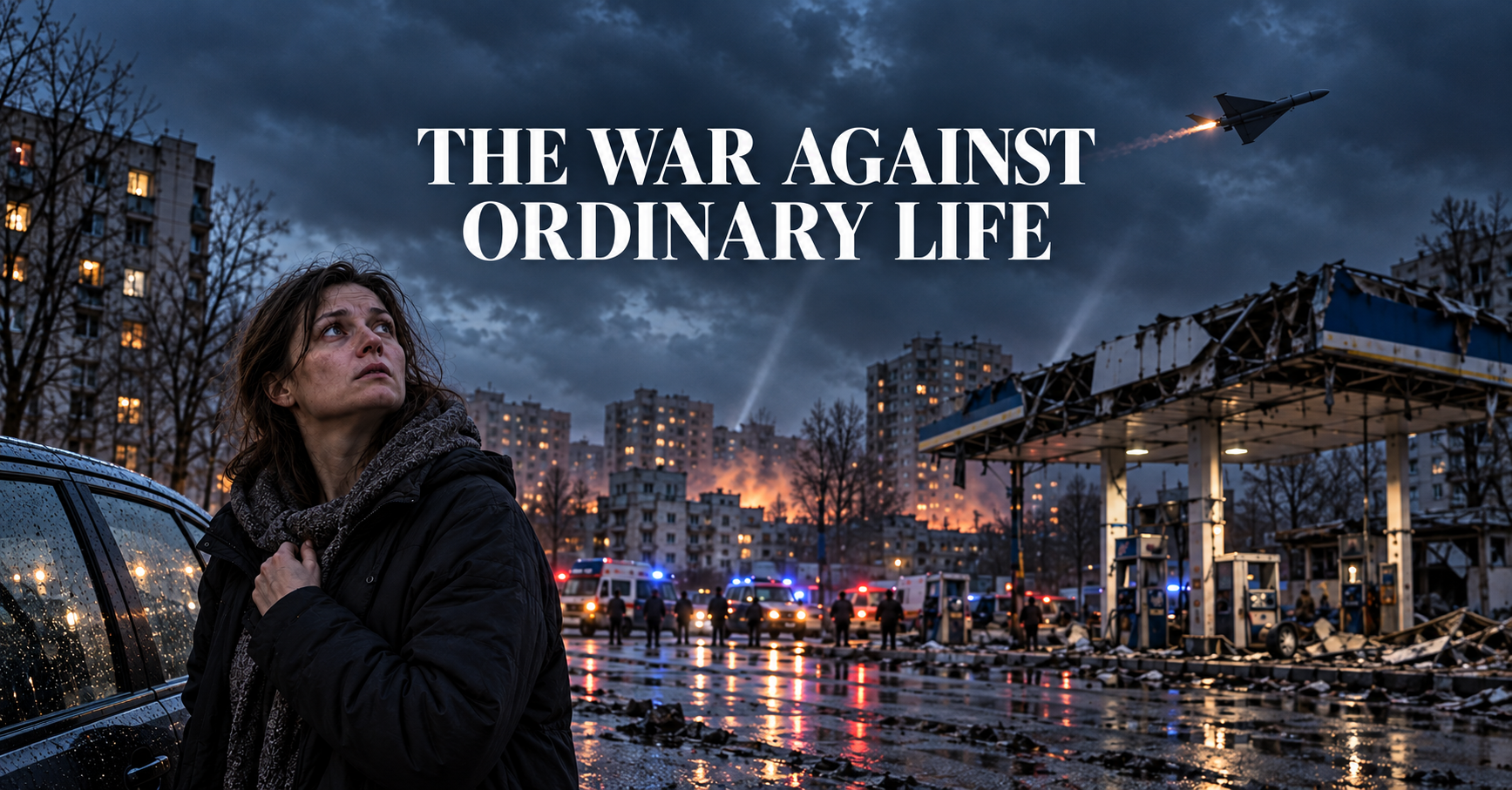
Russia's jet-powered drones are not merely attacking Kyiv's petrol stations. They are disrupting daily life, disturbing sleep and keeping civilians in a state of constant apprehension, while Ukraine's strikes inside Russia show that both sides are increasingly using psychological pressure in modern warfare.
By David A. Williams
A petrol station is an unusually intimate target. It is not hidden behind concrete walls or enclosed within a distant military compound. It stands beside the road, illuminated at night, woven into the ordinary movements of commuters, delivery drivers, parents and ambulance crews. When Russian jet-powered drones struck petrol stations in Kyiv on successive days, killing two people and injuring others, the physical destruction was obvious. The deeper purpose is harder to photograph. These attacks tell every resident that the machinery of daily life can suddenly become lethal. Filling the car, waiting for a bus or passing through an intersection acquires a small but persistent shadow of danger. This is warfare directed not only at infrastructure, but at expectation. Its battlefield is the civilian nervous system.
Russia's faster drones make that psychological pressure particularly acute. Earlier generations of propeller-driven attack drones announced themselves with a distinctive engine noise, giving civilians at least some sense of an approaching threat. The new jet-powered variants travel much faster and sharply reduce the time available to identify, track and intercept them. According to reporting in The Times, some Ukrainians may have only seconds to react. Speed changes more than military arithmetic. It changes the emotional texture of the attack. A slow drone produces dread as it approaches; a jet drone produces shock because the interval between warning and impact has almost disappeared. One torments through anticipation, the other through unpredictability. Used repeatedly, the two can work together, ensuring that neither silence nor noise feels entirely safe.
This is why the petrol station strikes should not be understood simply as an attempt to destroy fuel supplies. A few damaged forecourts will not immobilize a city the size of Kyiv. Their importance lies in what they represent. Petrol stations are nodes in the circulation of urban life, places through which people, goods and emergency services move. Strike enough of them, or merely persuade people that they may be struck, and the effects spread beyond the blast radius. Drivers begin queuing elsewhere. Employees hesitate to report for work during alerts. Parents alter routes. Businesses revise deliveries. Rumors race ahead of official information. The weapon continues operating after it has exploded because the population carries its possible return around in its head.
Air power has pursued this elusive prize for more than a century. Early theorists believed that bombing cities would break civilian morale and force governments to surrender. During the Second World War, Londoners endured the Blitz, German cities were subjected to immense Allied bombing campaigns, and Japan experienced destruction on a still greater scale. The V-1 flying bomb and V-2 rocket added a particularly modern form of fear. The V-1 could be heard approaching, and the sudden stopping of its engine signaled that it was falling. The V-2 arrived faster than sound, so the explosion came before any warning. Russia's combination of noisy propeller drones and faster jet-powered weapons carries an unsettling echo of that distinction. The technology is different, but the psychological manipulation of time is familiar.
History, however, contains a warning for those who believe terror automatically produces submission. Strategic bombing repeatedly devastated cities without reliably breaking their populations. Britain did not surrender during the Blitz, Germany continued fighting amid enormous urban destruction, and later bombing campaigns from Vietnam to the Balkans demonstrated that physical damage and political capitulation are not the same thing. Bombing can exhaust, traumatize, and displace a population, yet it can also intensify the hatred of the attacker and strengthen collective identity. The civilian does not necessarily blame the government that failed to protect him. She may blame the enemy that tried to frighten her. Terror is therefore a dangerously imprecise political instrument. It can damage morale without converting that damage into obedience.
That does not make the psychological effect imaginary. The popular language of resilience can sometimes conceal what people are actually being asked to endure. A society may continue working while sleeping badly, raising children in corridors during alerts, checking telephone warnings compulsively and calculating whether the next journey is worth the risk. Resilience is not invulnerability. It is the ability to function while absorbing injury, and the injury accumulates. The World Health Organization has warned throughout the war of extensive mental-health needs among Ukrainians exposed to violence, displacement, bereavement and prolonged insecurity. The strategic objective may not be to drive an entire population clinically mad. It is enough to exhaust attention, shorten tempers, weaken concentration, disrupt education and make normal life feel provisional. A country can remain politically defiant while its citizens quietly pay the psychological bill.
The petrol station also connects private anxiety to national economics. Fuel is movement, and movement is confidence. If stations close during alerts, deliveries are delayed, and commuters remain at home, every strike creates secondary costs that require no additional explosive. Emergency services must disperse, companies introduce redundancies, insurers reconsider risks, and air defenses face the expensive problem of intercepting comparatively cheap machines. This is one of the defining asymmetries of drone warfare. The attacking state does not have to destroy an entire system. It merely has to make the defender spend heavily protecting thousands of possible targets. A drone aimed at a modest civilian facility can force calculations in military headquarters, municipal offices, corporate boardrooms and family kitchens simultaneously.
Ukraine understands this logic because it also uses long-range drones to carry disruption deep into Russia. Ukrainian forces have repeatedly attacked Russian oil refineries, fuel depots, chemical plants and other facilities connected to the war economy. These operations have a clear material rationale: Russia earns revenue from energy, requires fuel to sustain military operations and must divert air defenses to protect infrastructure far from the front. Yet the psychological dimension cannot be ignored. A refinery burning hundreds of kilometers from Ukraine tells Russians that geography no longer guarantees immunity. Airport closures, interrupted mobile services and the sound of air defenses near major cities bring a previously distant war into domestic life. Ukraine is not only striking productive capacity. It is challenging the Kremlin's promise that Russians can live normally while their country wages war elsewhere.
Recognizing this does not require pretending that the two campaigns are morally, legally, or strategically identical. Russia launched the full-scale invasion and has conducted a much larger campaign against Ukrainian cities and essential civilian infrastructure. Ukraine describes its deep strikes as attacks on facilities sustaining that invasion, although debris, targeting errors and attacks affecting civilian areas can still kill or injure people. Context matters, target selection matters, and proportionality matters. Nevertheless, the mechanisms of psychological pressure are increasingly reciprocal. Both sides know that a drone does more than carry explosives. It transports uncertainty across distance, compelling people far behind the front to participate emotionally in the conflict.
This points towards an uncomfortable future for European security. The old distinction between front line and home front is dissolving, not because every city will face mass bombing, but because relatively inexpensive autonomous weapons can impose fear and disruption without achieving conventional air superiority.
A hostile power may not need to flatten Copenhagen, Warsaw or Tallinn to alter political behaviour. Repeated drone incursions near airports, fuel terminals, power substations and transport hubs could create economic costs, public anxiety and demands for protection while allowing the aggressor to deny responsibility or remain below the threshold of formal war. The attack would be measured not only in casualties, but in canceled flights, closed schools, exhausted police units, viral rumors and the gradual corrosion of public confidence.
Defending a population against this form of warfare therefore requires more than interceptors. Governments need layered air defence, protected infrastructure and rapid repair capacity, but they also need credible communication, mental-health support and procedures that allow ordinary life to continue during prolonged threat. Every false alert, confused official statement and unexplained explosion creates space for fear to become politically useful. The strongest defense is not the pretense that nothing is wrong. It is public confidence that the danger is understood, information is trustworthy and damaged systems will be restored quickly. Psychological resilience cannot be ordered into existence with patriotic slogans. It has to be engineered into institutions.
The drone is often described as a precise weapon, but that description is incomplete. Its explosive charge may strike a precise coordinate while its psychological effect spreads indiscriminately across a city. Russia's attacks on Kyiv's petrol stations show how modern warfare can turn the mundane into the menacing. Ukraine's strikes inside Russia show that the same technology can return insecurity to the society supporting the aggressor's war. The danger is that each side becomes increasingly skilled at attacking not simply what the other possesses, but how the other population feels. Once war enters the nervous system, the absence of an explosion no longer quite means peace.
Sources:
The Guardian: Russia targets Kyiv petrol stations with jet-powered drones
Ukrainska Pravda: Russian drone attack on Kyiv petrol station kills two
Ukrainska Pravda: Jet-powered drones strike petrol stations in two Kyiv districts
The Kyiv Independent: Russia intensifies attacks on Kyiv petrol stations
Interfax-Ukraine: Ukrnafta confirms strike on Kyiv filling station
RAND: Psychological effects of air operations in four wars
US Air University: United States Strategic Bombing Surveys
Copyright © 2026 David A. Williams / Sphere Magazine