The Seduction of Civilised Barbarism: Humanity, War and the International Drone Show in Odense
David Williams
I remember being in a bazaar in Tunisia during the late 1980s with a companion. A friendly local approached us and offered to show us where the real bargains could be found. Innocently, we followed him.
He walked quickly through the crowded streets. Then faster. Soon we found ourselves hurrying to keep up. Before long, we were practically running after him through the maze of people and alleyways.
Then something happened.
My brain suddenly engaged.I realised I had stopped thinking. I had surrendered my judgment and was simply following. Every instinct screamed that we were being led somewhere we should not go."STOP!" I shouted out loud to my companion.
We halted immediately. The man continued into the crowd and disappeared, never to be seen again.
I was reminded of that moment recently while attending the International Drone Show* in Odense earlier this month.
Outside the entrance stood a small group of anti-war protesters. With their placards and reggae music, they looked like survivors from a 1960s peace rally. Their appearance made their message seem almost quaint amid the excitement surrounding one of the world's most advanced technology exhibitions.
Inside, however, was a different world.
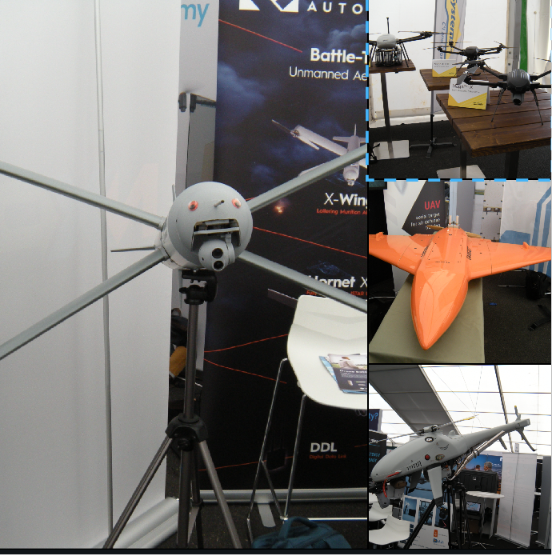
Enormous exhibition halls were filled with drones of every imaginable size and capability. They were sleek, elegant, beautifully engineered machines. One was designed for wildlife conservation in Africa. And several supported search-and-rescue operations, environmental monitoring, infrastructure inspection, farming or police work.
But the vast majority were designed for the battlefield.And most of these were designed to find, track, and kill.
Oddly enough, that did not concern me at first. Weapons have always evolved. Every generation produces more efficient ways of fighting, from the English longbow to the machine gun, from tanks to precision-guided missiles. The drones on display were simply the latest chapter in a very old story.
Then came the moment when my brain once again shouted, "Stop."Later in the day, journalists attended a presentation by Vyacheslav Shvydak, founder and CEO of Dropla Tech in Ukraine. He praised Denmark's substantial support for Ukraine and highlighted the establishment of a drone hub in Odense. His gratitude was genuine, and his presentation was impressive.
Then he described a system used to motivate drone operators.
Destroy an enemy vehicle and earn points.
Eliminate an enemy combatant and earn points.
Capture an enemy alive and earn even more points.
The logic was simple: gamification increases engagement and performance.
In business, that principle is widely accepted. Companies use points, badges, and rankings to motivate employees and customers. Social media platforms use similar mechanisms to keep users engaged.
But war is not business.
War is not a video game.
The moment killing becomes a points-scoring exercise, something profoundly important is at risk of being lost. Your humanity.
I was reminded of a story from the Falklands War in 1982. A British soldier had fought with exceptional bravery and was reportedly being considered for high honours following his death on the battlefield. Then it was discovered that he wore a necklace strung with the ears of Argentine soldiers he had killed.
Whatever courage he had displayed on the battlefield was overshadowed by something darker. He had crossed a line. He had ceased to see the enemy as human beings and had turned war into a personal game.
History repeatedly shows what happens when this barrier collapses. The twentieth century's worst atrocities, from the trenches of the First World War to the death camps of Nazi Germany and the killing fields of Cambodia, were made possible not merely by weapons, but by dehumanisation. The victims became numbers, targets, categories, or obstacles rather than people.
Technology itself is morally neutral. A drone has no conscience. An algorithm has no sense of mercy. A machine cannot distinguish between necessity and cruelty.
That responsibility belongs entirely to us.
The Prussian military theorist Carl von Clausewitz famously wrote that war is the continuation of politics by other means. He was right. But war is also a reflection of the societies that wage it.
If we allow war to become entertainment, if we allow killing to become a scoreboard, if we allow sophisticated technology to distance us emotionally from the consequences of violence, then we risk descending into a kind of infantile barbarism dressed in the clothing of modernity.
The enemy may indeed be our enemy.
But they are also someone's son.
Someone's husband.Someone's father.Someone who, under different circumstances, might have been our neighbour.
The drones at Odense were remarkable achievements of engineering. Their designers deserve recognition for their skill and ingenuity. Yet as I left the exhibition, I found myself thinking not about the machines, but about that moment in Tunisia decades ago.
Sometimes the most important thing a human being can do is stop.
Stop following.
Stop being impressed.
Stop being carried along by the crowd.
And remember what it means to remain human.