The Price of Being Safe: Denmark and the New Economics of Security
By David A. Williams
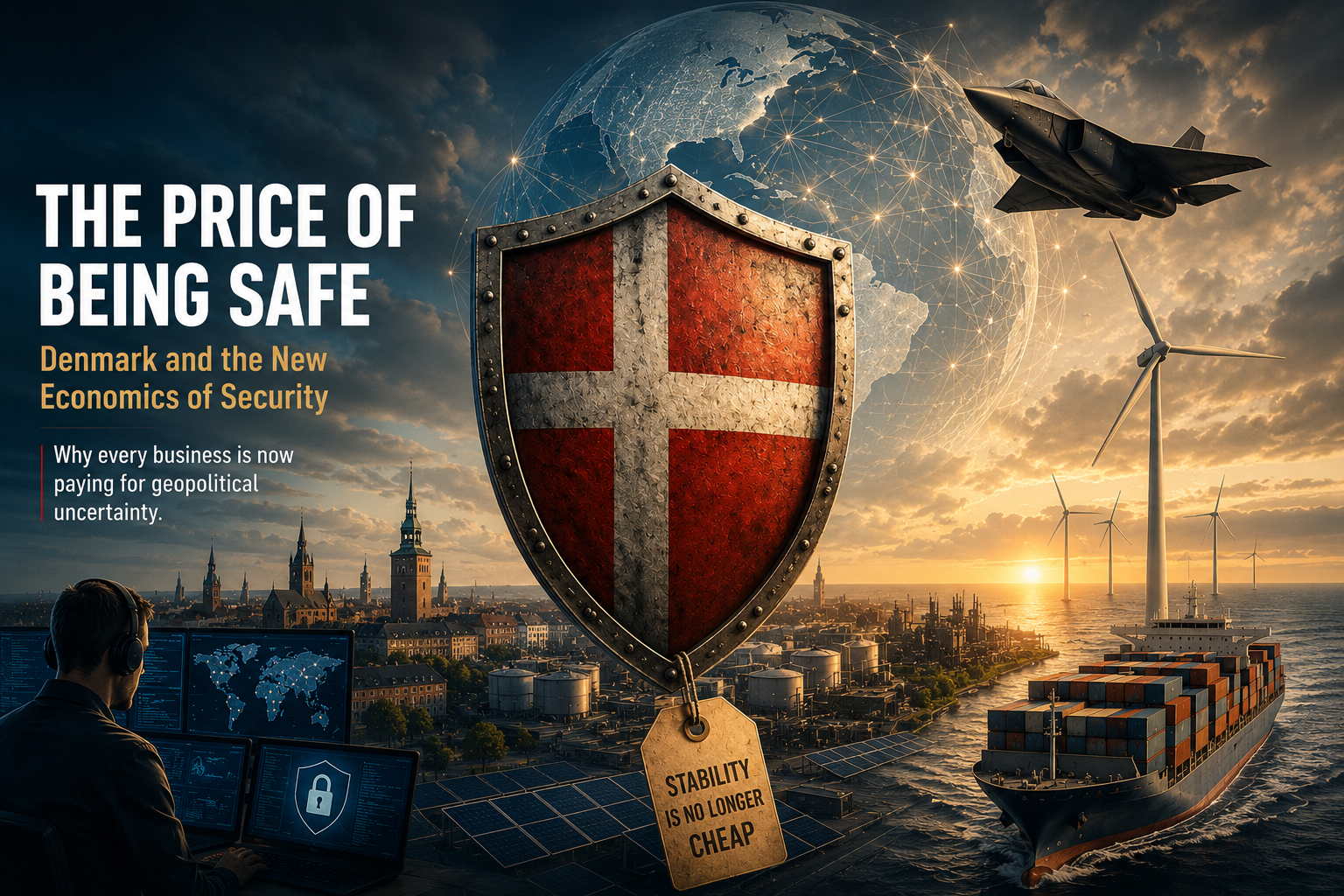
For more than three decades, Europe quietly enjoyed what economists rarely acknowledged and businesses quietly assumed. Security was treated as a free public good. It existed in the background like electricity flowing from a socket or clean water arriving through a tap. Defense budgets were trimmed because there seemed little reason to spend more. Supply chains stretched across continents because efficiency mattered more than resilience. Companies outsourced production to wherever labor was cheapest, inventory became a liability rather than an asset, and energy markets were organized around the assumption that politics would never seriously interfere with commerce. Stability itself became so commonplace that nobody bothered to calculate its true value. It simply existed. That era is ending, and Denmark offers one of the clearest illustrations of what comes next. The country is discovering, alongside the rest of Europe, that security is no longer free. It has become one of the most expensive inputs in the modern economy.
This transformation reaches far beyond military budgets. Defense spending understandably dominates the headlines because it is visible, measurable and politically contentious. NATO's changing expectations, Russia's continuing confrontation with Europe, the militarization of the Arctic and growing instability across several regions have pushed governments towards sustained increases in defense expenditure. Denmark has committed itself to significantly expanding military capabilities while investing in naval assets, air defence, intelligence and infrastructure. Those investments matter, but they are merely the visible portion of a much larger economic shift. The real story is that security costs are now embedded throughout the economy, appearing in places that would once have seemed entirely unrelated to national defence.
Consider cyber security. Ten years ago, cyber protection was largely viewed as an IT expense. It sat somewhere between software licenses and server maintenance. Today it has become a boardroom issue, an operational necessity and, increasingly, a geopolitical consideration. Every ransomware attack, every attempt to penetrate critical infrastructure, and every act of digital espionage remind businesses that they are no longer operating in an environment where commercial competition is their only concern. Danish pharmaceutical companies, financial institutions, logistics providers, hospitals, and manufacturers are investing unprecedented sums in cyber resilience because digital vulnerability has become a business risk equal to financial risk. The return on these investments is difficult to quantify because success means nothing happens. Customers never see the attack that failed. Investors rarely celebrate disasters that never occurred. Yet the money must still be spent.
Energy tells a remarkably similar story. For decades, Europe built an economic model around affordable and predictable energy. The Russian invasion of Ukraine shattered that assumption almost overnight. Suddenly, energy security became inseparable from national security. Denmark has responded by accelerating renewable energy deployment, expanding offshore wind capacity, strengthening electricity interconnections and investing in grid resilience. These are often presented as climate initiatives, and indeed they contribute to climate objectives, but they are equally investments in strategic autonomy. Every offshore wind farm, every upgraded transmission line, and every battery installation reduces dependence on unstable geopolitical relationships. The price attached to those investments is substantial, yet the cost of failing to make them has become far greater.
Supply chains have undergone an equally profound reassessment. For years, businesses pursued efficiency with almost religious conviction. Lean inventories, just-in-time manufacturing and globally dispersed suppliers delivered lower costs and higher profits. Then came the pandemic. Then came geopolitical fragmentation. Then came disruptions in the Red Sea, semiconductor shortages, sanctions, export controls and rising tensions across the Taiwan Strait. Suddenly, the mathematics changed. A supplier located thousands of kilometers away was no longer simply cheaper. It was also a potential source of strategic vulnerability. Danish manufacturers, shipping companies and exporters increasingly evaluate suppliers through a geopolitical lens as much as a financial one. Diversification has become insurance. Redundancy has become rational. Warehousing has returned after decades of being regarded as wasteful. None of these adjustments increases productivity in the traditional sense. They increase resilience, and resilience has become a competitive asset.
Strategic reserves represent another shift in economic thinking. Governments are rebuilding stockpiles of medical supplies, critical minerals, fuel and essential equipment. Businesses are following suit with inventories that accountants once considered inefficient. This reflects a broader philosophical change. Modern capitalism spent decades optimizing for average conditions. It is now being redesigned to survive exceptional ones. That distinction matters enormously. A system optimized for efficiency often performs brilliantly until it encounters disruption. A system designed for resilience may appear more expensive during normal times, but it survives crises that destroy leaner competitors. Investors are beginning to recognize that these hidden forms of strength deserve a premium.
Denmark's economy illustrates this transition particularly well because it sits at the intersection of several strategic trends. It is a global shipping nation operating in increasingly contested waters. It is an energy leader navigating the politics of critical infrastructure. It is home to world-class pharmaceutical and biotechnology companies facing sophisticated cyber threats. It possesses advanced digital public services that require constant protection. It occupies a geographically significant position between the Baltic and the North Sea while maintaining responsibility for Greenland and the Arctic. Each one of these characteristics transforms geopolitical developments into commercial realities. Danish businesses cannot afford to treat security as someone else's responsibility because security increasingly shapes their own balance sheets.
Perhaps the most overlooked consequence of this transformation is its effect on inflation and long-term growth. Economists have become accustomed to analyzing inflation through interest rates, wages, and consumer demand. Yet a growing proportion of costs now arise from resilience itself. Building duplicate suppliers costs money. Investing in cyber defense costs money. Diversifying energy infrastructure costs money. Expanding defense industries require skilled labor that competes with other sectors. Insurance premiums reflect geopolitical uncertainty. Financing costs increasingly incorporate political risk. None of these expenses disappear simply because inflation falls elsewhere. They become structural features of the economy.
This creates an uncomfortable paradox. Businesses are spending more money precisely to preserve the conditions that once allowed them to spend less. The investments are defensive rather than expansionary. They rarely produce spectacular new products or dramatic productivity gains. Instead, they reduce vulnerability. That distinction is crucial because traditional economic models often undervalue prevention. Success is measured by visible growth rather than invisible resilience. Yet in today's environment, preventing catastrophe may be economically more valuable than generating marginal efficiency improvements.
The implications extend into corporate governance. Boards increasingly require expertise that would once have belonged exclusively to diplomats, intelligence analysts, or military planners. Questions about sanctions, export controls, political instability, cyber warfare and strategic dependencies now influence decisions about acquisitions, factory locations and supplier relationships. Risk management has become geopolitical management. The chief financial officer increasingly finds themselves discussing issues that previously belonged to ministries of foreign affairs.
Investors are adapting as well. Companies that demonstrate operational resilience, diversified supply chains, strong cyber governance and reliable access to energy may command higher valuations over time because they appear better equipped for an unpredictable world. Markets have traditionally rewarded efficiency. They are beginning to reward durability. The businesses capable of absorbing geopolitical shocks without significant operational disruption may become tomorrow's safest investments, even if they appear marginally less profitable during periods of stability.
There is also an important societal dimension that deserves greater attention. Citizens inevitably pay for this new economics of security through taxes, prices, and slower gains in living standards. Defense budgets require funding. Infrastructure projects require financing. Businesses pass resilience costs through supply chains until they eventually reach consumers. It is tempting to view these developments as economic burdens. Yet history suggests a different perspective. Stable societies have always invested heavily in the institutions that preserve stability. The difference today is simply that those investments have become impossible to ignore.
Denmark therefore stands as a compelling case study in Europe's changing economic reality. The country is not abandoning openness or globalization. Rather, it is redefining the conditions under which openness can safely exist. Efficiency is no longer the only measure of success. Security has become an economic variable. Resilience has become productive capital. Strategic autonomy has acquired a measurable financial value.
This may prove to be one of the defining economic shifts of the coming decade. Future historians may conclude that the real turning point was not a particular election, invasion or diplomatic crisis. Instead, it was the moment businesses accepted that geopolitical stability was no longer a free resource supplied by governments and international institutions. It had become something they needed to purchase, maintain, and continuously strengthen themselves.
The age of cheap stability is over. The next era will belong to those who understand that the cost of security is no longer an exceptional expense appearing during moments of crisis. It is becoming a permanent feature of economic life. Companies that continue to calculate only the price of production while ignoring the price of protection will increasingly misunderstand their own balance sheets. Those who recognize resilience as an investment rather than a cost may discover that, in an age defined by uncertainty, the safest business strategy is not to eliminate risk but to make surviving it part of the business model itself.
Full URLs for Sources Consulted.
OECD – Economic Security in a Changing World https://www.oecd.org/en/publications/economic-security-in-a-changing-world_4eac89c7-en.html
OECD – Denmark Economic Snapshot https://www.oecd.org/en/topics/sub-issues/economic-surveys/denmark-economic-snapshot.html
OECD – Denmark: Economic Outlook 2026 https://www.oecd.org/en/publications/2026/06/oecd-economic-outlook-volume-2026-issue-1_8be0dba6/full-report/denmark_6f3418c0.html
OECD – Resilient Supply Chains https://www.oecd.org/en/topics/sub-issues/resilient-supply-chains.html
International Energy Agency – Critical Entity Resilience Directive https://www.iea.org/policies/26916-directive-20222557-on-the-resilience-of-critical-entities
NATO https://www.nato.int
European Commission – Economic Security https://commission.europa.eu/strategy-and-policy/priorities-2019-2024/europe-fit-digital-age/european-economic-security-strategy_en
Danish Ministry of Defense https://www.fmn.dk
Danish Energy Agency https://ens.dk/en
Danish Business Authority https://erhvervsstyrelsen.dk/en