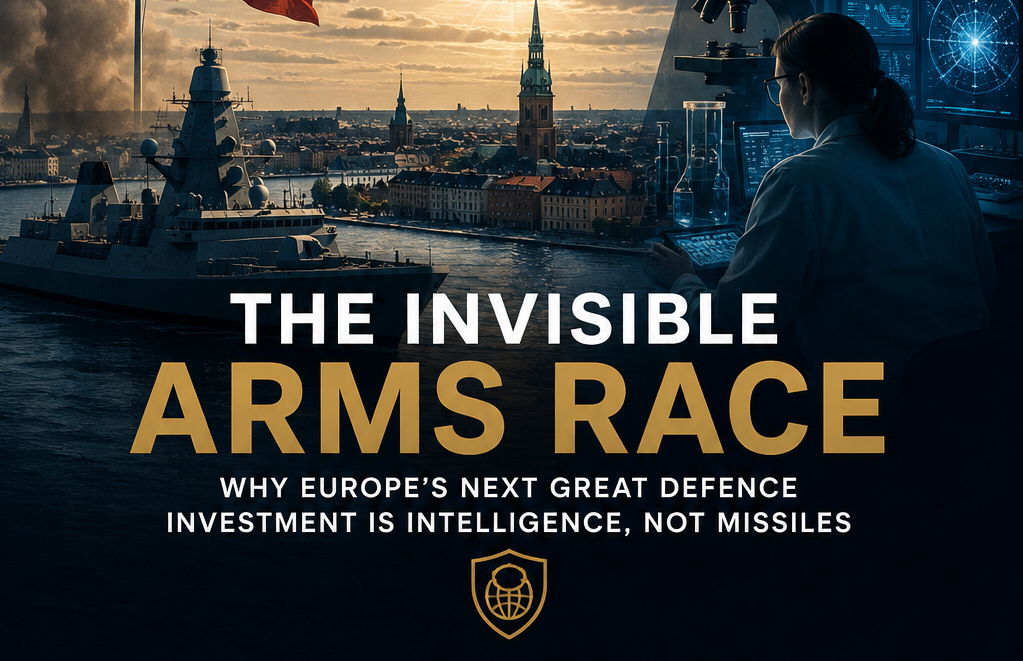
The Invisible Arms Race: Why Europe's Next Great Defense Investment Is Intelligence, Not Missiles
By David A. Williams
History has a habit of misleading us. It encourages us to look for decisive moments that can be neatly framed around a treaty, a battle or the unveiling of a new weapons system. Yet the most consequential shifts in international security often begin quietly, almost unnoticed, inside research laboratories, university lecture halls and government offices where engineers, scientists and intelligence specialists start asking different questions. Europe may be approaching one of those moments now. The headlines understandably focus on ballistic missile defense and the military implications of Russia's continued aggression, but concentrating solely on missiles risks missing the far more significant transformation taking place beneath the surface. Denmark is not simply participating in a stronger European defense posture. It is becoming part of a broader experiment in which knowledge itself is emerging as the decisive instrument of national power.
The announcement by several European governments that they intend to deepen cooperation on an integrated ballistic missile defense initiative is important for reasons that extend well beyond military hardware. Modern missile defense is not merely about intercepting projectiles traveling at extraordinary speeds. It requires countries to share intelligence, integrate radar systems, coordinate command structures, and trust one another with information that was once guarded as closely as the weapons themselves.
Technology may provide the machinery, but confidence between governments provides the capability. This reflects an important evolution in European thinking. Collective security is no longer simply about standing together in times of crisis. It increasingly depends on building permanent networks that can anticipate threats before they materialize and respond as though national borders have become operational rather than political. That is a profound change in how Europe conceives of its own security. It is also one that Denmark appears well positioned to influence.
Denmark's contribution to this changing landscape is revealing because it extends beyond defense spending or military procurement. The partnership announced between the Technical University of Denmark and the Danish Defense Intelligence Service illustrates a recognition that the strategic competition shaping the coming decades will not be decided solely by soldiers or diplomats.
It will also be shaped by physicists developing advanced sensors, computer scientists refining artificial intelligence, mathematicians improving data analysis and engineers designing technologies whose civilian applications may ultimately prove just as valuable as their military ones. The distinction between economic innovation and national security is becoming increasingly difficult to maintain because the same technological breakthroughs that strengthen productivity also determine strategic resilience.
This is where Denmark demonstrates a particularly interesting form of strategic thinking. Many countries still organize government around traditional categories such as defence, education, industry, and research. Those administrative divisions made sense when security threats were largely physical, and innovation moved at a relatively predictable pace. Today's environment bears little resemblance to that world. Artificial intelligence can reshape intelligence gathering almost overnight. Quantum technologies threaten existing encryption methods. Autonomous systems alter military doctrine. Cyber attacks can disrupt critical infrastructure without crossing a border. Universities have, therefore, become more than centers of education. They are increasingly part of a nation's strategic infrastructure, producing expertise that influences both prosperity and security simultaneously.
There is a temptation to see this development as the militarization of academic research, but that interpretation misses the larger picture. Democracies face a challenge that authoritarian states understand well. Scientific discovery and technological innovation are now inseparable from geopolitical competition. The question is no longer whether universities will influence national security. They already do. The real question is whether democratic societies can create frameworks that preserve academic openness while protecting technologies with strategic importance. Denmark's emerging approach suggests that collaboration rather than isolation may offer the more sustainable answer. The objective is not to transform researchers into intelligence officers. It is to ensure that scientific excellence strengthens society without compromising the principles upon which that excellence depends.
Business leaders should be paying close attention because these developments reveal where tomorrow's opportunities are likely to emerge. Defense is no longer confined to manufacturers of aircraft, naval vessels or armored vehicles. Increasingly, the critical suppliers are software developers, semiconductor specialists, satellite companies, cybersecurity firms, robotics engineers and advanced manufacturers capable of translating research into practical capability. Investors looking exclusively at conventional defense industries may therefore overlook the companies positioned to benefit most from Europe's evolving security priorities. The defense economy is becoming an innovation economy, and the countries that connect research with resilience will enjoy advantages extending well beyond military affairs.
For policymakers, the implications are equally significant. Europe has spent decades debating defense budgets as though security could be measured primarily in percentages of gross domestic product. Those discussions remain necessary, but they are becoming insufficient. The more difficult challenge is determining whether Europe possesses the intellectual capacity, industrial flexibility, and technological independence required to sustain security over the coming generation. Financial investment without innovation produces expensive stagnation. Innovation without strategic coordination produces fragmented excellence. The emerging European model seeks to combine both, creating an ecosystem in which governments, universities, industry and intelligence institutions reinforce one another instead of operating in isolation.
Perhaps the most revealing aspect of Denmark's approach is what it says about the changing nature of power itself. Throughout much of modern history, influence rested upon territory, population, industrial production and military strength. Those factors remain relevant, but they are increasingly complemented by less tangible assets. Trust between allies, the ability to attract talented researchers, secure digital infrastructure, resilient supply chains, and the capacity to convert knowledge into practical capability are becoming defining measures of national influence. These assets cannot be displayed in military parades, yet they often determine whether a nation can respond effectively when crises emerge.
The irony is striking. Europe is investing in missile defense because it fears increasingly sophisticated threats, yet the most valuable shield it may develop is not one that sits in the sky waiting to intercept incoming weapons. It is the network of relationships, institutions, and ideas that allows democratic societies to adapt more quickly than those who seek to challenge them. Missiles remain necessary because deterrence still matters. Intelligence remains indispensable because uncertainty still exists. But neither will prove sufficient unless they are supported by societies capable of learning faster than their competitors.
That may ultimately become Denmark's quiet contribution to European security. Not the size of its armed forces, nor the value of its defense budget, but its recognition that the strongest form of deterrence begins long before the first radar detects an incoming threat. It begins with knowledge, with trusted institutions, with scientific ambition and with the confidence to treat innovation as a strategic resource rather than merely an economic one. Europe is often described as entering a new age of rearmament. That description is only partially true. It is also entering an age of rethinking where power comes from. Those who continue counting missiles may discover too late that the decisive competition has already moved somewhere else.
Sources consulted: The factual background for this article has been drawn exclusively from freely accessible sources:
Official Joint Declaration on the Integrated Anti-Ballistic Missile Coalition (13 July 2026): https://www.elysee.fr/en/emmanuel-macron/2026/07/13/joint-declaration-on-the-establishment-of-the-integrated-anti-ballistic-missile-coalition
NATO, Ballistic Missile Defense : https://www.nato.int/cps/en/natohq/topics_49635.htm
European Commission, Defense Industry and Space: https://defence-industry-space.ec.europa.eu
Technical University of Denmark (DTU): https://www.dtu.dk
Author's note: All analyses, interpretations and opinions in this article are original. They are based on the publicly available facts contained in the sources above but do not reproduce or reflect the analysis or editorial positions of those sources.