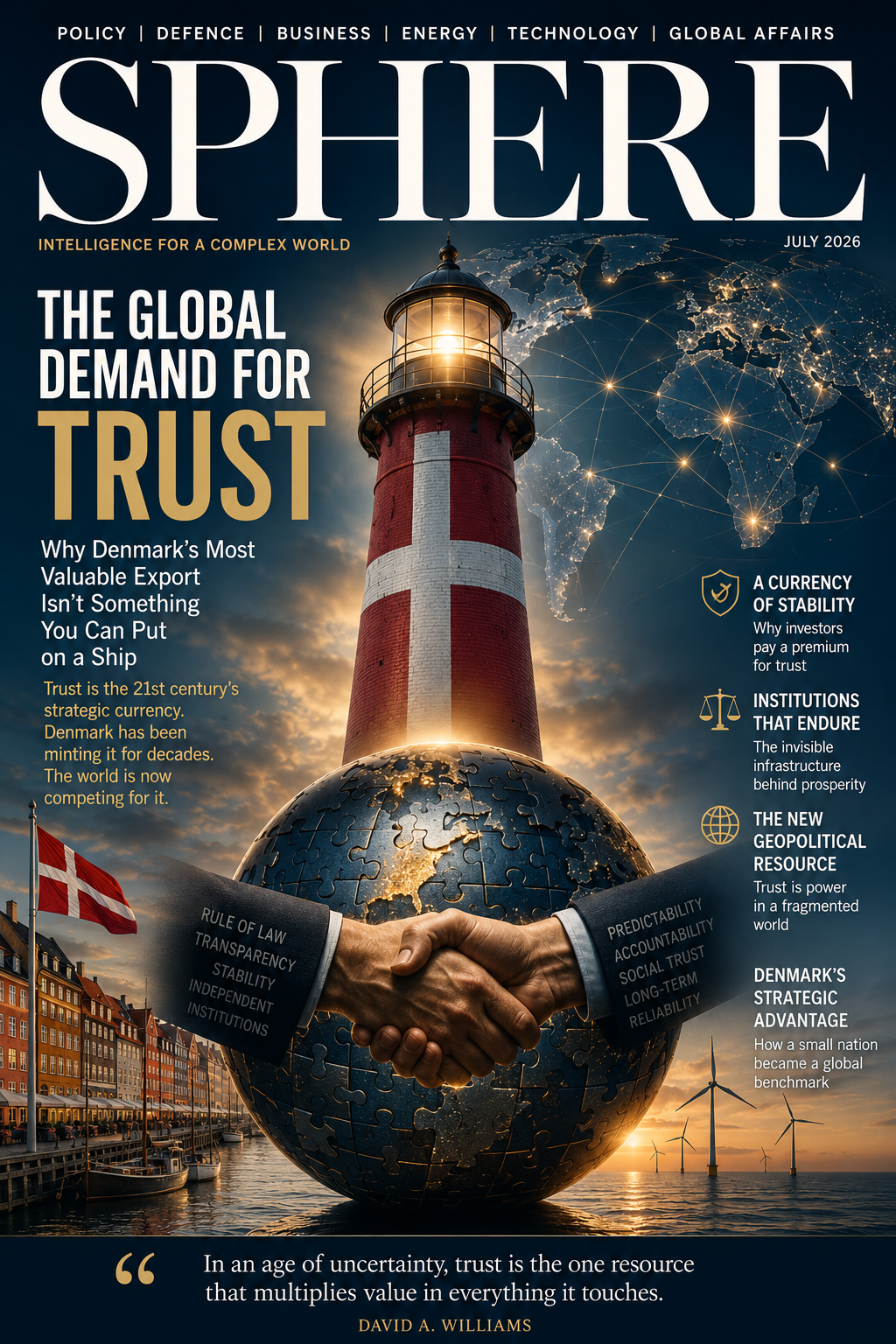
The Global Demand for Trust: Why Denmark's Most Valuable Export Isn't Something You Can Put on a Ship
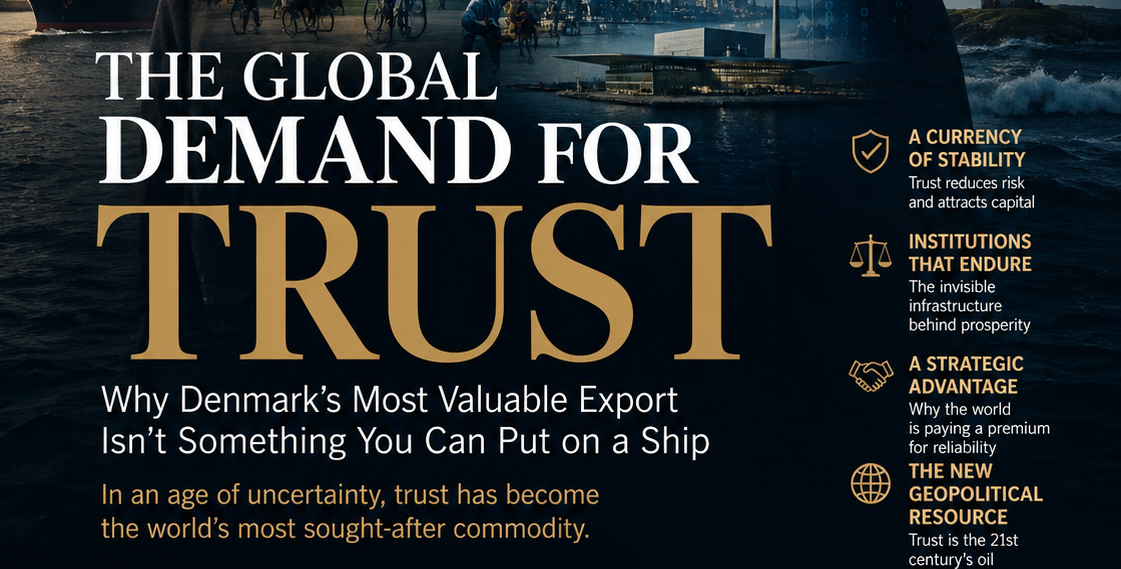
By David A. Williams
There is a dangerous assumption lurking beneath much of today's economic debate. We continue to believe that nations compete primarily through what they manufacture, extract, or invent. Governments proudly announce new semiconductor plants, battery factories, offshore wind farms and artificial intelligence investments as though prosperity can still be measured by counting cranes on the skyline or containers leaving a port. Those industries undoubtedly matter, but they are increasingly becoming the visible outcome of something much deeper and far more difficult to create. However, the countries that will shape the twenty-first century may not be those producing the greatest volume of goods or the most advanced technologies. They may instead be those capable of producing the one commodity that has become scarce across an increasingly fractured world. That commodity is trust. It cannot be mined, patented, or exported through conventional trade routes, yet investors, governments, and multinational corporations are competing for it with an intensity that rivals the search for oil during the last century. We simply have not recognised that trust has become a strategic resource in its own right.
This is where Denmark enters a much larger global story. On paper, it is a nation of fewer than six million people, too small to dominate the geopolitical calculations that usually focus on Washington, Beijing, Moscow, or Brussels. Yet that view mistakes size for influence. Denmark consistently ranks among the world's most trusted societies, not because it has perfected government or eliminated political disagreement, but because it has built institutions that people broadly expect to function tomorrow much as they function today. Contracts are expected to be honoured. Public authorities are generally assumed to act according to law rather than personal interest. Independent institutions command credibility beyond the political cycle. These qualities rarely generate dramatic headlines because they lack the excitement of elections, military deployments, or technological breakthroughs. Yet they quietly shape investment decisions worth billions of euros every year. Confidence, it turns out, has become one of the world's most valuable economic assets, and Denmark has spent generations accumulating it without ever describing it as an export.
For much of the modern era, economists asked where labour was cheapest, where taxes were lowest, or where regulations imposed the smallest burden on business. Those questions reflected an age in which efficiency was the defining objective of globalisation. Companies stretched supply chains across continents because stability was largely taken for granted. Political risk was something investors associated with distant markets rather than advanced democracies. That world has disappeared with astonishing speed.
The pandemic exposed how fragile international supply chains had become. Russia's invasion of Ukraine transformed energy policy into national security policy almost overnight. Strategic rivalry between the United States and China has redrawn global investment patterns. Cyber attacks have demonstrated that economies can be disrupted without a single soldier crossing a border. Artificial intelligence has intensified competition for electricity, data, and computing power while simultaneously raising profound questions about governance and accountability. In this new environment, businesses are no longer searching only for efficiency. They are searching for certainty. That subtle change may prove to be one of the defining economic shifts of our age.
The remarkable aspect of this transformation is that it has elevated institutional credibility into a form of infrastructure. We normally associate infrastructure with roads, ports, airports, and electricity grids because they are visible expressions of national capacity. Yet beneath every successful economy lies another infrastructure that cannot be photographed. Independent courts that enforce contracts without political interference. Professional civil services capable of implementing policy consistently across successive governments. Regulators whose decisions can be anticipated because they follow transparent principles rather than political whim. Statistical agencies whose figures are accepted as reliable by citizens and investors alike. Central banks are trusted to act in the long-term national interest rather than the short-term interests of whichever government happens to hold office. These institutions reduce uncertainty in precisely the same way that efficient transport networks reduce the cost of moving goods. Without them, even the most impressive physical infrastructure gradually loses much of its economic value because confidence begins to erode long before prosperity visibly declines.
Perhaps this explains why Denmark's greatest competitive advantage is so frequently overlooked. It is easy to celebrate the country's leadership in offshore wind, pharmaceuticals, shipping, or green technology because these achievements can be measured in exports, employment, and investment. Trust is different. It produces no spectacular ribbon-cutting ceremonies and cannot be displayed at international trade fairs. Yet every major Danish success story rests upon it. Investors commit capital because they believe the rules will remain broadly predictable. Researchers collaborate because they trust institutions to protect intellectual property and academic freedom. International companies establish regional headquarters because they expect governance to remain transparent and corruption to remain exceptional rather than routine. The more one examines Denmark's economic model, the more apparent it becomes that its visible exports are merely the products of an invisible national asset whose value is steadily increasing as instability becomes the defining characteristic of international affairs.
This leads to an uncomfortable but necessary question. What if trust is becoming to the twenty-first century what oil was to the twentieth? The comparison is not intended to suggest that trust replaces energy or industrial production. Rather, it recognises that both resources perform a similar strategic function. Oil powered the industrial economy by reducing the physical constraints on production, transportation, and military capability. Trust performs an equally important role within advanced knowledge economies by reducing uncertainty. It lowers the cost of doing business, attracts investment, encourages innovation, strengthens financial markets, and enables governments to respond more effectively during periods of crisis. Like oil, trust also reshapes geopolitical influence. Countries rich in institutional credibility increasingly attract capital, talent, and strategic partnerships, while those that allow confidence in their institutions to deteriorate often discover that economic decline begins long before conventional indicators reveal the damage. The next great geopolitical competition may therefore revolve not simply around technology, military power or access to critical minerals, but around which societies can convince the world that they remain dependable in an age when dependability has become exceptionally rare.
Perhaps that is Denmark's quiet lesson for the rest of the world. Its greatest export is not something that leaves the Port of Aarhus or crosses the Øresund. It is not manufactured in a laboratory, assembled in a factory, or loaded onto a container ship. It exists in the confidence that agreements will be honoured, institutions will endure, and tomorrow will remain sufficiently predictable for people to build businesses, careers and lives upon them. In a century increasingly defined by uncertainty, that confidence may become one of the most valuable strategic commodities any nation can possess. The real question is not whether Denmark understands the value of what it has created. It is whether the rest of the world has begun to recognise just how much it is willing to pay for it.
- Selected sources inform the analysis
OECD research on trust in public institutions, governance, and economic performance.
Transparency International Corruption Perceptions Index and governance research.
World Bank Worldwide Governance Indicators and rule of law datasets.
World Economic Forum reports on competitiveness, resilience, and global risks.
Edelman annual global trust surveys.
International Monetary Fund analysis of institutions, resilience, and long-term investment.
European Commission Economic Security Strategy and policy papers on resilience and strategic autonomy.
NATO resilience and societal preparedness frameworks.