The Drone Revolution: Game Changer Or An Expensive Firework With A Microchip
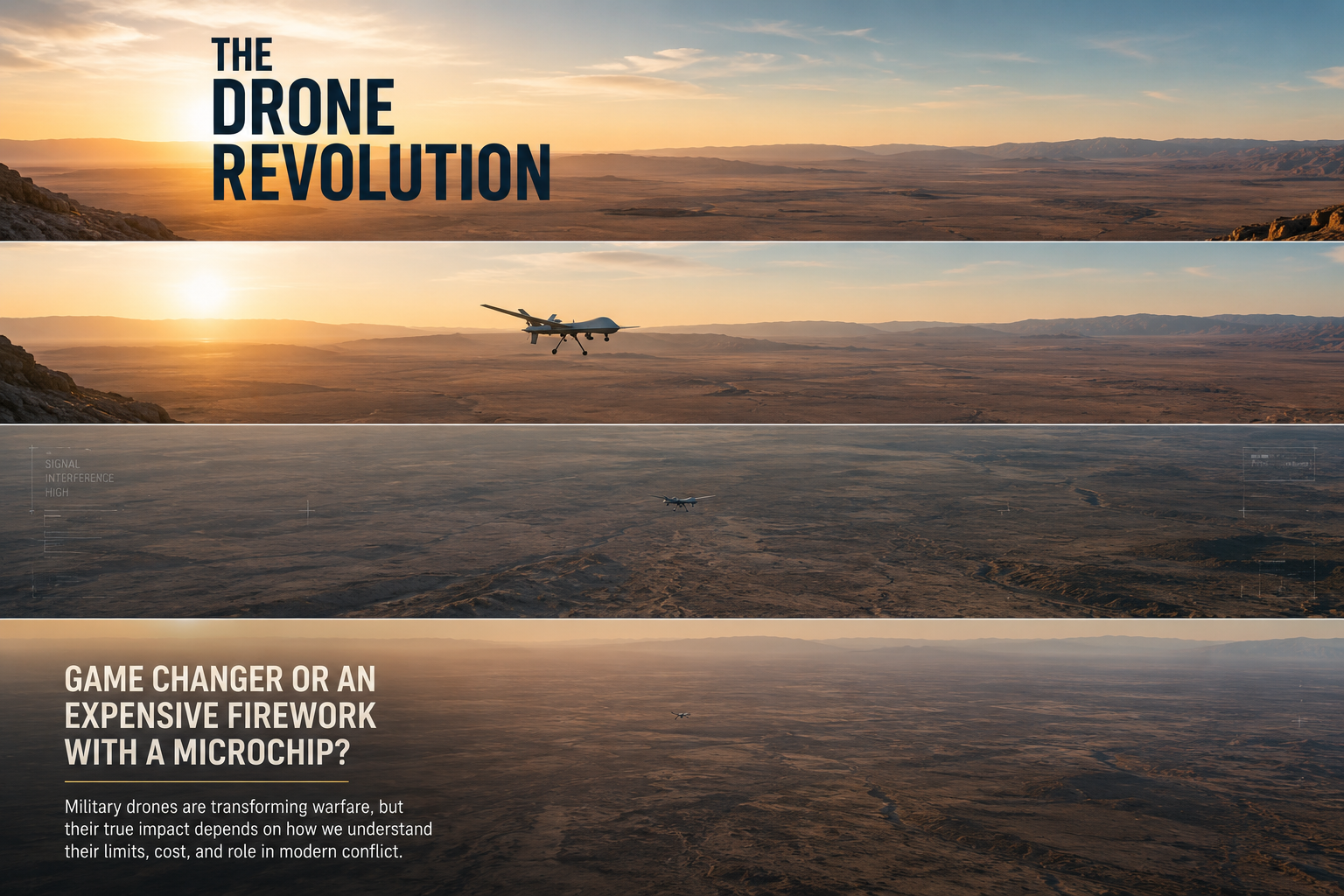
Few military technologies have risen to prominence as quickly as the drone. Over the past decade, these unmanned aircraft have evolved from niche surveillance tools into the stars of modern warfare. Videos of drones hunting tanks, tracking troops, and striking targets with startling accuracy have become a regular feature of news broadcasts and social media feeds. The impression is unmistakable: warfare has entered a new era.
David A Williams
Yet beneath the excitement lies a question worth asking. Are drones truly transforming warfare as dramatically as many claim, or have we become captivated by a technology whose reputation sometimes exceeds its reality?
There is no doubt that drones have changed the battlefield. They have given militaries the ability to observe enemy positions in real time, gather intelligence at relatively low cost, and conduct strikes without placing pilots at risk. Compared with a modern fighter jet that can cost more than $80 million, many drones appear remarkably economical. That comparison alone helps explain their popularity.
But economics in warfare is rarely as straightforward as it seems.
Many of the drones dominating today's conflicts are disposable by design. They launch, locate a target, and destroy themselves in the attack. In practical terms, they are often closer to guided munitions than traditional aircraft. They may carry cameras, sensors, and sophisticated software, but their operational lifespan is frequently measured in hours rather than years.
This raises an uncomfortable question. If a drone costing $20,000, $50,000, or even $100,000 is expected to survive only a single mission, what exactly are militaries buying? A revolutionary aircraft or a sophisticated projectile?
The answer depends entirely on the value of the target. Destroying a $5 million tank, a radar installation, or a command post with a relatively inexpensive drone represents a highly favourable exchange. In those circumstances, the drone is not merely cost-effective. It is transformative.
Yet the story becomes more complicated when one considers how many drones never reach their targets.
Modern battlefields are increasingly saturated with electronic warfare systems designed to disrupt communications, jam signals, and interfere with navigation. In some conflicts, drones are being lost at extraordinary rates. Many fail because of technical issues, electronic countermeasures, or simple battlefield attrition. The public rarely sees these failures. What circulates online are the spectacular successes, not the long list of drones that disappeared without making an impact.
This creates a distorted perception. Watching a compilation of successful strikes can make drones appear unstoppable. The reality is that modern warfare has become a technological contest between drones and the systems designed to defeat them. Every advance in drone capability is quickly met by a new countermeasure.
What drones have unquestionably achieved is something less dramatic but potentially more important. They have transformed visibility.
For most of military history, armies could conceal their movements with relative confidence. Today, inexpensive drones can monitor roads, trenches, supply routes, and artillery positions with unprecedented ease. Commanders now possess information that previous generations could only dream of obtaining. In many cases, the camera attached to a drone is more valuable than the explosive payload beneath it.
This ability to see has altered the battlefield in profound ways. Troop concentrations are easier to detect. Artillery can be corrected in real time. Supply lines can be monitored continuously. The result is a battlefield that has become far more transparent than at any point in history.
Yet transparency alone does not win wars.
The fascination with drones sometimes obscures a more enduring reality. Wars are won by industrial capacity, logistics, training, leadership, and political determination. A military equipped with thousands of advanced drones can still fail if it lacks the ability to sustain operations over time. Technology can provide advantages, but it cannot replace strategic competence.
This is why the most sensible view of drones lies somewhere between the extremes. They are neither miracle weapons nor overhyped toys. They are powerful tools whose effectiveness depends entirely on the context in which they are used.
The tendency to portray drones as the defining weapon of the twenty-first century may ultimately prove too simplistic. History suggests that no single technology dominates indefinitely. Every innovation eventually encounters adaptation, countermeasures, and diminishing returns. Drones are unlikely to escape that pattern.
What they have done is add a new layer to warfare. They have made reconnaissance cheaper, strikes more accessible, and battlefield awareness vastly more sophisticated. Those are significant achievements. But they have not overturned the fundamental principles that have shaped conflict for centuries.
The real lesson of the drone age is not that machines are replacing strategy. It is that strategy that remains as important as ever. The battlefield may look different, filled with buzzing aircraft and digital networks, but victory still belongs to the side that can outthink, outproduce, and outlast its opponent.
For all the excitement surrounding drones, that truth remains stubbornly unchanged. Technology can alter the character of war. It rarely changes its nature.
Subscribe to the LinkedIn Newsletter Sphere Magazine to read more articles like this