The Baltic Is No Longer a Buffer. Denmark's Defence Transformation Signals a New Strategic Reality
By David A. Williams
For decades, Denmark occupied an unusual position in European security. It was a frontline nation by geography yet often viewed as a rear-area contributor within NATO, protected by the collective strength of the Alliance and buffered by a relatively stable Baltic Sea. That assumption has steadily eroded. Russia's invasion of Ukraine fundamentally altered Europe's security architecture, Sweden and Finland have joined NATO, military activity across the High North and Baltic has intensified, and the question confronting Copenhagen is no longer whether deterrence must evolve but how quickly it can do so.
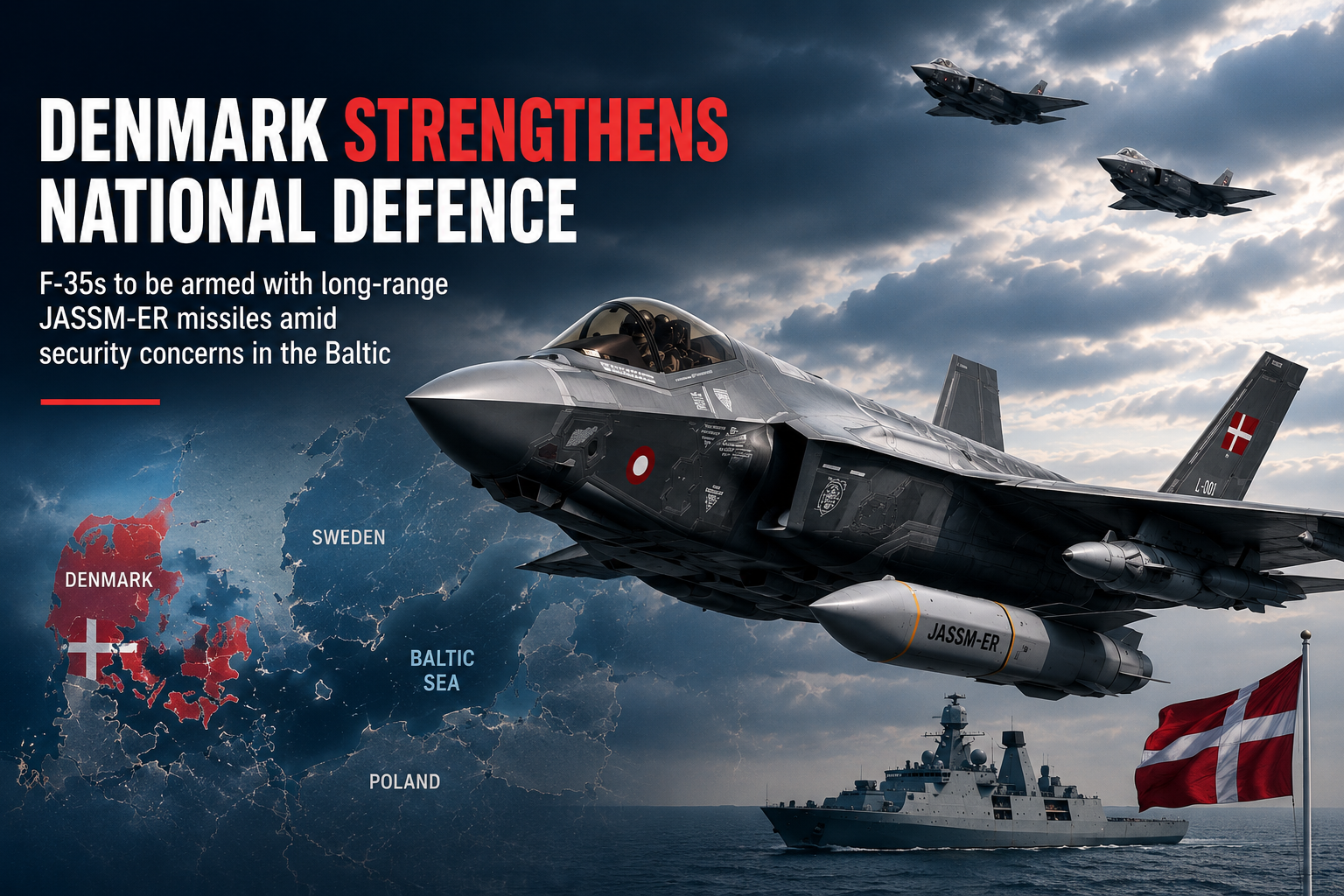
Against that backdrop, reports that Denmark intends to equip its fleet of F-35 Lightning II fighter aircraft with the long-range AGM-158 Joint Air-to-Surface Standoff Missile Extended Range, commonly known as JASSM-ER, deserve far greater attention than the headlines they generated. Reported by The Times of India and consistent with Denmark's wider defence modernisation programme, the decision represents more than the purchase of another sophisticated weapon. It reflects a profound shift in military thinking. Denmark is moving beyond territorial defence towards a posture that can project credible conventional deterrence over significant distances.
The distinction matters. An aircraft equipped only for air defence is fundamentally reactive. An aircraft carrying precision stand-off weapons capable of striking strategic targets hundreds of kilometres away changes the strategic equation entirely. It forces any potential adversary to calculate not simply whether they can threaten Denmark, but whether critical military infrastructure, logistics hubs, command centres or missile batteries could themselves become vulnerable before a conflict escalates.
This is not an isolated Danish decision. It sits within a much broader transformation occurring across Northern Europe. Finland is expanding long-range strike capabilities. Poland continues to invest heavily in precision missiles and integrated air defence. Sweden is rebuilding military capacity after decades of reductions. Germany has embarked upon its largest defence modernisation since reunification. Across NATO's northern flank, governments are reaching remarkably similar conclusions.
Distance is no longer protection, warning time is shrinking, and deterrence increasingly depends upon precision, reach and interoperability.
For policymakers, this raises an uncomfortable but necessary question. Why now?
The answer lies partly in geography. Denmark controls access between the North Sea and the Baltic through the Danish Straits, one of Europe's most strategically important maritime chokepoints. Any confrontation involving the Baltic States, Poland or NATO naval forces inevitably places Denmark at the centre of operational planning. Protecting those sea lanes has always been important. Today it has become indispensable.
There is another dimension that receives far less public attention. Denmark has quietly become one of Europe's most critical energy and digital infrastructure hubs. Offshore wind installations continue to expand across Danish waters. Electricity interconnectors link Scandinavian and continental power markets. Submarine fibre optic cables carry enormous volumes of digital communications. Pipelines, ports and logistics infrastructure collectively underpin northern Europe's economic resilience. These assets cannot simply be defended by patrol vessels and radar stations. They require integrated air, maritime, cyber and long-range strike capabilities capable of deterring sophisticated state actors.
For business leaders and investors, defence spending is often viewed through the narrow lens of government expenditure. That misses the larger economic picture. Defence has become industrial policy. Modern military capability drives demand for advanced manufacturing, artificial intelligence, cybersecurity, satellite communications, software engineering, autonomous systems and resilient supply chains. Denmark's investment, therefore, supports not only military readiness but also technological competitiveness within an increasingly contested global economy.
The acquisition of long-range weapons also reinforces Denmark's role within NATO's integrated force structure. The F-35 was never intended to operate as a standalone aircraft. Its real value lies in its ability to function as an intelligence node, collecting, processing and sharing battlefield information across allied networks while coordinating operations with naval forces, ground units and other aircraft. Adding JASSM-ER extends that capability beyond surveillance into precision strike, increasing operational flexibility while reducing risk to aircrews by allowing engagements from outside the range of many air defence systems.
Yet capability alone does not automatically produce security. There is an equally important debate over practicality.
Long-range precision missiles are expensive to acquire, maintain and replenish. They require extensive training, sophisticated targeting intelligence, secure communications and continuous logistical support. They also depend upon robust political decision-making. Possessing the ability to strike distant targets is one thing. Authorising such strikes during a rapidly evolving crisis presents a very different challenge.
There is also the question of strategic signalling. Deterrence relies upon credibility, but credibility can be interpreted differently by different audiences. NATO members describe these investments as defensive measures designed to prevent conflict by raising the costs of aggression. Moscow predictably portrays them as evidence of NATO militarisation. The resulting cycle of action and reaction illustrates the uncomfortable reality of modern European security. Every defensive investment is viewed through the prism of an adversary's strategic narrative.
What distinguishes Denmark is that its choices remain closely aligned with allied planning rather than unilateral military expansion. Copenhagen has consistently framed defence modernisation within NATO's collective deterrence strategy while simultaneously increasing support for Ukraine, strengthening Arctic security and investing in domestic resilience. The missile programme, therefore, appears less about projecting power for its own sake than ensuring Denmark can contribute meaningfully to a rapidly evolving alliance.
This broader perspective explains why defence has moved from the margins of economic policy to its centre. Institutional investors increasingly examine geopolitical exposure alongside traditional financial metrics. Corporate boards now assess supply chain resilience against scenarios that would once have belonged exclusively to defence ministries. Insurance markets, infrastructure operators and technology companies all recognise that security has become an economic variable rather than a purely military concern.
The strategic lesson extends beyond Denmark itself. Europe is entering an era in which geography once again shapes national policy. The optimism that characterised the post-Cold War decades has given way to a recognition that deterrence requires investment, preparedness and technological superiority.
Denmark's decision to strengthen its F-35 fleet with long-range strike capability should therefore be understood not as an isolated procurement programme but as part of a continental reassessment of risk.
Whether these investments ultimately prove sufficient will depend less on the missiles themselves than on the political cohesion, industrial capacity and alliance unity that sustain them. Military hardware can deter only when backed by credible strategy, resilient institutions and enduring partnerships. Denmark appears to have concluded that waiting for certainty is no longer an option. In today's Baltic security environment, preparedness has become the price of stability rather than its consequence.
Sources: The Times of India reporting on Denmark's planned acquisition of JASSM-ER missiles for its F-35 fleet; NATO strategic documents; Danish Ministry of Defence policy statements; Lockheed Martin programme information; publicly available assessments from the International Institute for Strategic Studies (IISS), the Centre for Strategic and International Studies (CSIS), and the Stockholm International Peace Research Institute (SIPRI).