Is Denmark Full of Wind?
David Williams
At first glance, the question sounds almost like a joke. Denmark is famous for blustery coastlines, cyclists battling headwinds and a landscape so flat that even modest hills become local landmarks.
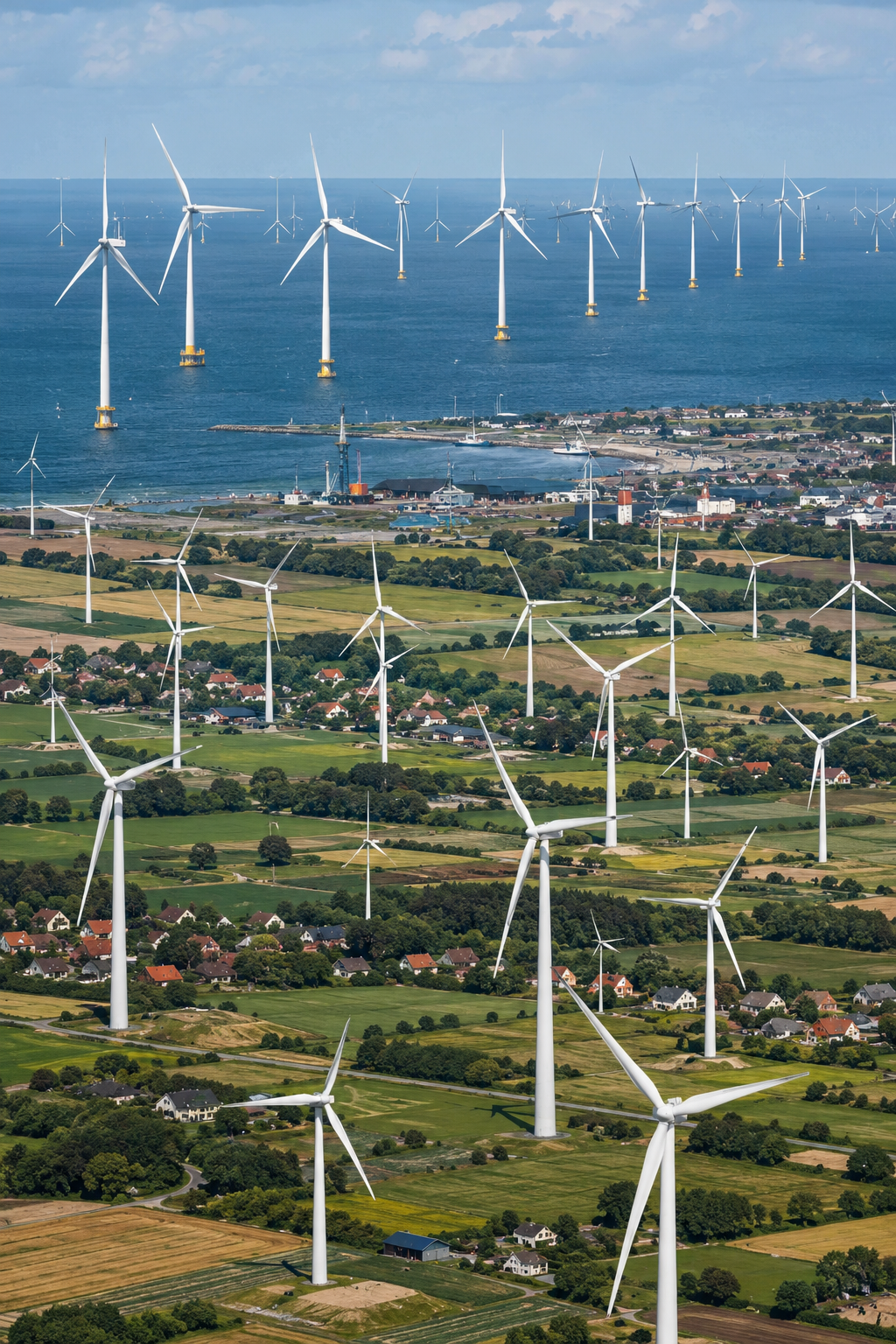
But when energy experts describe Denmark as one of the world's most wind-intensive economies, they mean something far more significant. Wind power is not simply part of Denmark's energy mix. It has become one of the foundations of the modern Danish economy.
'According to the official Danish government portal, https://denmark.dk/, Denmark remains a global leader in renewable energy deployment, particularly in offshore wind and the integration of renewable power into the electricity grid. That achievement did not happen by accident.
Many countries have strong winds. Many have coastlines. Many have invested billions in renewable energy. Yet Denmark managed to build an entire energy system around the assumption that the wind would sometimes provide more power than needed and at other times provide very little. Rather than treating this variability as a problem, Denmark designed its infrastructure around it.
The roots of this strategy stretch back to the oil crises of the 1970s.
At a time when much of Europe worried about energy security, Denmark concluded that dependence on imported fuel carried unacceptable risks. Wind energy gradually evolved from an environmental ambition into a national strategic priority.
Geography helped. Sitting between the North Sea and the Baltic Sea, Denmark enjoys some of Europe's most favourable wind conditions. Shallow coastal waters made offshore wind farms technically feasible long before many competing countries were ready to pursue them.
Yet geography alone does not explain Denmark's success.
Britain has excellent wind resources. Ireland has powerful Atlantic winds. The United States possesses some of the world's largest wind corridors. Denmark's advantage was consistency.
Governments changed, but the long-term direction largely remained the same. Energy policy became a national project rather than a political football.
Public acceptance also played a crucial role. In many countries, wind farms become lightning rods for local opposition. Denmark largely avoided that fate by encouraging local ownership and community participation. Turbines became part of the landscape rather than symbols of conflict.
Today, however, Denmark's position at the top is no longer guaranteed.
The United Kingdom is arguably the most immediate challenger.
Over the past decade, Britain has transformed the North Sea into one of the world's largest offshore wind regions. With a larger economy, a bigger coastline and greater financial resources, the UK has the capacity to overtake Denmark in several key measures.
China presents an even greater long-term challenge.
While Denmark pioneered offshore wind, China is industrialising it on a scale that few countries can match. Chinese companies now dominate much of the global turbine manufacturing industry, while the country's annual additions of wind capacity often exceed the entire installed capacity of smaller nations.
Germany remains another serious contender. Despite well-documented challenges involving grid expansion and industrial costs, Germany's economic scale gives it enormous potential. If Berlin succeeds in accelerating infrastructure development, it could become one of Europe's dominant renewable-energy powers.
The Netherlands, Sweden and even Poland are also emerging as important players. What was once a relatively exclusive club has become increasingly crowded.
Yet Denmark's biggest threat may not come from abroad. It may come from the changing nature of the energy transition itself.
The first phase of renewable energy was about building turbines.
next phase is about managing what those turbines produce. As wind generation expands, the challenge shifts towards energy storage, grid stability, interconnections and industrial electrification.
In other words, the future may belong not to the country that generates the most renewable power, but to the country that uses it most effectively.
This is where Denmark still has a powerful opportunity.
The country is investing in advanced electricity interconnectors, offshore energy hubs, smart-grid technology and green hydrogen.
These developments may prove even more important than additional wind farms. They address one of renewable energy's central challenges: what happens when the wind is blowing strongly but demand is low, or when demand is high and the wind has dropped.
If Denmark can solve those problems before its competitors, it may retain its leadership position even as larger countries install more turbines.
There is also a deeper lesson in Denmark's experience.
Denmark never became a renewable-energy leader because it was the largest country, the richest country or the most powerful country. It succeeded because it recognised earlier than many others that energy security, economic competitiveness and climate policy were interconnected.
The countries now racing to catch up are, in many respects, following a path Denmark helped create.
The next chapter will determine whether Denmark remains simply a pioneer of wind power or becomes the model for what a fully renewable energy system looks like in practice.
If Denmark succeeds, it will not be because it has the most turbines. China and perhaps Britain are likely to dominate on scale.
Denmark's future advantage lies elsewhere. It lies in proving that an advanced industrial economy can run reliably, competitively and securely on renewable energy. That is a much harder challenge than building wind farms. It is also a far more important one. If Denmark can continue to lead in that area, its influence on the global energy transition could remain far greater than its size would suggest.
Subscribe to the LinkedIn Newsletter