Football Isn't a Matter of Life and Death. Geopolitics Is.
"Some people think football is a matter of life and death. I assure you, it's much more serious than that." Bill Shankly, the legendary Liverpool manager.
By David A. Williams
When Denmark won the 1992 European Football Championship, it did something that should never have happened. They had not even qualified. The Danes only took part because Yugoslavia was expelled as war engulfed the Balkans. Players were recalled from their summer holidays, the squad was missing its greatest talent after Michael Laudrup refused to play following a dispute with coach Richard Møller Nielsen, and expectations barely existed. Yet while Denmark entered the tournament with little to lose, Europe's footballing giants carried the burden of expectation. Germany were reigning world champions, the Netherlands were defending European champions, and France arrived with one of the continent's most gifted squads. They looked stronger because they were stronger. But strength and success are not always the same thing.
The tournament unfolded at a moment when Europe itself was in turmoil. The Cold War had only recently ended, Yugoslavia was collapsing into civil war, and political uncertainty cast a shadow over the competition. Denmark, almost by accident, found itself occupying the space created by other nations' crises. Free from pressure and united by circumstance, they defeated the Netherlands before stunning Germany 2-0 in the final. It remains one of football's greatest improbabilities, proof that history occasionally rewards the side that simply arrives at the right moment.
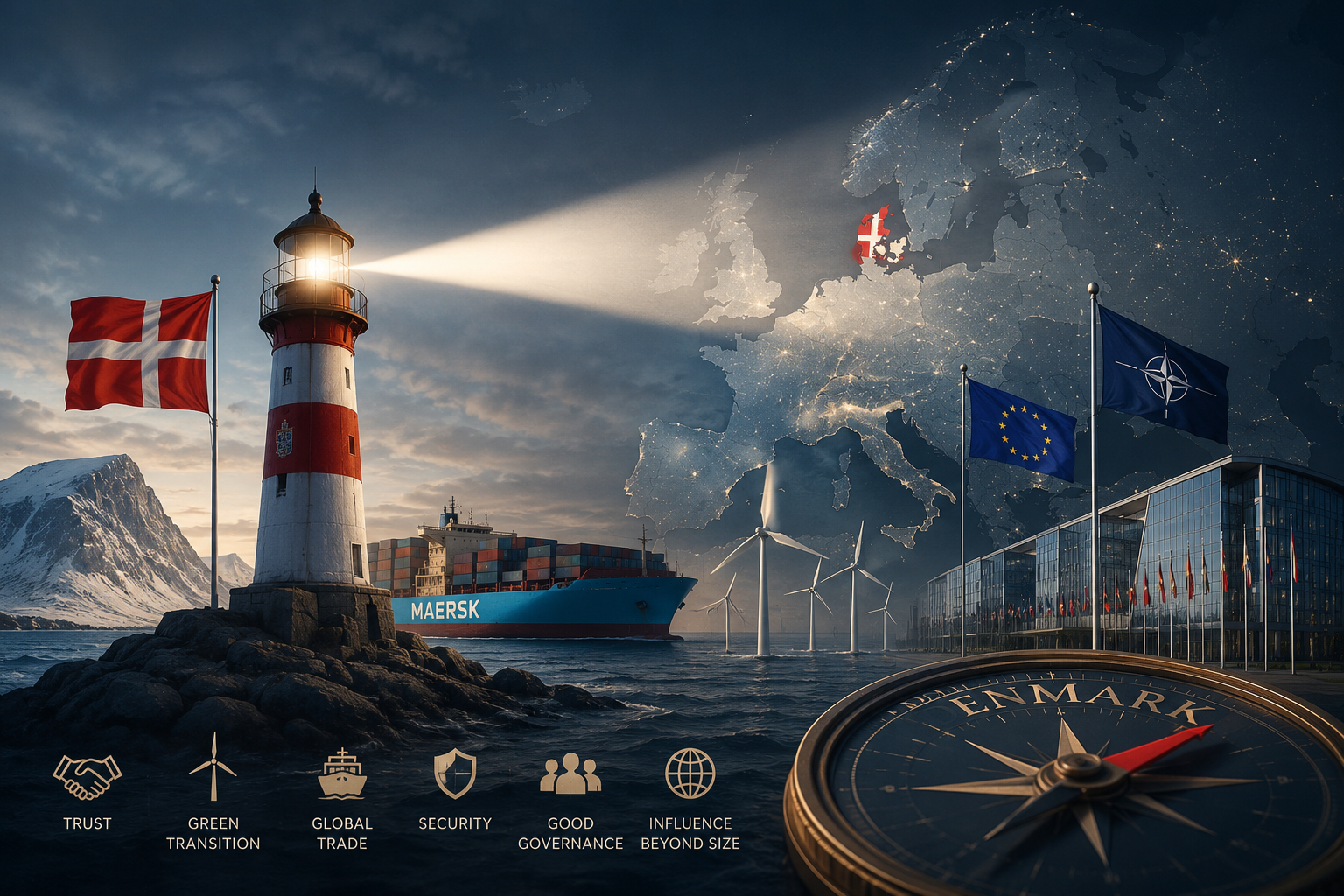
Today, Denmark finds itself in a remarkably similar position, not on a football pitch but on the geopolitical stage. With a population of just under six million, Denmark ought to be a peripheral player. Instead, it has become one of Europe's most influential middle powers. It is home to global leaders in pharmaceuticals, shipping and renewable energy. Companies such as Novo Nordisk and Maersk exert influence far beyond Denmark's borders, while Copenhagen has become an increasingly important voice within NATO and the European Union on everything from Arctic security to energy independence. Timing, once again, appears to be working in Denmark's favour.
The larger Western powers are wrestling with problems that have narrowed their room for manoeuvre. Germany is enduring years of sluggish growth after losing access to cheap Russian energy. France remains politically fractured. Britain is still searching for its place after Brexit, while the United States has become increasingly consumed by domestic political division and strategic rivalry with China. Across much of Europe, governments face ageing populations, mounting public debt and stubbornly weak productivity. The established powers have not suddenly become weak, but they have become distracted. That creates opportunities for countries that are coherent, stable and adaptable.
Denmark has quietly spent decades building precisely the qualities that now matter most. It possesses one of Europe's strongest green energy sectors, commands enormous influence over global shipping through Maersk, sits at the centre of growing Arctic competition because of Greenland, and consistently ranks among the least corrupt and best governed countries in the world. In an era when competence has become a strategic asset, Denmark finds itself unusually well placed. Like the footballers of 1992, it is punching above its weight because circumstances have shifted around it. History has created an opening that few would have predicted even a decade ago.
But history also teaches that such openings rarely last. Denmark's football miracle was never repeated. The closest came at the delayed Euro 2020 tournament, played in 2021 after the pandemic, when they reached the semi-finals before losing 2-1 to England after extra time. The decisive penalty awarded to Raheem Sterling remains deeply controversial in Denmark, where many still believe it should never have been given. The defeat left a lingering bitterness, not simply because Denmark lost, but because another rare opportunity had slipped away.
That may be the greatest lesson of all. Success has a habit of convincing us that we deserve it, when in truth it is usually the product of preparation meeting a fleeting moment in history. The Danes of 1992 did not inherit greatness. They seized an opportunity that may never come again. Nations, like football teams, do not remain in history's spotlight forever. They step into it briefly, if they are ready and if the timing is right. The mistake is not failing to repeat greatness. The mistake is forgetting how extraordinary it was when it happened the first time.