Europe’s Green Transition and the Forgotten Resource: Trust
By David Williams
A Continent Caught Between Hope and Confusion
Europe’s energy transition is often presented as a moral necessity and a technological revolution. Governments speak of decarbonisation, electrification, carbon neutrality, and the promise of a cleaner future. Few serious people deny that climate change is real or that Europe must modernise its energy systems. Yet beyond the conference halls, policy papers, and speeches, there is another mood spreading quietly across the continent. It is not outright hostility toward green energy. More often, it is confusion, exhaustion, and a growing sense that ordinary people are being left behind in a conversation they can no longer follow.
This is not because citizens have not been informed. They have been informed constantly. Politicians, activists, corporations, and European institutions have produced endless reports, targets, and campaigns explaining why the transition is necessary. But there is a profound difference between hearing something repeatedly and genuinely understanding it.
When Complexity Stops Informing and Starts Alienating
For many people, the entire process has become so complicated that it creates a strange psychological effect. I am reminded of an interview I attended as a young man for a job as a financial adviser. I dutifully studied the glossy brochures, impressive graphs, and endless jargon, yet somehow felt more confused than when I started. The plans were supposedly designed to make money for clients, but once commissions, fees, projections, and conditions entered the conversation, I could no longer see how clients truly benefited. Then the department manager leaned forward and admitted, in a rare moment of honesty, that the brochures were deliberately written to overwhelm rather than clarify. The more confused people became, the less likely they were to question the system itself.
At times, Europe’s green transition feels uncomfortably similar.
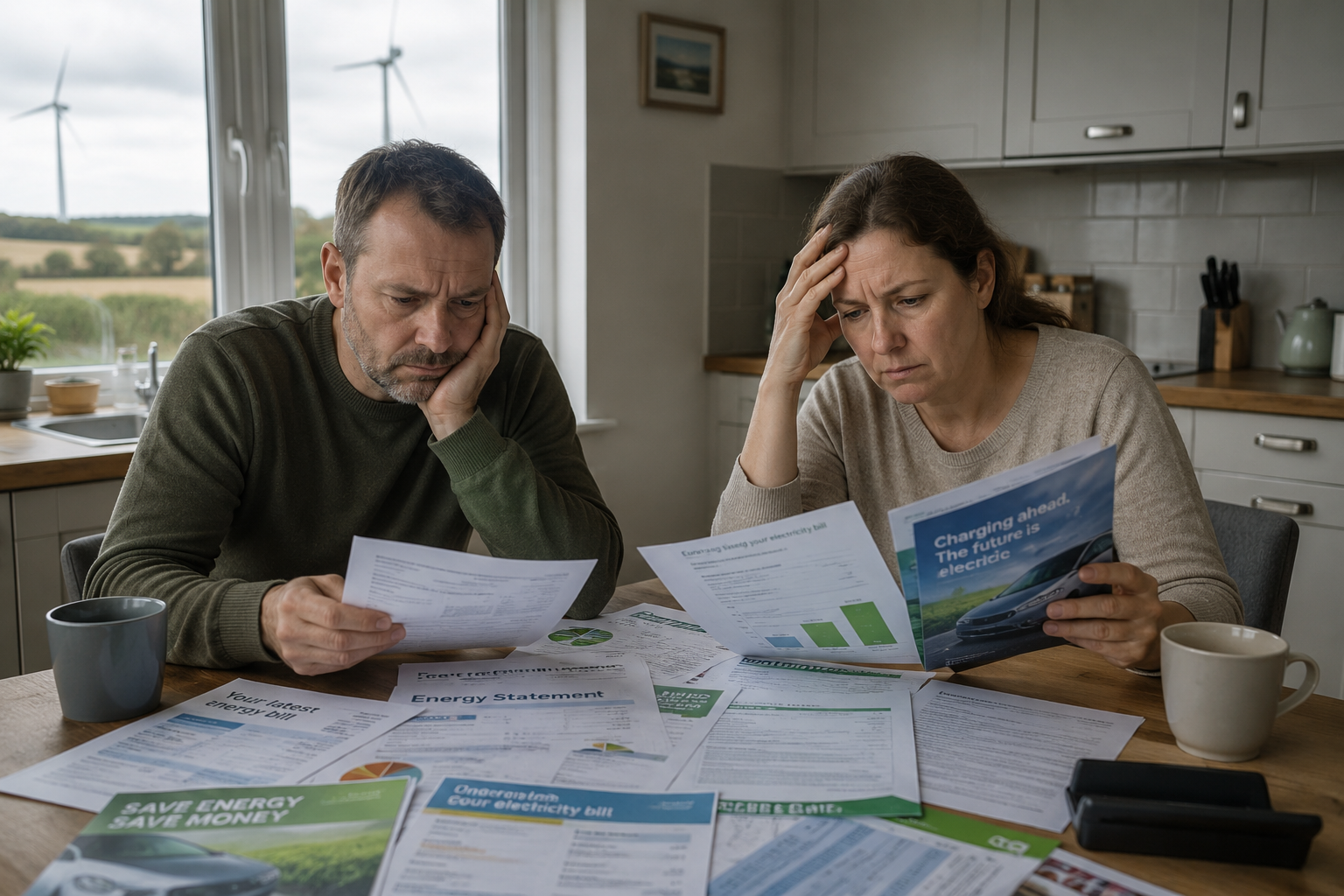
The average citizen is now expected to understand carbon trading systems, emissions markets, energy taxes, renewable subsidies, hydrogen infrastructure, heat pumps, battery storage, and “net-zero pathways.” Even specialists disagree over the long-term consequences of some of these policies. Meanwhile, ordinary households experience the transition in far simpler terms. Electricity bills rise. Petrol becomes more expensive. Diesel cars are discouraged. Heating systems must eventually be replaced. New regulations appear constantly. People are told these sacrifices are necessary, yet many still struggle to understand precisely how the system works or where it ultimately leads.
This gap between elite policy language and ordinary lived experience is becoming politically dangerous.
The Reality of Energy Poverty
Research has repeatedly shown that energy affordability is now a serious concern across Europe. In the academic journal Energy Policy, researchers Stefan Bouzarovski and Sergio Tirado Herrero warned in their article “The energy divide: Integrating energy transitions, regional inequalities and poverty trends in the European Union,” published in November 2017, that energy policy frameworks often fail to reflect the real pressures faced by households living with rising costs and stagnant incomes.
More recently, a 2025 study in Energy Policy titled “Energy poverty in Europe: Challenges and policy responses” found that millions of Europeans continue to struggle with energy affordability despite years of green investment and subsidy programmes. The study argued that official measurements frequently underestimate the scale of the problem because they rely too heavily on technical indicators rather than lived reality.
This matters because people do not experience the energy transition through policy documents. They experience it through monthly bills and shrinking disposable income.
The Rise of a Utopian Vision
There is also a deeper philosophical issue emerging beneath the economics. Parts of Europe’s environmental movement increasingly appear driven not simply by environmental protection, but by a broader ideological vision of how society itself should function. Consumption must shrink. Car ownership should decline. Air travel should become rarer. Meat consumption should fall. Economic growth itself is sometimes treated with suspicion.
Critics increasingly argue that this vision can drift into utopian thinking. Not because renewable energy is unrealistic. Wind, solar, hydroelectric, and nuclear energy all clearly have roles to play in Europe’s future. The problem arises when politicians imply that difficult trade-offs can somehow disappear through moral conviction alone.
In reality, Europe is attempting several enormously difficult goals at the same time. It wants lower emissions, lower energy prices, industrial competitiveness, strategic independence from foreign energy suppliers, rapid electrification, and social equality. These ambitions are admirable, but they are not always compatible.
The Trade-Offs Nobody Wants to Discuss
Researchers have repeatedly warned about these tensions. In September 2018, a paper published on arXiv titled “Energy System Optimization Models: Uses, Limitations, and Future Directions” argued that many energy models produce highly uncertain outcomes and can hide uncomfortable trade-offs behind layers of technical assumptions.
Another paper, “The paradox of the energy transition,” published in June 2017, warned that rapid renewable expansion can unintentionally destabilise electricity markets by undermining investment incentives for backup power generation needed during periods of low wind or sunlight.
These are not arguments against renewable energy. They are reminders that large-scale energy systems are extraordinarily complicated and often resistant to political idealism.
Yet modern political culture increasingly struggles to admit uncertainty. Too often, skepticism about implementation is treated as moral failure. Citizens who question affordability, infrastructure readiness, or industrial consequences are sometimes dismissed as ignorant, selfish, or manipulated by misinformation.
The Human Cost of Technocratic Politics
Certainly, misinformation exists. Fossil fuel interests have a documented history of lobbying and influence campaigns. In August 2024, The Guardian published an article by Fiona Harvey titled “Fossil fuel industry using disinformation campaign to slow green transition, says UN,” which detailed concerns raised by United Nations officials about organised efforts to undermine climate policies.
But dismissing every public concern as manipulation is equally dangerous. Many people are reacting rationally to material pressures in their own lives.
A pensioner worried about heating costs is not necessarily anti-environmentalist. A factory worker concerned about deindustrialisation is not automatically a climate denier. Farmers protesting regulations are not simply obstacles to progress. Often, they are responding to policies designed by people whose economic realities look entirely different from their own.
The Democratic Problem at the Heart of the Transition
This is where the democratic problem begins to emerge. Democracy depends not only on elections but on comprehension. Citizens do not need advanced degrees in climate science or energy economics to support reform. But they do need to understand, in plain language, what is happening, why sacrifices are being demanded, who benefits, and whether those sacrifices are being shared fairly.
Too often, Europe’s green transition feels designed from the top downward. The people shaping policy are frequently educated urban professionals who can more easily absorb rising costs, purchase electric vehicles, or retrofit homes with new heating systems. For millions of others, these choices are financially impossible.
The tragedy is that many of the goals behind the transition are entirely reasonable when explained clearly. Reducing dependence on authoritarian energy exporters makes strategic sense. Cleaner air improves public health. Modernised infrastructure can create resilience and long-term efficiency. Most citizens understand these ideas instinctively.
What they struggle with is the language surrounding them. Acronyms replace explanations. Targets replace clarity. Technical frameworks replace ordinary speech. The result is a growing suspicion that complexity itself has become a political shield.
Trust Is Becoming Europe’s Most Important Energy Resource
When systems become so complicated that ordinary people can no longer understand them, trust begins to erode. And once trust erodes, suspicion quickly fills the vacuum.
Europe’s green transition may ultimately succeed technologically while failing politically if leaders continue to underestimate this human reality. Citizens do not want perfection. Most are capable of accepting sacrifice when they believe they are being spoken to honestly. What they resent is the feeling of being managed, lectured to, or buried beneath technical language that obscures difficult truths.
The future of Europe’s energy policy may therefore depend less on technology than on something much older and simpler: trust.