Europe's Drone Mirage? The Supply Chain Question Behind Denmark's Drone Industry
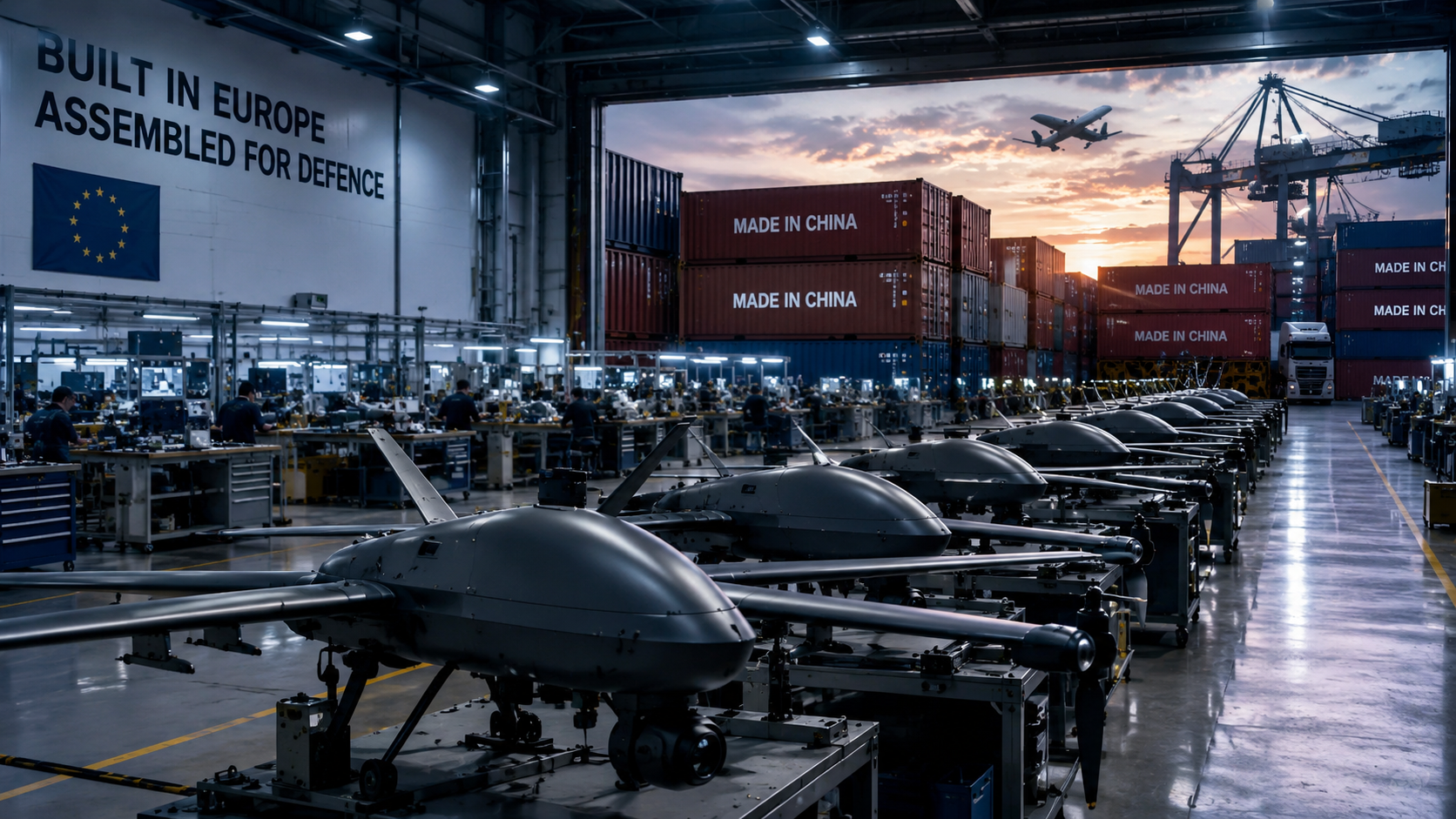
As Europe races to expand its defence capabilities, drones have become one of the most celebrated success stories. From Ukraine's battlefield innovations to the growth of drone hubs in countries such as Denmark, the impression is often given that Europe is rapidly building an independent drone manufacturing sector. Yet behind the headlines lies a more complicated question: who is actually making these drones?
David A. Williams
The issue was recently highlighted by Alexander Mercouris, a British political commentator, former barrister, and editor of independent online media outlet, The Duran, a geopolitical affairs platform known for its coverage of international relations and the war in Ukraine. During a broadcast discussing conversations and attitudes within Russia, Mercouris described what he said is a widely held view among Russian officials regarding the origin of many drones supplied to Ukraine.
According to Mercouris, Russian officials do not believe that many of the drones presented as European or Ukrainian products are truly manufactured in either Europe or Ukraine. Instead, they argue that the overwhelming majority of critical components originate in China. Motors, electronics, batteries, controllers, spare parts, and the rare earth magnets essential to drone technology are all seen as products of Chinese industry.
The Russian argument is not that Europe plays no role. Rather, it is that Europe is largely performing the final assembly. Components are reportedly exported to intermediary countries such as Malaysia and other Asian trading hubs before being purchased by European companies. The parts are then shipped to Europe, assembled into complete systems, and eventually delivered to Ukraine. In some cases, Russian officials believe that additional modifications are made before the drones are presented as European products.
Whether one agrees with that interpretation or not, it touches on a reality that is difficult to ignore. China occupies a dominant position in the global drone supply chain. The country is home to many of the world's largest drone manufacturers and is a leading producer of the batteries, motors, sensors, electronics, and specialist materials that modern drones require.
China's influence extends beyond drone production itself. It also dominates the processing of rare earth elements used in high-performance magnets, which are essential components in electric motors and guidance systems. According to international energy and industry studies, China remains responsible for the vast majority of global rare earth processing capacity. This gives Chinese manufacturers a significant advantage that competitors have struggled to match.
These realities raise interesting questions for Europe's emerging drone sector, including Denmark's much-publicised drone cluster in Odense. Over the past decade, Odense has established itself as a centre for robotics and unmanned aerial systems. Companies based there have developed expertise in software, autonomous navigation, testing, systems integration, and advanced applications for both civilian and military use.
None of that expertise should be underestimated. Designing sophisticated software, integrating complex systems, and developing new operational concepts are valuable achievements in their own right. Yet critics argue that there is a difference between designing and assembling a product and manufacturing the components that make it work.
That distinction lies at the heart of the debate. If a drone is designed in Denmark, assembled in Denmark, and programmed in Denmark, but relies on Chinese batteries, Chinese motors, Chinese magnets, and Chinese electronics, where should its true origin be said to lie? Reasonable people can disagree, but it is a question that policymakers are increasingly being forced to confront.
The issue becomes even more important when viewed through the lens of strategic independence. European leaders frequently speak about reducing reliance on foreign suppliers and strengthening domestic industrial capacity. The war in Ukraine has accelerated those ambitions by exposing vulnerabilities in supply chains that many governments previously took for granted.
Building an independent defence industry, however, involves far more than opening assembly facilities. It requires access to raw materials, processing capabilities, specialist manufacturing, and entire networks of suppliers that often take decades to develop. Europe has made progress in some areas, but many critical components still come from outside the continent.
Mercouris also claimed that Russian concerns about Chinese drone components reaching Ukraine are raised regularly in discussions between Russian and Chinese officials. According to his account, Russian representatives argue that Chinese-manufactured parts are ultimately ending up in systems used against Russian forces. He says Chinese officials respond by pointing to the size of their drone industry and the economic consequences that would follow from imposing sweeping restrictions on exports.
Whether that explanation fully satisfies Moscow is another matter. What it does reveal is the complexity of modern manufacturing. In today's global economy, products rarely come from a single country. A drone assembled in Europe may contain components sourced from several continents, just as a smartphone or automobile does.
For Europe, the challenge is not simply producing more drones. It is developing the industrial ecosystem that allows those drones to be built from the ground up. Until that happens, questions about the true origins of many supposedly European systems are likely to persist.
The debate highlighted by Mercouris may not provide all the answers, but it does shine a light on an uncomfortable reality. In an age of globalised supply chains, the difference between manufacturing and assembly can be much greater than many public discussions acknowledge.
Subscribe to the LinkedIn Newsletter: Sphere Magazine