Europe Is Entering a Permanent Heat Emergency
By David A. Williams
"Europe's Heatwaves Are No Longer Extraordinary Events, They Are a Preview of a Hotter Future We Are Already Living In" Statement from WHO Europe
The World Health Organization Regional Office for Europe (WHO Europe) has warned that the current heatwaves affecting the continent should be understood as an unfolding public health emergency rather than isolated climatic anomalies. In a statement issued from Copenhagen on Tuesday, Dr Hans Henri P. Kluge, Regional Director for WHO Europe, described the situation as a sustained test of national health systems, urban infrastructure, and emergency response capacity across multiple countries simultaneously.
"Across Europe, we are witnessing a health emergency unfold in real time," Dr Kluge said. "Hospitals are experiencing prolonged surges in admissions, ambulance services are operating beyond previous peak levels, and several countries are reporting significant increases in heat-associated mortality. This is becoming a repeated seasonal pressure rather than a rare disruption."
The statement highlights that Europe is heating at more than twice the global average, a trend that is steadily reshaping the baseline conditions under which health systems must operate. Recent data cited by WHO Europe includes sharp increases in emergency call-outs in France, record-breaking ambulance demand in the United Kingdom, and hundreds of excess deaths recorded in Spain over a short period, alongside confirmed fatalities in Italy during successive heat events.
"Europe is warming at more than twice the global average," Dr Kluge said. "We are no longer dealing with occasional extremes. We are facing a pattern of recurring stress events that expose structural weaknesses in preparedness and response."
Despite the escalating pressures, WHO Europe stressed that outcomes are still being influenced by intervention. The statement points to evidence that heat-related mortality would have been substantially higher in recent years without existing adaptation measures. Early warning systems, community outreach to vulnerable populations, and designated cooling spaces have already reduced preventable deaths, although their availability remains uneven across the region.
"What we are seeing is not inevitable harm," Dr Kluge said. "Where measures are in place, lives are being saved. The problem is that coverage is inconsistent, and too many populations remain outside these protective systems."
Healthcare services are described as being affected on multiple fronts. Beyond increased patient volumes, hospitals are contending with degraded working conditions caused by sustained high temperatures, reduced recovery for staff due to warm nights, and additional strain on medical equipment and cooling infrastructure.
"This is placing simultaneous pressure on people and systems," Dr Kluge said. "Care environments are being compromised at the very moment demand is rising, which intensifies risk across the entire chain of response."
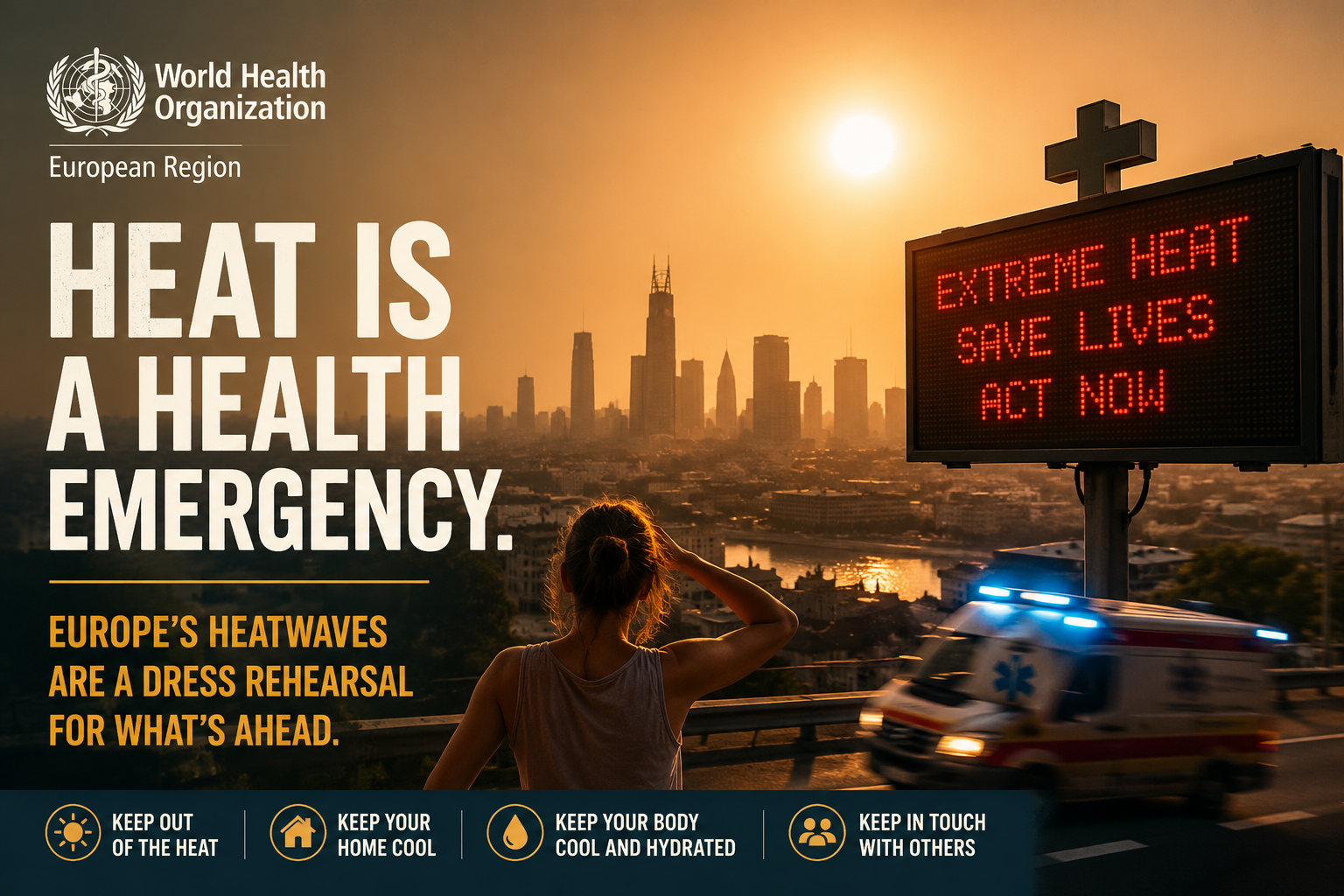
WHO Europe concludes that the present conditions should be interpreted as a rehearsal for more severe summers ahead, urging governments to accelerate implementation of heat-health strategies, strengthen early warning networks, and expand access to protective urban spaces. The agency is also convening national focal points to review lessons from the current wave and assess readiness for future events.
"The key issue now is preparedness," Dr Kluge said. "These conditions will return, and likely with greater intensity. The question is whether systems will adapt quickly enough to reduce avoidable loss of life."