Caligula’s Horse and the Quiet Collapse of Democracy
David A. Williams, Editor, Sphere Magazine
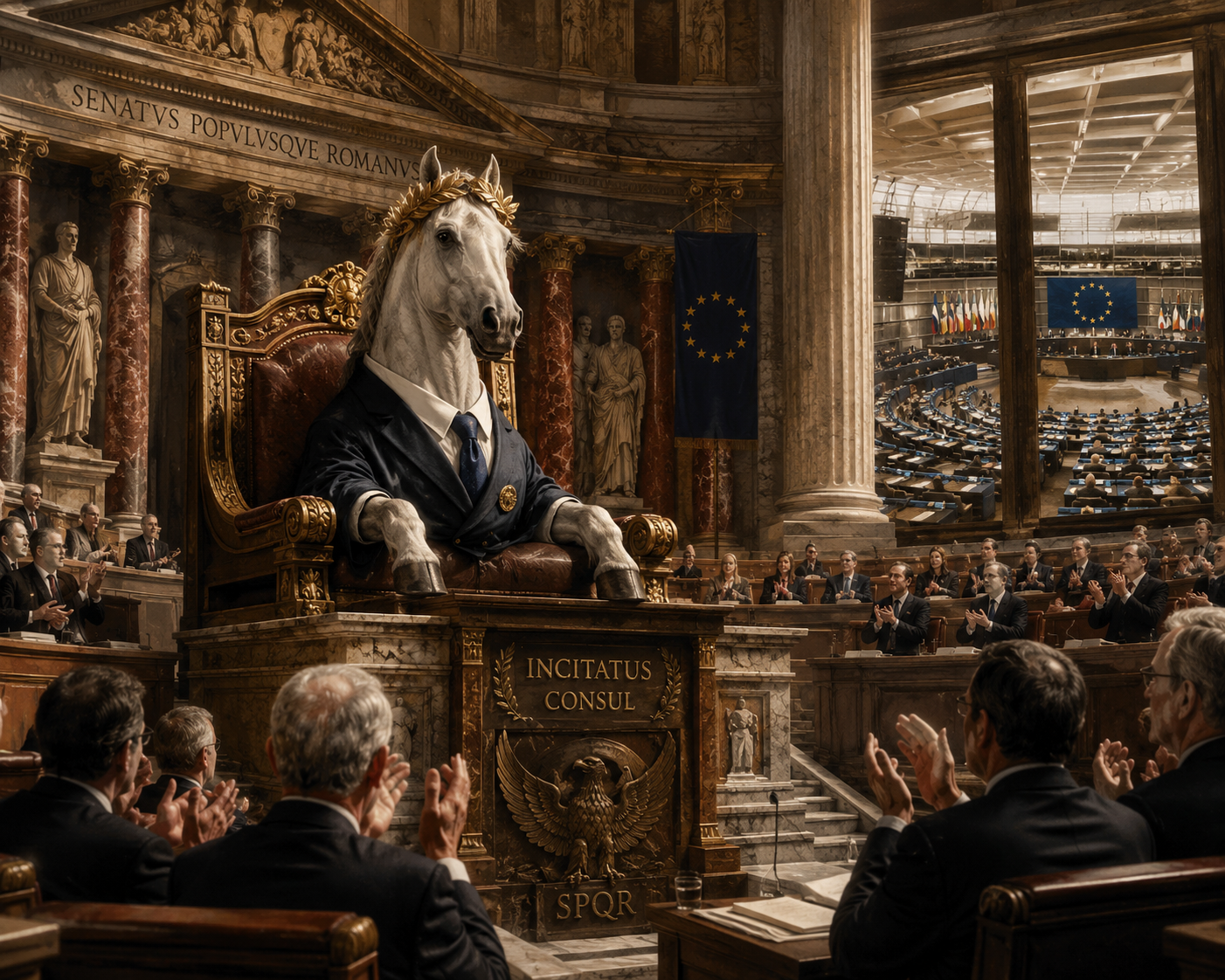
There is a story from ancient Rome that refuses to die because every generation eventually recognises itself in it. The Roman emperor Caligula supposedly loved his horse, Incitatus, so much that he planned to appoint it consul, one of the highest offices in the empire.
Historians still argue about whether he genuinely intended to do it or whether it was a grotesque joke aimed at humiliating the Roman political class. Either way, the story survived because people instinctively understood what it represented. A society had reached the point where power no longer needed to pretend it respected competence.
The horse became a symbol. Not of madness alone, but of contempt. Contempt for institutions, for public service, and for the idea that important positions should belong to capable people rather than favourites, flatterers and insiders.
Modern democracies love to imagine they are above this sort of thing. We point to elections, constitutions, parliamentary debates and free media as if those things alone guarantee political health. But democracy is not a magic shield against decay. Calling a country democratic does not automatically make it fair, competent or honest.
Too often, the conversation stops the moment somebody says, “Well, we live in a democracy.” As though the label itself settles the matter.
It does not.
Cronyism and nepotism exist in democratic societies everywhere, including Denmark. Sometimes it appears in subtle forms. The same surnames circulate through politics, media, academia and business. The same social circles produce ministers, commentators, executives and cultural gatekeepers. Doors open more easily for people who already know where the doors are.
Most people recognise this instinctively, even if they rarely say it aloud.
And while small-scale favouritism may seem harmless, history repeatedly shows that elite networks protected from scrutiny eventually become dangerous. When loyalty matters more than competence, systems weaken from the inside.
The 2008 financial crisis revealed what happens when political, financial and regulatory elites grow too comfortable with one another. Across several countries, people tasked with oversight became entangled with the industries they were supposed to regulate. The result was not just economic collapse but a profound collapse of trust.
The COVID-19 years produced similar questions in many democratic nations. Emergency contracts flowed rapidly toward politically connected firms. In some cases, vast sums of public money disappeared into incompetence, waste or outright failure while ordinary citizens were told sacrifices were necessary for the greater good.
Even stable democracies are not immune. In the United States, political dynasties surrounding families like the Kennedy family and the Bush family have long fuelled debate about inherited influence. More recently, critics have raised similar concerns regarding the family-centred political orbit of Donald Trump. Even in Denmark, we see the scion of new and old political dynasties creep into the Folketinget election after election.
None of this means democracy is failing beyond repair. It means democracy requires constant vigilance. Healthy societies are not defined by the absence of corruption or favouritism. They are defined by their willingness to confront it honestly.
That honesty has become surprisingly difficult.
Just as criticism of Israeli military actions has come to mean that you are immediately anti-Semitic, modern democracies too often confuse criticism of democracy with disloyalty. If you point out obvious favouritism, closed networks or institutional mediocrity, somebody inevitably accuses you of undermining faith in democracy itself. But refusing to discuss a problem does not strengthen a society. It merely protects the problem.
The Romans understood something we sometimes forget. Institutions can continue functioning outwardly long after they have begun rotting internally. Rome maintained ceremonies, titles and republican traditions even as real accountability disappeared behind palace walls and elite alliances.
By the time an emperor could joke about appointing a horse to high office, the deeper decay had already happened.
Cronyism is not just morally irritating. It is economically stupid and politically corrosive. Organisations built on personal loyalty rather than merit become fragile. Competent people leave or stop trying. Cynicism spreads. Public trust erodes quietly at first, then all at once.
Eventually, people stop believing excellence matters.
That is the moment a democracy becomes vulnerable, not when elections disappear, but when citizens conclude the outcome was largely decided by networks, access and inherited privilege long before any votes were cast.
This is why free speech matters, and it is why transparency matters. It is why investigative journalism matters. It is why independent institutions matter. Democracies survive not because they are democratic on paper, but because citizens remain willing to scrutinise power even when doing so feels uncomfortable.
The real danger today is not some theatrical dictator declaring his horse a senator before cheering crowds.
The real danger is far more mundane.
It is the board appointment nobody questions because of the surname involved. The consultancy contract mysteriously awarded to an old friend. The senior role filled before interviews even begin. The culture of polite silence surrounding obvious insider advantage.
Rome, at least, had the decency to make the absurdity visible.
Today, we dress Caligula’s horse in a navy suit, send it to leadership seminars, put it on advisory panels and praise its “strong network” on LinkedIn.
And if anyone objects, the horse is immediately invited onto television to discuss the importance of defending democratic values.
© Sphere Magazine [2026]. All rights reserved.