Between the Baltic and the Bear: Can Denmark Defend Itself in a New European War?
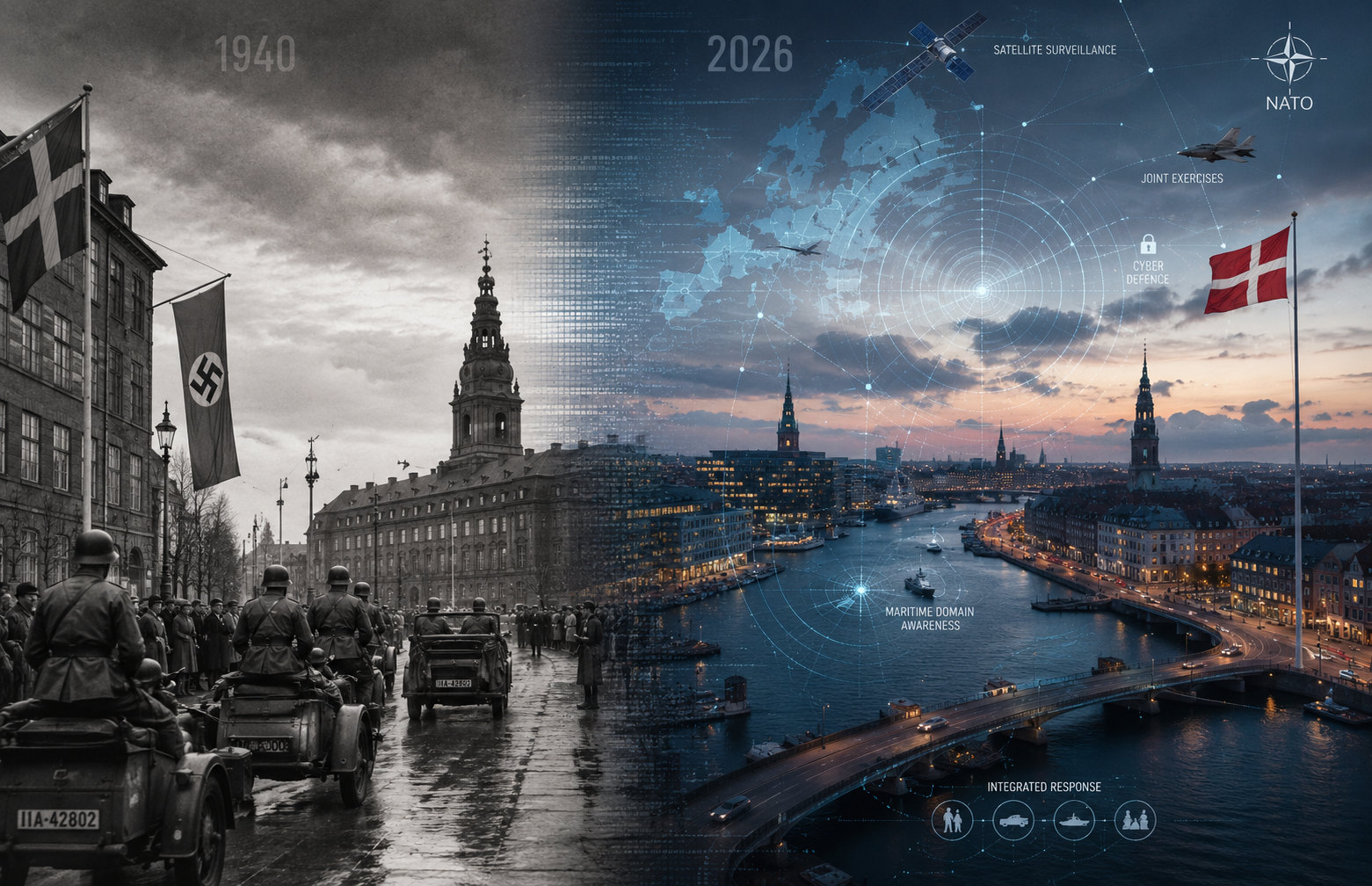
If war in Europe ever broke out, directly involving Denmark and Russia, the question almost writes itself: would Denmark be a front-line state, or simply a stepping stone in a wider NATO confrontation? And then another question follows, quieter but more unsettling: is this 1940 all over again, or something structurally different?
David Williams
The easy historical analogy is occupation. Denmark in 1940 was overwhelmed quickly by a larger power, its geography flat and open, its strategic value tied to access to the Baltic Sea. But does that analogy survive contact with today’s reality? Denmark is no longer alone. It sits inside NATO, bound by Article 5, where an attack on one is considered an attack on all.
So what does Denmark actually rely on?
One answer is deterrence by alliance. NATO leaders have repeatedly framed it in simple terms: an attack on one is an attack on all. That sentence is not just rhetoric. It is the core assumption behind Danish defence planning. But is belief in collective defence the same as immediate physical security?
A Danish defence planner might point to modernisation efforts, increased defence spending, and cooperation in the Baltic region. Denmark’s military posture is not built to match Russia tank for tank. Instead, it leans into niche capabilities: naval control of key maritime routes, surveillance in the North Atlantic and Baltic approaches, and integration with allied forces. The logic is less fortress-like, more network-like.
Yet critics ask a sharper question. If the opening hours of a conflict are decisive, does networked defence arrive fast enough? The geography of Denmark, sitting astride critical sea lanes, makes it strategically important but also exposed. In a fast escalation scenario, especially one involving hybrid warfare or missile strikes, would reinforcement be immediate or delayed?
Then there is another perspective, often heard in strategic think tanks: the hybrid scenario. Not 1941 with massed infantry, but something less visible. Cyberattacks on infrastructure, pressure in the Baltic Sea, disinformation campaigns, and rapid political destabilisation. In that reading, the question is not whether Denmark can repel an invasion, but whether it can maintain cohesion long enough for allied systems to activate.
A sceptic might argue that reliance on NATO creates a psychological gap. If everyone assumes someone else will arrive, does readiness quietly degrade? A supporter of the current system would respond that deterrence only works if it is credible, and credibility requires visible integration, joint exercises, and forward planning already underway.
So where does this leave the historical analogy? Is it 1940 again?
Not quite. In 1940, Denmark stood largely alone. Today it stands inside a collective defence structure with nuclear backing, integrated command systems, and multinational planning. But the uncomfortable truth is that geography has not changed. The Baltic still matters. The approaches to Northern Europe still matter. And speed still matters more than theory in the first hours of crisis.
It is worth adding a more uncomfortable layer to this debate, one that often circulates in strategic commentary.
A claim frequently attributed to Henry Kissinger in discussions of NATO credibility is that the United States might not automatically go to war under Article 5 if a small ally were attacked. The exact wording varies depending on who repeats it, and there is no single definitive public transcript confirming it in that form. But the underlying strategic anxiety it reflects is widely discussed: would US commitment always translate into immediate escalation?
That question becomes more politically charged when viewed through the lens of the Donald Trump era. Trump repeatedly framed NATO as conditional on burden sharing, suggesting that allies not meeting spending expectations might not receive automatic protection. For critics, this introduced ambiguity into what had long been treated as an ironclad guarantee.
So where does that leave Denmark and its sense of security inside NATO?
One interpretation is that nothing fundamental has changed. Article 5 remains intact, NATO planning is deeply integrated, and US forces remain central to the European defence architecture. From this view, political rhetoric fluctuates, but institutions hold.
Another interpretation is more cautious. It argues that deterrence is not only legal text but perception. If adversaries believe there is even a small window of hesitation in Washington, does that window become strategically decisive? And if allies begin to doubt automatic response, does that alter behaviour long before any conflict occurs?
So the historical analogy becomes more complex rather than simpler. Denmark today is not isolated in the way it was in 1940.
But it is still exposed to a question that has never fully been tested: how fast does alliance commitment translate into action when seconds matter?
Perhaps the real question is not whether Denmark can defend itself alone, but whether Europe can respond fast enough to make “alone” impossible in practice.
And that brings us back to the final tension. Treaties define obligation, but wars test timing. Deterrence does not fail in declarations. It fails in hesitation.
Subscribe to the LinkedIn Newsletter Sphere Magazine