Among Dinosaurs on Election Night
David Williams
April 21, 2026
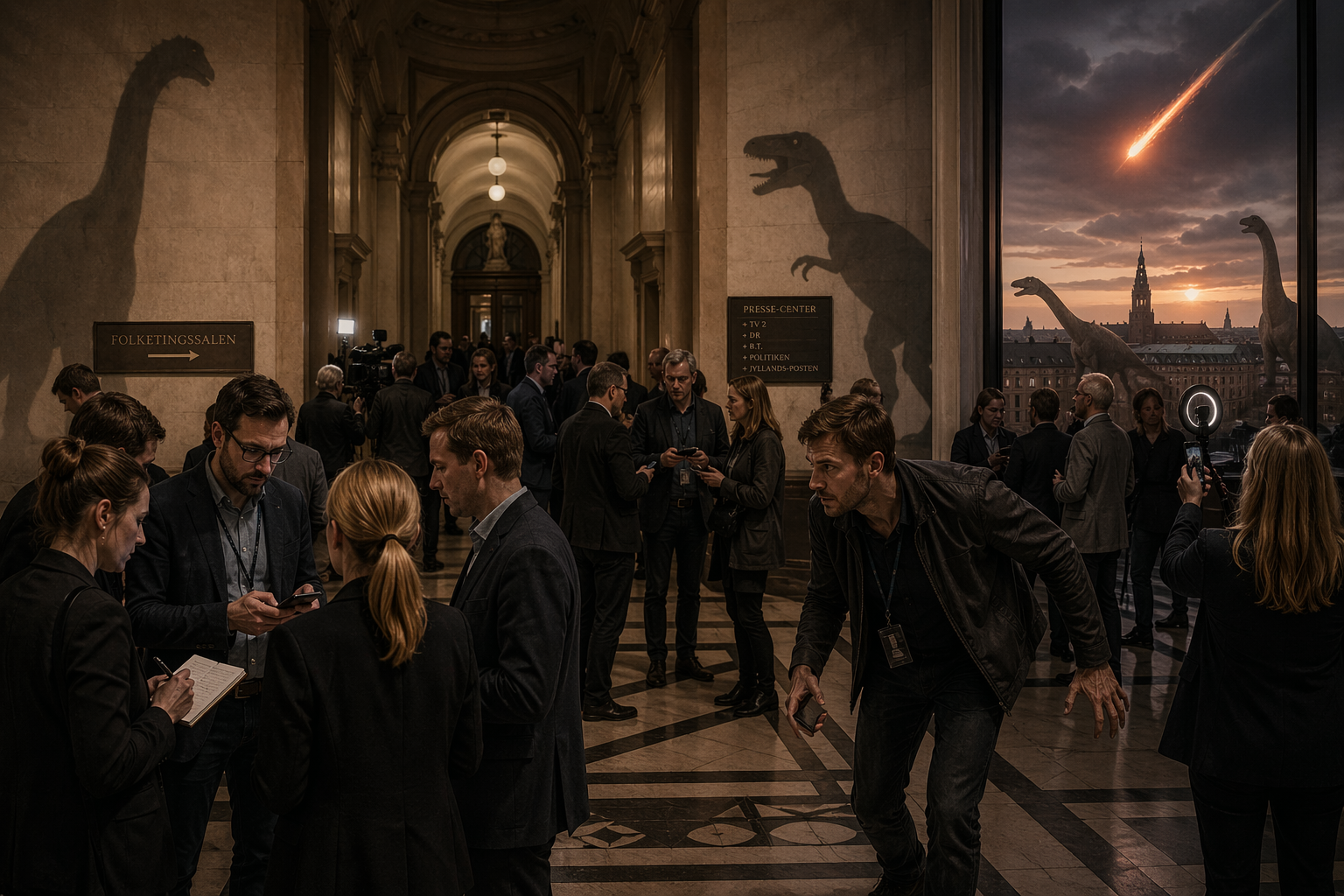
Walking into the Folketing on Denmark's election night in March as a member of the press, I found everything looked familiar. The corridors were full, as expected. The air carried that warm blend of chatter and urgency that always accompanies power in motion. And yet, there was an odd undertone. Not dramatic. Just a faint sense that what I was looking at belonged slightly more to yesterday than to tomorrow.
Stepping back for a moment, the impression sharpened. I could almost believe I had wandered onto the set of The Land That Time Forgot, a 1970's film about a hidden world where dinosaurs survive long after their time has passed.
The journalists moved in herds. Calm, methodical, creatures of habit. Think Diplodocus rather than predator. They drifted between offices and press points like long-necked grazers moving from one political watering hole to another. Heads lowered, ears half-tuned, always alert to the next quote, the next whisper, the next small edge. It is a ritual as old as the trade itself, and performed with the quiet confidence of repetition.
Among them was a newer species. Influencers. Tighter, quicker, louder. Where the journalists grazed, these hunted. Not for facts, but for attention. More like velociraptors. Lean, reactive, constantly scanning for movement, ready to pounce on whatever might pass for relevance in the moment.
Two different species. Different instincts. But with the same certainty that they understood the terrain.
But watching them, it was hard to shake a simpler thought. Neither of them really did.
Because the landscape is already shifting. Not in a way you can point to in a single moment. More like a slow change in climate. Subtle, then undeniable. The kind that does not remove species overnight, but makes them gradually unfit for the world they thought they understood.
Call it AI if you want. It is part of it. But the bigger change is structural.
For years, journalism has rested on a quiet assumption. That effort equals value. Turn up, do the work, file the story, and the system around you will take care of the rest. Distribution, audience, revenue, all handled somewhere else, by someone else. You write. Others make it matter.
It was always a convenient division. It is now an obsolete one.
I was reminded of a jounalist I worked with in the early 1990s at The Daily Telegraph in London. He was permanently at his desk. Never out in the pub for lunch, never drifting, rarely even standing. Occasionally, he would make a short pilgrimage to the coffee machine, then return immediately, as if the change might not quite suit him.
One day, he stood up mid-morning and put on his coat.
“Where are you going?” someone asked.
“I’m going out,” he said.
There was a pause. Then a voice from across the room, amused but not entirely joking, asked, “Are you sure you know what outside looks like?”
Everyone laughed. Not him, he didn't get it.
That joke lands differently now.
Because a great deal of the industry still behaves like that journalist. Busy, diligent, enclosed. Deeply engaged in its own processes, yet oddly detached from the wider reality reshaping it. The routines feel solid. The assumptions feel safe.
They are neither.
Writing alone is no longer enough. Nor is visibility. Nor is access. Each of those used to be a role. Now they are just fragments of a much larger task.
The people who will endure are the ones who can do the entire job. Find the story, shape it, publish it, distribute it, and make it sustainable. No clean handoffs. No invisible infrastructure doing the heavy lifting. Just a continuous line from idea to audience.
The old journalistic herds will struggle. The influencer ego hunters will too. One depends on routine, the other on noise. Both are poorly suited to a world that rewards adaptability over habit and substance over performance.
What comes next is smaller, sharper, and more self-contained. Less comfortable, certainly. But far more real.
Years ago, when people asked what I did at whatever publication I happened to be working for, I would usually say, “I am the toilet cleaner, the one who does everything.” It was meant as a joke. It usually worked.
Only later did it become clear that it was not a joke at all.
It was a journalist's job description for the future.
The future belongs to the all-knowing, all-doing creator.
But I prefer a term I coined the last time someone asked what I did.
"I am the omnicreator."