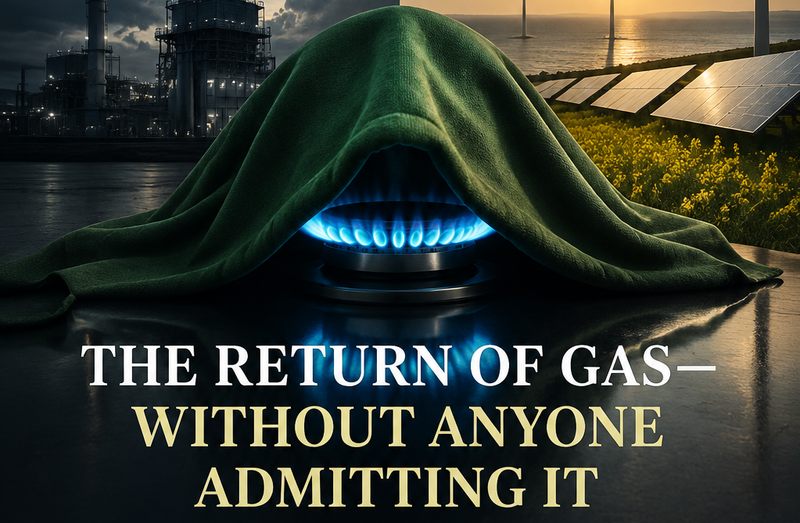
The Return of Gas - Without Anyone Admitting It
By David A. Williams
Every era has its political taboos. Some ideas may be privately acknowledged in cabinet rooms, accepted by engineers and quietly reflected in investment decisions, yet remain almost unspeakable in public because they disrupt the story governments wish to tell. In the twenty-first century, natural gas has become one of those subjects. Listen carefully to the language surrounding Europe's energy transition, and one could easily conclude that gas belongs to history, destined to disappear beneath a rising tide of offshore wind, solar farms, artificial intelligence and hydrogen. Yet electricity systems have an irritating habit of refusing to participate in political theatre. They recognise no manifestos, applaud no speeches and remain entirely indifferent to ministerial optimism. Their only concern is whether sufficient electricity exists at precisely the moment somebody reaches for a light switch. It is in that unforgiving distinction between narrative and physics that one of Europe's most quietly fascinating contradictions is emerging. Gas has not returned because it never entirely left. What has changed is that almost nobody wishes to acknowledge the role it still performs.
Denmark illustrates this paradox better than almost any country on Earth. It has earned its international reputation as a pioneer of renewable energy honestly. Few nations have demonstrated greater ingenuity in harnessing offshore wind, integrating district heating, constructing sophisticated electricity markets and proving that decarbonisation need not come at the expense of prosperity. Successive governments have built an energy model that many larger economies now seek to emulate, and with good reason. Yet success has produced its own peculiar form of intellectual discomfort. The more impressive the renewable revolution becomes, the less willing politicians appear to discuss the occasions when renewables alone are insufficient. Those occasions are neither frequent nor catastrophic, but they are real. Northern Europe periodically experiences long stretches of calm weather accompanied by weak winter sunlight, conditions known in Germany as Dunkelflaute. During these episodes, the elegant certainty of climate policy gives way to the untidy reality of operating an advanced industrial society. Hospitals cannot suspend operations because atmospheric conditions have become inconvenient. Data centres cannot inform artificial intelligence that it should resume processing when the wind improves. Railways, factories, communications networks and military installations all continue consuming electricity with complete indifference to meteorology.
This is where the political conversation becomes unexpectedly revealing. Few governments now speak enthusiastically about natural gas, yet almost every electricity system still plans around its availability. The vocabulary has simply changed. Ministers discuss flexibility instead of gas, resilience instead of gas, balancing services instead of gas, and strategic reserves instead of gas. The fuel itself gradually disappears from official speeches even as infrastructure planners continue ensuring that sufficient dispatchable capacity remains available for precisely those moments when nature decides not to cooperate. It is an extraordinary exercise in democratic linguistics. Society has not eliminated dependence on controllable generation. It has merely renamed it. History suggests that civilisations frequently solve political problems by changing the language before changing reality. The Roman Empire continued evolving long after it ceased calling itself a republic. Colonial empires became commonwealths. Bailouts became market stabilisation. Gas, it seems, has become flexibility.
There is a deeper philosophical question hidden beneath this semantic transformation. For much of modern history, energy policy has been built around abundance. Coal offered abundance, then oil, then natural gas itself. Renewable energy introduces a different civilisational logic. It asks societies not merely to consume energy but to live with patterns established by nature. The future electricity system increasingly resembles agriculture rather than manufacturing. Farmers have always understood that harvests depend upon forces beyond human control. Energy planners are rediscovering the same lesson, albeit with algorithms instead of almanacs. Artificial intelligence may forecast wind speeds with astonishing precision, optimise battery charging down to milliseconds and orchestrate millions of connected devices simultaneously, but it cannot negotiate with the atmosphere. Software can become infinitely more intelligent while the weather remains gloriously irrational. The coming Cognitive Grid, remarkable though it will be, cannot optimise electricity that has not first been generated.
Perhaps this explains why gas has quietly acquired an entirely different strategic identity. It is no longer the dominant fuel that powered Europe's economic expansion during previous decades. Instead, it increasingly resembles something closer to a constitutional safeguard. Democracies insure banks they hope will never fail. They maintain armed forces they hope never need to fight. They stockpile medicines for pandemics that may never arrive. Increasingly they are discovering that dispatchable generation belongs within the same category. Its value lies not in daily utilisation but in preserving confidence that exceptional circumstances will remain manageable. Insurance has always appeared wasteful until precisely the moment it becomes indispensable. The political difficulty arises because voters are rarely enthusiastic about paying for infrastructure whose greatest achievement is preventing disasters that never happen. Success becomes invisible.
There is another irony here that deserves more attention. Europe rightly concluded after Russia's invasion of Ukraine that energy dependence represented a strategic vulnerability as much as an economic one. Diversification became an imperative rather than a preference. Yet diversification itself requires accepting that resilience often looks inefficient. A perfectly optimised electricity system, stripped of every apparently redundant asset, may also become a dangerously fragile one. Engineers have long understood that resilience requires spare capacity, alternative routes and occasional duplication. Economists have traditionally viewed those same characteristics as unnecessary costs. Geopolitics increasingly sides with the engineers. The world after 2022 has reminded governments that resilience carries a price, but fragility carries a far greater one.
This raises an uncomfortable possibility. Perhaps the next phase of the energy transition will not primarily concern replacing one fuel with another. Perhaps it will involve replacing a philosophy. For decades Western governments measured success through efficiency, reducing inventories, eliminating redundancy and extracting maximum value from every asset. Electricity systems are beginning to move in the opposite direction. Spare capacity, strategic reserves and backup generation are returning to favour, not because technology has failed, but because geopolitical uncertainty and climatic variability have changed the definition of security itself. The future grid may therefore become simultaneously cleaner and more conservative, embracing innovation while rediscovering the virtues of redundancy that previous generations regarded as simple common sense.
Natural gas occupies an awkward place within this transformation because it embodies an inconvenient truth. It reminds us that transitions are rarely linear. Civilisations seldom replace one technology with another in a single decisive moment. They accumulate layers. Horses continued transporting goods long after railways appeared. Steamships sailed beside sailing vessels for decades. Printed newspapers survived the arrival of the internet far longer than anyone predicted. History is untidy because societies cannot afford abrupt discontinuities in essential systems. Energy, perhaps more than any other sector, evolves through overlap rather than replacement.
This is why the real debate should not be whether gas has returned. That question mistakes visibility for importance. The more interesting question is whether politics has become increasingly uncomfortable with admitting that resilience sometimes requires living with temporary contradictions. Denmark will almost certainly continue expanding renewable energy faster than most of the world. Artificial intelligence will make electricity networks more intelligent than any previous generation imagined possible. Long-duration storage will mature, hydrogen will find commercially viable applications, and entirely new technologies will emerge that today remain confined to laboratories. Yet until the day arrives when those innovations can guarantee reliable electricity through every winter calm and every geopolitical crisis, natural gas will remain quietly present, seldom celebrated, occasionally criticised and repeatedly relied upon.
The irony is almost literary. The fuel that once symbolised Europe's dependence may ultimately become the bridge that allows Europe to complete its independence. History has a habit of preserving what politics has already declared obsolete. Electricity, unlike ideology, is incapable of wishful thinking. It simply asks whether the lights remain on. Everything else is commentary.
Sources and evidence used
- The article is an original analysis rather than a summary, but it draws on established evidence and concepts from the following authoritative sources:
- The International Energy Agency , particularly its Electricity Market Reports , World Energy Outlook , and analyses of electricity security and flexibility.
- The European Network of Transmission System Operators for Electricity , including Winter Outlooks, Seasonal Outlooks and adequacy assessments on European power system reliability.
- Energinet publications on Danish electricity security, balancing markets, system operation and renewable integration.
- The Danish Energy Agency reports on Denmark's energy mix, security of supply and long-term energy planning.
- Research on "Dunkelflaute" from European energy researchers, including studies by the Fraunhofer Institute for Solar Energy Systems and other academic institutions examining prolonged low wind and solar events.
- European Commission analyses on electricity market design, flexibility, capacity mechanisms and REPowerEU.
Author's note: All analyses, interpretations, and opinions in this article are original. They are based on the publicly available facts contained in the sources above but do not reproduce or reflect the analysis or editorial positions of those sources.