Europe Escaped One Energy Trap. It May Already Be Walking Into Six Others
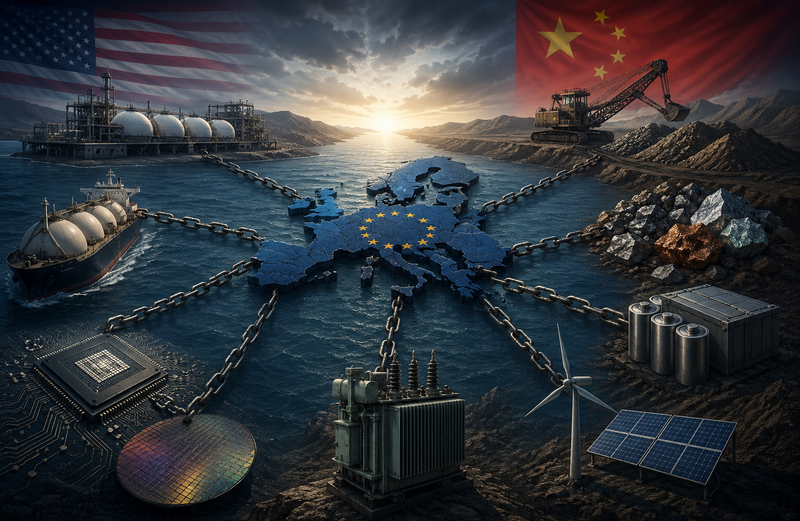
When Russian gas pipelines began shutting down after Moscow's invasion of Ukraine, Europe responded with remarkable speed. Floating LNG terminals appeared almost overnight. Imports from Norway surged. American liquefied natural gas crossed the Atlantic in record volumes, while governments declared that Europe had broken free from decades of Russian energy coercion. It was an extraordinary achievement, one that few analysts believed possible in early 2022. Yet geopolitical victories often conceal strategic compromises. Europe may have reduced its dependence on Russian gas, but the broader question remains unsettling. Has the continent simply exchanged one form of vulnerability for several others?
By David A. Williams
The numbers suggest a remarkable transformation. Before the war, Russia supplied around 40 percent of the European Union's natural gas. That figure has fallen dramatically through sanctions, market diversification and infrastructure investment. According to the International Energy Agency (IEA), LNG has become the backbone of Europe's new energy security architecture, with the United States emerging as its dominant supplier. The U.S. accounted for almost half of Europe's LNG imports in 2023, making Washington not merely an ally but a critical pillar of European energy stability. The dependency is politically comfortable today because strategic interests align. That does not guarantee they always will.
History rarely repeats itself exactly, but it often echoes. Europe spent decades assuming Russian gas would remain insulated from politics because economic interdependence supposedly benefited both sides. That assumption collapsed spectacularly. There is little reason to believe every future supplier relationship will remain immune from geopolitical disruption. American LNG exports depend upon domestic political priorities, environmental regulation, shipping capacity, hurricanes affecting Gulf Coast terminals and growing Asian demand. A future administration in Washington facing domestic energy shortages or inflationary pressure could legitimately prioritise American consumers over European markets. Markets respond to price signals, not alliances.
Energy, however, is only the visible layer of Europe's strategic exposure. Beneath it lies a far more complex web of industrial dependencies that receive significantly less political attention.
Take critical minerals. The clean energy transition depends upon lithium, cobalt, graphite, nickel and rare earth elements. Although these materials are extracted across multiple continents, China dominates refining and processing. The International Energy Agency estimates that China controls around 60 percent of global lithium refining, approximately 70 percent of cobalt processing and well over 90 percent of rare earth separation. Raw materials can originate elsewhere, but without Chinese industrial capacity they cannot become batteries, electric motors or advanced defence components. Europe has enthusiastically embraced electrification while remaining deeply reliant on supply chains it cannot independently control.
The same strategic imbalance exists within battery manufacturing. Despite ambitious initiatives under the European Battery Alliance, China continues to dominate global battery production capacity. Benchmark Mineral Intelligence projects that Chinese firms will remain responsible for the majority of worldwide lithium-ion battery manufacturing throughout this decade. European automotive manufacturers increasingly depend upon Chinese technology, investment or joint ventures even as political tensions deepen between Brussels and Beijing. Strategic autonomy sounds compelling in speeches. Industrial reality tells a different story.
The semiconductor sector presents another uncomfortable paradox. Europe's ambitions for digital sovereignty have accelerated through the European Chips Act, yet advanced semiconductor manufacturing remains concentrated in East Asia. Taiwan produces the overwhelming majority of the world's cutting-edge chips, while South Korea and increasingly the United States occupy other critical segments of the supply chain. The COVID-19 pandemic demonstrated how fragile these production networks can become when logistics fail. Modern economies no longer run on oil alone. They run on microchips embedded in everything from fighter aircraft and hospital equipment to automobiles and electricity grids.
Even the electricity grid itself reveals overlooked vulnerabilities. Europe's renewable transition requires thousands of high-voltage transformers capable of integrating new generation capacity. Yet transformer manufacturing has become a global bottleneck. Utilities across Europe and North America report waiting periods extending beyond two years for critical equipment, driven by shortages of electrical steel, specialised manufacturing capacity and skilled labour. The result is that investment capital exists, renewable projects receive approval, yet infrastructure cannot always be delivered on schedule. Grid resilience increasingly depends upon manufacturing capacity rather than political ambition.
Rare earth elements deepen this strategic dilemma further. Despite the name, they are not especially rare in geological terms. The challenge lies in environmentally intensive processing, an industry China has patiently cultivated for decades while Western economies outsourced much of the value chain. Wind turbines, precision-guided missiles, naval propulsion systems and advanced radar all rely upon these materials. Defence industrial policy and climate policy have quietly become inseparable.
This convergence creates an uncomfortable strategic picture. Europe has diversified energy imports but not necessarily systemic risk. Instead of one dominant dependency centred on Russian pipelines, it now faces a network of interlocking dependencies stretching across American LNG terminals, Chinese mineral processing facilities, Taiwanese semiconductor foundries and globally constrained industrial manufacturing. Diversification has increased resilience against any single shock, yet it has also expanded the number of potential pressure points available to geopolitical rivals.
The lesson extends beyond Europe. Economic globalisation created extraordinary efficiency precisely because production concentrated where comparative advantage existed. Strategic resilience requires something different. It values redundancy, domestic capacity and trusted partnerships even when they appear economically inefficient. The world is entering an era where resilience carries a measurable price tag.
For policymakers, the challenge is no longer simply reducing dependence on adversaries. It is identifying dependencies before they become crises. For investors, the implications are equally profound. Critical minerals, transformer manufacturing, semiconductor fabrication, energy storage and strategic logistics are no longer niche industrial sectors. They are becoming the foundations of geopolitical power. Capital increasingly follows security.
Journalists should perhaps ask a different question as well. The story is not whether Europe escaped Russian gas. It clearly did. The more important question is whether the continent has fully understood the architecture of its new dependencies before another geopolitical shock forces that lesson upon it.
Strategic autonomy has become one of Brussels' favourite phrases. Achieving it, however, demands far more than replacing one supplier with another. It requires rebuilding industrial ecosystems that Europe allowed to migrate overseas over several decades. That process will take years, perhaps generations. Until then, Europe's energy transition will remain not merely an environmental project, but an exercise in geopolitical risk management.
Sources: International Energy Agency (IEA), World Energy Outlook and Critical Minerals Market Review; European Commission, European Chips Act and Critical Raw Materials Act; Benchmark Mineral Intelligence; International Renewable Energy Agency (IRENA); European Court of Auditors, reports on EU strategic autonomy and critical raw materials.