Denmark's Quiet Rise as Europe's Energy Superpower
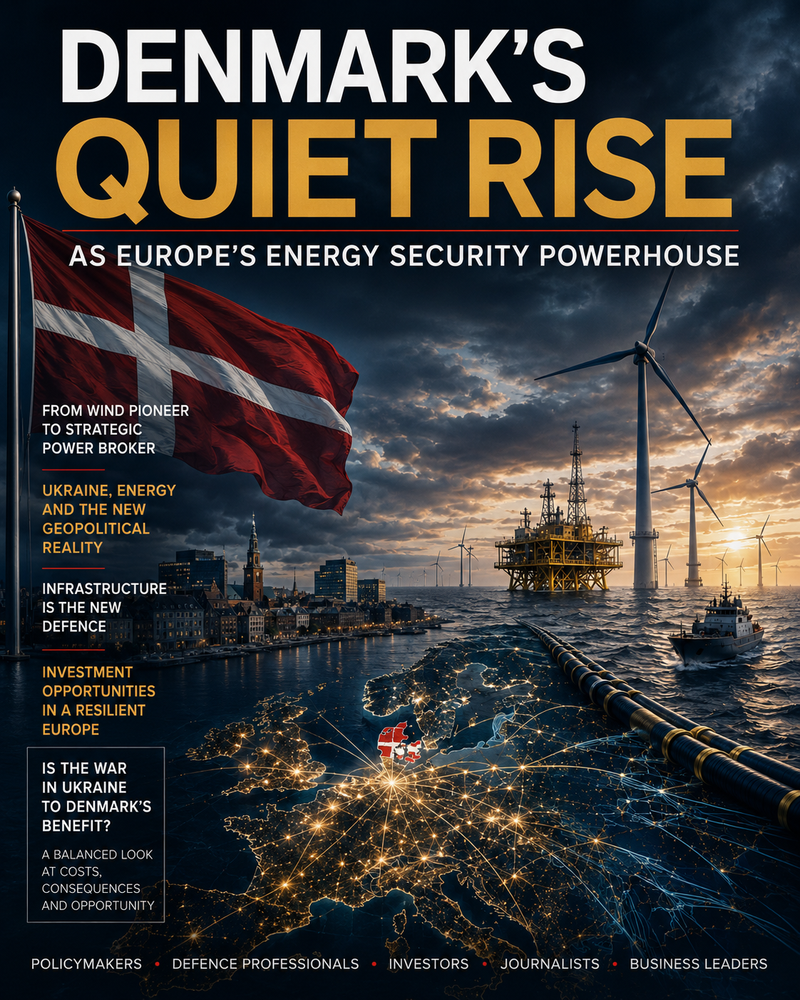
Wars reshape maps, topple governments, and destroy economies. They also create winners, although few are willing to admit it while the fighting continues. Russia's invasion of Ukraine has been an unmitigated catastrophe for millions of people. Yet geopolitics is rarely sentimental. It rewards preparation more than intention. And if there is one European country that appears to have emerged with considerably greater strategic importance than before February 2022, it is Denmark.
By David A. Williams
That is an uncomfortable proposition. Copenhagen has been among Ukraine's staunchest supporters, providing military aid, increasing defence spending and absorbing the economic shocks of Europe's energy crisis. Danish households felt the sting of soaring electricity prices like everyone else. But strategic advantage and immediate economic pain are not mutually exclusive. History is full of nations that endured short-term costs while quietly accumulating long-term influence. Denmark may now find itself in precisely that position.
For decades, Danish politicians were accused of treating climate policy as an expensive moral crusade. Wind turbines became symbols of environmental idealism rather than strategic statecraft. Those critics have largely fallen silent. Europe's abrupt divorce from Russian gas has transformed every offshore wind farm, every electricity interconnector, and every kilometre of subsea cable into an asset of geopolitical significance. What once looked like climate policy increasingly resembles national security policy by other means.
This is where Denmark's position becomes especially interesting. Unlike many larger European economies, it entered the crisis with decades of experience in offshore engineering, renewable electricity, maritime logistics, and cross-border energy integration. The expertise accumulated through the North Sea oil industry evolved naturally into global leadership in offshore wind. That was never designed as a geopolitical strategy. Nevertheless, it has become one.
The real story is not about turbines. It is about power, both electrical and political. Europe is entering an era in which electricity will underpin almost every sector of economic activity, from artificial intelligence and advanced manufacturing to defence production and transport. Countries that can generate abundant, reliable, and secure electricity will enjoy advantages that extend far beyond lower carbon emissions. They will attract data centres, battery factories, semiconductor investment and energy-intensive industries seeking stability in an increasingly volatile world.
Denmark has recognised this shift earlier than most. The country is no longer exporting only technology; it is exporting resilience. That resilience carries value because Europe has discovered, rather painfully, that energy dependence is simply another form of strategic dependence. Moscow weaponised gas. Beijing dominates many of the minerals and manufacturing processes essential for the green transition. Washington remains indispensable through liquefied natural gas and advanced technologies. European strategic autonomy remains more aspiration than reality.
The irony is striking. Europe spent years debating energy through the language of climate targets, emissions trading, and sustainability reports. Vladimir Putin reframed the conversation almost overnight. Energy became a deterrent. Pipelines became vulnerabilities. Offshore infrastructure became military targets. Following the sabotage of the Nord Stream pipelines, protecting energy infrastructure moved from the remit of utility companies to that of navies, intelligence agencies and defence ministries. Denmark, sitting astride some of Europe's most important maritime infrastructure, suddenly became far more significant than its size would suggest.
None of this guarantees lasting success. Denmark's advantage is real, but it is not permanent. Germany is accelerating investment in grid infrastructure. Poland is embracing nuclear energy. The Netherlands is expanding offshore capacity. Norway remains Europe's energy giant. Meanwhile, Chinese manufacturers continue to dominate global clean-energy supply chains, often at prices European firms struggle to match. Strategic leadership is not something that can be banked indefinitely; it must be defended through continued innovation, investment, and political coherence.
There is another question that policymakers should confront, however uncomfortable it may be: has the war in Ukraine ultimately strengthened Denmark's strategic position? Economically, certain sectors have undoubtedly benefited. Offshore engineering firms, defence contractors, port operators, cybersecurity companies and energy infrastructure specialists are operating in an environment where demand is likely to remain elevated for years. Copenhagen's influence within both the European Union and NATO has also grown as energy security has become inseparable from collective security.
Morally, however, the answer remains very different. No democratic nation should regard a war that has devastated Ukraine and destabilised Europe as beneficial. The destruction of cities, the displacement of millions, and the human cost cannot be offset by stronger export markets or increased geopolitical relevance. To argue otherwise would be both callous and strategically short-sighted. Yet acknowledging that Denmark has become more influential because of the conflict is not the same as celebrating the conflict itself. Policymakers must be mature enough to distinguish between opportunity created by circumstance and opportunity deliberately sought.
The deeper lesson extends well beyond Denmark. Europe's next great strategic competition is unlikely to revolve around fossil fuels. It will revolve around who owns the grids, who secures the cables, who builds the offshore infrastructure, who controls electricity storage, and who supplies the technologies that keep modern economies running. Military power will remain essential, but economic resilience and energy resilience are becoming equally decisive measures of national strength.
Denmark did not set out to become one of Europe's energy powerhouses. It simply invested consistently in capabilities that many of its neighbours dismissed as peripheral. Ukraine has changed that calculation forever. The countries likely to shape Europe's future will not necessarily be those with the largest populations or the biggest defence budgets. They may instead be those who quietly mastered the infrastructure on which Europe's security, prosperity, and industrial competitiveness increasingly depend. Denmark is one of them, and that may prove to be one of the least appreciated geopolitical consequences of the war.