Denmark's AI Grid Could Become Europe's Most Valuable Energy Export
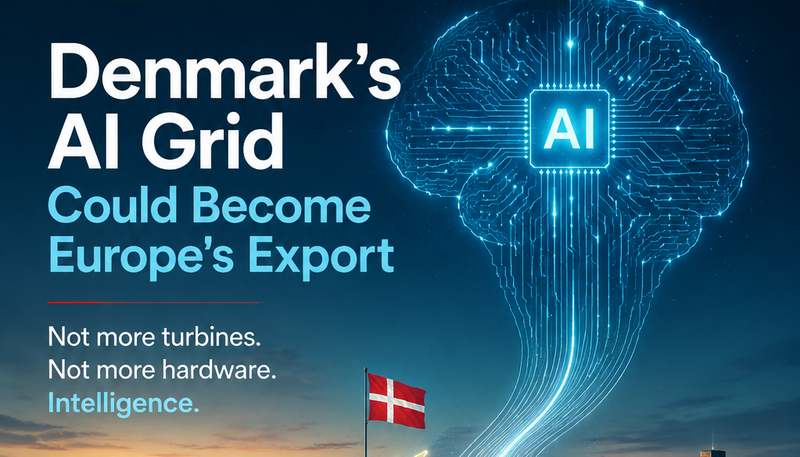
Denmark built one of the world's smartest energy systems. The next export may not be another turbine or transformer, but the intelligence that allows an entire electricity system to think.
By David Williams
For half a century, Denmark has become synonymous with exporting physical energy technology. The country's global reputation rests on towering offshore wind turbines, highly efficient district heating systems, advanced power electronics and an electricity market that many governments quietly study before attempting their own reforms. Danish engineering became an international brand because it solved practical problems. When countries wanted cleaner electricity, they bought Danish hardware.
That assumption may soon become outdated. The next great Danish export may have no blades, no steel and no concrete. It may be invisible.
Artificial intelligence is beginning to transform electricity systems in a way that resembles what operating systems did for personal computers during the 1980s. Before Windows and macOS, computers were collections of expensive components that required specialist knowledge to operate. The operating system connected processors, memory, storage and software into something that ordinary people could use. Electricity networks are approaching a similar moment. They already contain millions of individual assets, from offshore wind farms and district heating plants to batteries, electric vehicles, rooftop solar panels and industrial consumers. What has largely been missing is the intelligence capable of coordinating them all simultaneously. AI changes that equation.
Few countries are better positioned than Denmark to build such a system because the necessary ingredients already exist. Denmark possesses one of the world's most sophisticated district heating networks, supplying around two-thirds of households. It operates one of Europe's most mature offshore wind sectors. Smart meters are widespread, electricity markets reward flexibility, consumers increasingly participate in demand response programs, and digital infrastructure is deeply embedded throughout the energy economy. Individually, these are impressive achievements. Together they form something far more interesting. They create the foundations of what might become the world's first genuinely national cognitive energy system.
The distinction matters because the value increasingly lies not in the physical assets but in the intelligence that orchestrates them. Wind turbines generate electricity. AI decides which batteries should charge, which factories should temporarily reduce consumption, when district heating systems should store excess renewable power as heat, how electric vehicle charging should be staggered overnight, and which electricity prices encourage consumers to shift demand without even noticing. Every second becomes an optimization problem. Every connected device becomes part of a national conversation.
This is where Denmark's opportunity begins to diverge from traditional energy policy. For decades, governments competed to manufacture turbines, solar panels, and electrical equipment. Those industries have become brutally competitive, dominated by global manufacturing giants operating at enormous scale. Software follows very different economics. Once developed, algorithms can be replicated almost indefinitely with relatively little additional cost. The country that develops the best energy operating system does not simply sell machines. It licenses intelligence.
Imagine a future in which another European country builds an offshore wind farm. The turbines might be manufactured in Germany, Spain or South Korea. The transformers could come from France. The cables might arrive from Italy. Yet the entire system could be managed by Danish software continuously learning from millions of previous operating decisions made across Denmark's electricity network. Denmark would not merely export technology. It would export experience encoded into algorithms.
This possibility becomes even more compelling because AI improves with scale. Every weather pattern, every consumer behaviour, every unexpected equipment failure, and every market fluctuation teaches the system something new. Unlike physical infrastructure, intelligence compounds. The more complex the electricity network becomes, the more valuable sophisticated coordination becomes. Denmark's relatively small geography actually becomes an advantage. It offers a manageable national laboratory where technologies can be deployed rapidly before being exported across Europe.
The implications stretch well beyond economics. Europe increasingly speaks about energy sovereignty, strategic autonomy and reducing dependence on external suppliers. Much of that discussion focuses on physical infrastructure. Yet future dependence may arise just as easily through software. If electricity systems become AI-managed, whoever writes the algorithms may influence how power flows across the continent. Questions once reserved for engineers become matters of industrial policy and even national security. Who controls optimization? Who owns operational data? Whose AI decides which parts of the network receive priority during moments of stress?
Denmark has already demonstrated an unusual ability to integrate energy policy, digital governance and public trust. Danish consumers have historically accepted technologies that might encounter resistance elsewhere because institutions generally enjoy relatively high levels of confidence. That trust creates valuable data. Valuable data creates better algorithms. Better algorithms attract further investment, creating a feedback loop that becomes difficult for competitors to replicate.
There is also an important cultural advantage. Danish energy policy has rarely been driven by ideological spectacle. It has usually evolved through pragmatic experimentation involving municipalities, utilities, universities, regulators and private companies working together. AI development benefits from precisely this kind of ecosystem. It requires continuous testing, collaboration and refinement rather than dramatic technological breakthroughs. Denmark has spent decades quietly building the institutional relationships that cognitive energy systems will require.
This does not mean success is inevitable. Cybersecurity risks multiply as intelligence becomes centralized. Regulatory frameworks remain fragmented across Europe. Utilities remain cautious organizations for understandable reasons. Consumers will need confidence that increasingly autonomous systems act transparently and fairly. AI models are only as good as the data they receive, and energy systems cannot tolerate the kinds of errors that social media platforms sometimes survive. Building a cognitive grid therefore becomes as much a governance challenge as a technological one.
Even so, history suggests that countries rarely dominate industries by simply manufacturing products. They succeed when they define the architecture upon which others build. Britain exported railway engineering. America exported internet platforms. Estonia exported digital government. Denmark now has an opportunity to define the operating logic of intelligent electricity itself.
Perhaps that is the most provocative way to think about Denmark's energy future. For years the country's success has been measured by how many wind turbines it could build or how much renewable electricity it could generate. Those achievements remain remarkable, but they may not represent the country's ultimate competitive advantage. The real prize may be the intelligence that coordinates an entire energy system so efficiently that other nations decide to adopt the same digital architecture.
The next chapter of Denmark's energy story may therefore be written not in steel, but in code. The country's greatest export may no longer stand on the horizon turning in the North Sea. It may sit quietly inside data centers, continuously learning, constantly optimizing and invisibly helping electricity systems across Europe think for themselves.
Sources
- International Energy Agency reports on digitalisation, AI and electricity systems.
- International Energy Agency, Electricity 2025 and publications on AI's growing electricity demand.
- Energinet publications on Denmark's electricity market, grid balancing and digitalisation.
- Danish Energy Agency reports on district heating, offshore wind and smart energy systems.
- State of Green case studies on integrated Danish energy infrastructure.
- European Commission initiatives on the Action Plan for the Digitalisation of the Energy System and the AI Continent strategy.
- Research from the Technical University of Denmark and Aalborg University on smart grids, energy AI and sector coupling.
Author's note: All analyses, interpretations, and opinions in this article are original. They are based on the publicly available facts contained in the sources above but do not reproduce or reflect the analysis or editorial positions of those sources.
And if articles like this resonate with you, subscribe to the LinkedIn Newsletter: Sphere Magazine
Visit our website: www.spheremag.dk