Denmark Has Begun to Ration the Digital Future
By David A. Williams
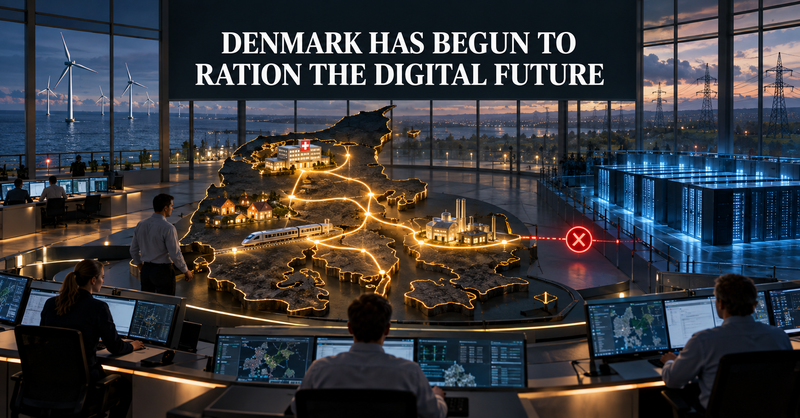
For years, Denmark has behaved as though the electricity grid were an accommodating national host: build the wind turbines, invite the investors, electrify transport, replace gas boilers, manufacture hydrogen and welcome the data centers, then trust that sufficient capacity will somehow arrive before everybody sits down to dinner. That assumption has now collided with physics. Under emergency legislation published by the government, access to the grid would no longer be governed principally by the order in which applications were received. Households, small businesses, critical infrastructure and projects supporting electrification and the green transition would be placed ahead of most new data centres. The servers may be intelligent, but they will have to wait their turn. This is more than an administrative adjustment. Denmark is beginning to treat electricity capacity as a strategic national resource whose allocation must reflect political priorities rather than the purchasing power of whoever reaches the connection desk first.
The immediate cause is a queue that has become detached from economic reality. Energinet reportedly received applications for around 60 gigawatts of new electricity connections, including approximately 14 gigawatts associated with data centres, while Denmark's existing peak demand is roughly seven gigawatts. Not all those projects will ever be built. Developers often submit speculative applications, reserve possible locations or seek several potential connections before deciding where to invest. Yet a fictitious megawatt can obstruct a real one if it occupies a place in the queue. Denmark has therefore encountered a peculiarly modern shortage: not necessarily an absolute lack of electricity, but a lack of confidence about who genuinely needs it, where they need it and whether the promised economic value will justify the infrastructure that society must construct on their behalf.
The old first-come, first-served principle sounded fair because it spared the state from making uncomfortable choices. In practice, it converted timing into entitlement. A speculative data-centre proposal could stand ahead of a factory prepared to electrify its production, a district-heating project replacing fossil fuels or a transport connection needed by an expanding town. That is not a neutral market outcome. It is simply public policy wearing an invisibility cloak. Electricity grids are financed, planned, regulated and ultimately protected by society; pretending that their limited capacity can be distributed without political judgment does not remove politics from the process. It merely allows private applications to establish national priorities by accident.
Data centers have become the obvious target because their appetite for electricity is immense, concentrated and potentially open-ended. Their contribution is also unusually difficult to measure. A pharmaceutical plant produces medicine. An electric railway moves people. A heat pump replaces a recognizable quantity of fossil fuel. A hyperscale computing facility may process Danish hospital records, train a commercial language model, deliver foreign advertising or calculate which video will keep a teenager staring at a screen for another twenty minutes. All of these activities arrive at the substation disguised as identical electrical demand. The grid cannot distinguish between socially valuable computation and industrialized distraction, but governments may increasingly be forced to try. Once computing competes directly with housing, manufacturing and decarbonisation for scarce capacity, the question is no longer whether digital activity has value. It is whose value Denmark is being asked to subsidise.
This does not make data centers dispensable. Denmark needs secure computing capacity if it intends to retain any degree of digital sovereignty, support domestic artificial intelligence, protect sensitive information and reduce its dependence on a small number of foreign cloud providers. Placing every data center permanently at the rear of the queue could therefore produce the opposite of the intended result. The most socially useful Danish or European projects might be delayed alongside enormous foreign facilities carrying workloads of negligible national importance. A serious prioritization system should examine ownership, purpose, energy efficiency, waste-heat utilization, geographical location, operational flexibility and the extent to which a facility supports essential national functions. A data center willing to reduce consumption during periods of grid stress should not necessarily be treated like one demanding uninterrupted power at maximum capacity. "Data center" is a building type, not an adequate category of public value.
The reform nevertheless alters the conversation in a valuable way. For years, technology companies have spoken about computing as though it existed in an ethereal realm called the cloud. The language was commercially brilliant because clouds appear weightless, plentiful and naturally occurring. In reality, artificial intelligence is an electricity-intensive industrial activity involving substations, transmission cables, cooling systems, land, water and enormous quantities of capital equipment. Denmark's new hierarchy strips away the metaphor. A request to build computational capacity is also a request for a share of the country's physical energy system. The state is entitled to ask what it receives in return.
There is a danger, however, that prioritization becomes a substitute for construction. Denmark cannot administer its way out of every bottleneck. Queues must be cleaned of speculative projects, connection rights should carry credible milestones, and developers that reserve capacity without progressing ought to lose their place. Yet transmission and distribution networks must also expand more quickly, permitting must become less tortuous, and large electricity users should be encouraged to locate where renewable generation and grid capacity actually exist. The country should also demand more from applicants. A project claiming strategic importance could be required to show Danish employment, taxable activity, heat recovery, flexibility during peak periods or a meaningful contribution to national computing resilience. If electricity is scarce enough to be rationed, access to it should come with obligations.
The largest significance of this reform may eventually lie beyond data centres. Once Denmark accepts that grid capacity should be allocated according to national purpose, similar questions will arise about hydrogen plants, battery projects, electrified industry and other large consumers. Who decides which project is sufficiently green, productive or strategic? How are politically favored applicants prevented from becoming well-connected rent seekers? Can a government reliably compare the future value of a factory, an artificial-intelligence cluster and a power-to-X facility? There will be lobbying, mistakes and grand projects wearing suspiciously green hats. Transparent criteria, published decisions and enforceable deadlines will be essential because electricity rationing conducted behind closed doors would quickly become industrial patronage.
Still, Denmark has recognized something that many governments continue to avoid. The green transition and the artificial-intelligence boom are not separate revolutions unfolding politely beside one another. They are competing claims upon the same cables, substations, engineers and generating capacity. Electricity is becoming the organizing layer of the economy, which means that decisions about who receives it first will increasingly determine what kind of economy Denmark becomes. The country has not turned against data centers. It has simply rejected the idea that commercial demand, however large or fashionable, automatically constitutes a national priority. That is a decisive change. The digital future will still be built, but Denmark has begun to ask whether every version of that future deserves to be plugged in.
Sources
Bloomberg, republished by Energy Connects: “Denmark Publishes Emergency Grid Law That Puts Data Centers Last”, August 20, 2026.
Eurofound EU PolicyWatch: "Government proposes emergency plan to prioritize electricity grid access over data centers", 19 June 2026.
Tom's Hardware: “Denmark presses pause on new data center grid connections as total requests hit 60 GW”, 6 May 2026.
Copyright © 2026 David A. Williams / Sphere Magazine
Copyright © 2026 David A. Williams / Sphere Magazine