ENERGY

Sphere Magazine asks whether Danish drivers are being overcharged as petrol prices rise quickly in crises but fall slowly afterwards, raising concerns about weak competition, corporate power, and the limits of government regulation in a market-driven system.
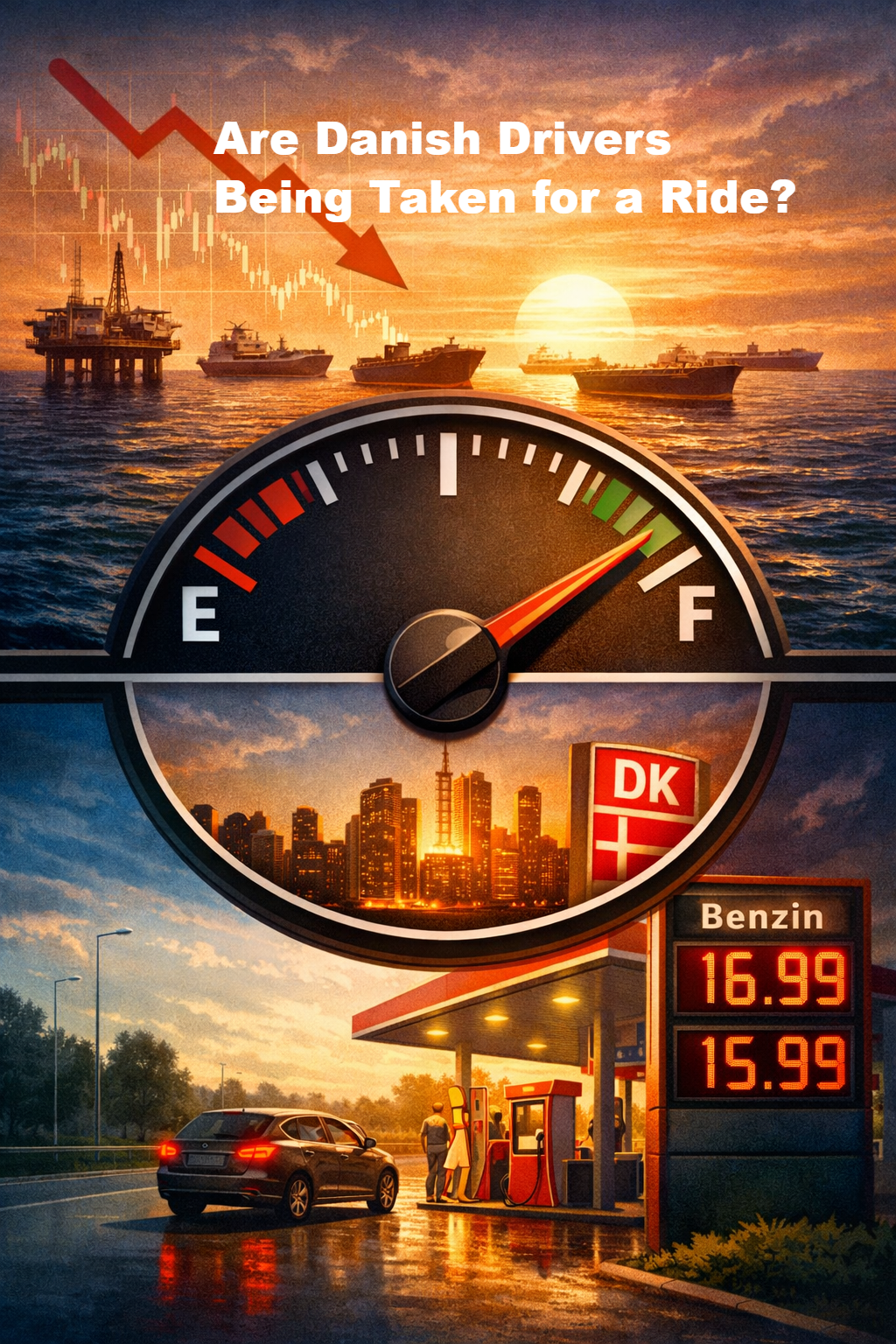
Are Danish Drivers Being Taken for a Ride? Petrol Prices and the Politics of Delay
David Williams
April 10, 2026
Why is petrol still so expensive? It is a simple question, and one more Danish drivers are starting to ask out loud.
When global oil prices rise, the effect is immediate. Prices at the pump climb within days, sometimes within hours. The reasons are always clear enough. Supply is under pressure. Risk is rising. Markets are reacting. Yet when those same pressures ease, the reversal is far less convincing. Prices drift down slowly, if at all. The urgency disappears.
This imbalance is becoming harder to ignore.
Following the recent easing of tensions in the Middle East, crude prices have softened. That should, in theory, bring relief to consumers. But at Danish petrol stations, the change is barely visible. For many drivers, there is no meaningful difference. The numbers remain high, stubbornly so.
Explanations are not in short supply. Fuel retailers point to hedging contracts, to refining costs, to distribution expenses, to the complexity of supply chains. All of these factors matter. None of them fully explain why increases are passed on so quickly, while decreases take their time.
The pattern invites a more uncomfortable line of thought. Are consumers simply at the mercy of a system that reacts faster to crisis than to calm? Or is there a structural incentive to keep prices elevated once they have reached a certain level?
In Denmark, studies have shown that petrol prices tend to move in near lockstep across the country. That kind of uniformity suggests limited competition. In a truly competitive market, one might expect sharper differences, more aggressive undercutting, a clearer fight for customers. Instead, prices often appear coordinated, even if no formal coordination exists.
Meanwhile, energy companies globally have posted strong profits in recent years. That fact does not prove wrongdoing. But it does shape perception. To many, it reinforces the suspicion that crises create opportunities. Prices go up quickly because they can. They come down slowly because they do not have to.
So where does that leave the Danish government?
There is a growing argument that more should be done. Greater transparency might help. Stronger competition oversight could make a difference. Some even suggest temporary intervention when markets behave in ways that seem detached from underlying costs. Fuel is not a luxury good. It is essential. People rely on it to get to work, to run businesses, to live their daily lives.
And yet, regulating this kind of behaviour is not straightforward.
Denmark operates within a broader market economy where intervention has limits. Push too hard, and there is a risk of distorting supply or discouraging investment. Companies may simply shift costs elsewhere or reduce activity. These are not theoretical concerns. They are part of the policymaker’s calculation.
There is also the question of influence. Large energy firms are not marginal players. They are deeply embedded in the economy. They employ thousands, contribute significant tax revenue, and operate across borders. Their reach extends beyond the forecourt. That inevitably shapes the political landscape in which decisions are made.
This is where the debate becomes less about petrol and more about the system itself.
If markets reward companies for maximising profit, and if those companies have the power to defend their position, then outcomes like this may not be an anomaly. They may be a feature. Governments can respond, but only within constraints. The result is a kind of stalemate. Public frustration grows, but meaningful change remains elusive.
For Danish drivers, the issue is no longer abstract. It is visible every time they pull up to a pump. Prices that rise quickly. Prices that fall slowly. Explanations that never quite settle the matter.
So the question lingers.
Is this simply how the market works, or is the balance tilted in ways that leave the consumer consistently on the losing side?
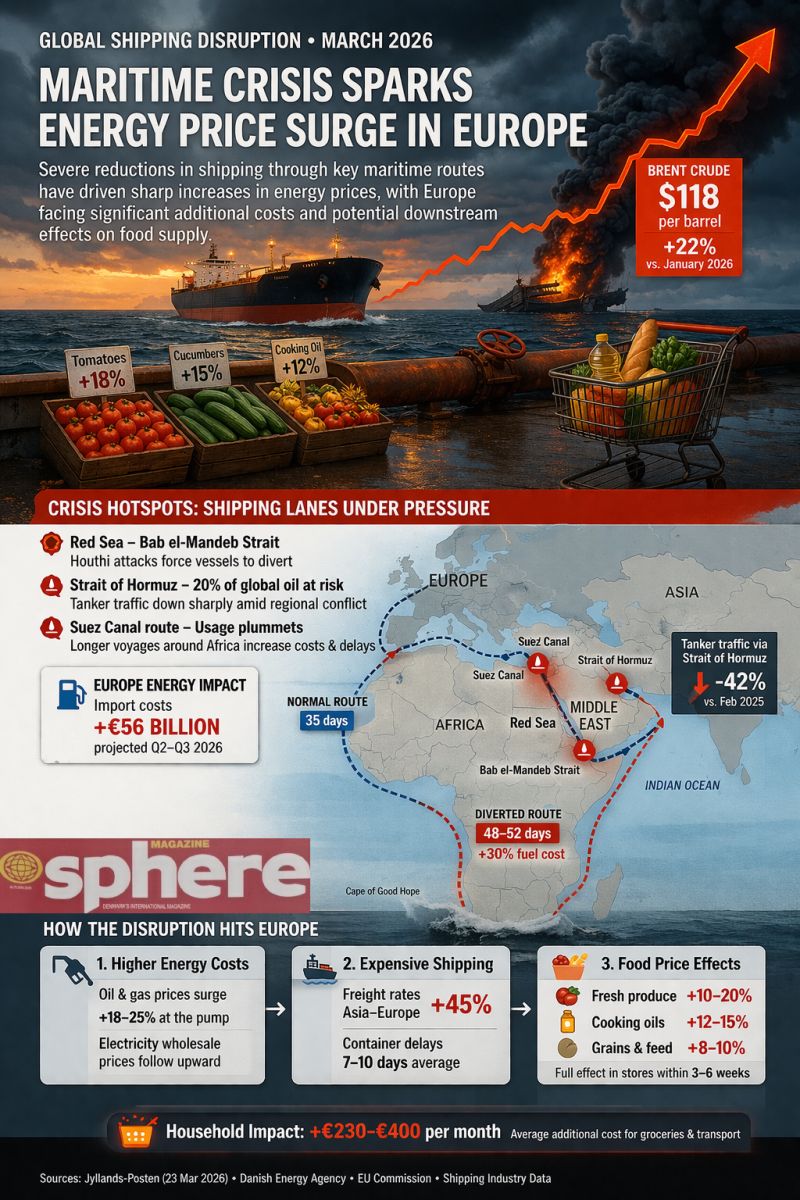
Shockwaves to the Supermarket: How War Reshapes Danish Living Standards
David Williams
March 23, 2026
The war between Israel, the United States, and Iran is not only a military or diplomatic crisis; it is rapidly becoming an economic shock transmitted through global trade. The disruption of key maritime routes, particularly around the Strait of Hormuz, has removed a significant share of oil supply and forced shipping to reroute at far higher cost.
For Denmark, a small, open economy, the consequences are immediate. The first channel is energy. Oil prices above $100 per barrel are no longer a temporary spike but a structural shift driven by constrained supply and geopolitical risk. Electricity and heating costs will rise, feeding directly into household budgets.
The second channel is transport. With shipping diverted around Africa rather than through the Suez Canal, transit times lengthen, increasing fuel use, insurance, and freight rates. These costs cascade through supply chains. Danish importers, from supermarkets to manufacturers, face higher input prices, typically passed on to consumers. The result is renewed inflation, especially in food.
A third channel emerges in agriculture. Disruptions to fertiliser markets and food logistics are pushing prices upward. For Danish households, this means more expensive staples, eroding real incomes. For lower-income groups, the effect is immediate and regressive.
More structurally, Danish industry faces a competitiveness squeeze. Energy-intensive sectors must absorb higher costs while competing in weakening global markets. Investment decisions may be delayed, deepening uncertainty.
Short-term responses could include targeted relief, energy subsidies, and income support. Yet these only cushion the shock. Long-term resilience requires accelerating renewable energy, diversifying supply chains, and strengthening European coordination.
What was a distant conflict is fast becoming a domestic cost-of-living crisis, embedding geopolitical risk in everyday prices.