After Hegemony: The West’s Reckoning in an Age of Multipolar Reality
March 28, 2026
For a good few decades after the Second World War, the West had things largely its own way. The United States set the rhythm, Europe moved more or less in step, and between them they built the scaffolding of the modern international system. Trade rules, security alliances, and even the way politics is talked about all bore a Western stamp. That influence has not disappeared. But it no longer settles debates by default, and that is a meaningful change.
What is happening now is less a single rupture than a slow accumulation of shifts. The war in Eastern Europe and now the Middle East grinds on without resolution. In Asia, alliances are being reworked, though not always in ways that are easy to follow. Countries that once kept their heads down are acting with more confidence, and often with less interest in picking sides. Meanwhile, economic energy has been drifting elsewhere. Growth looks stronger outside the traditional centres, while many Western economies are dealing with ageing populations and a more fractious political climate.
It is tempting to frame all this as a decline. That feels a bit too neat. The West is still rich, still capable, still influential in plenty of arenas. But it is no longer the axis around which everything else turns. Others are no longer organising themselves in relation to it, and that is a different reality to navigate.
The limits of superiority
Some of the difficulty is simply muscle memory. Western governments have spent years, arguably decades, in a position where setting the terms came naturally. Negotiation often meant presenting a framework and inviting others to sign on. Meeting halfway was not always the instinct.
There is still, at times, a quiet assumption that Western models, economic or political, should carry more weight. Increasingly, that assumption runs into resistance. Governments across Asia, Africa and Latin America are more willing to push back, especially when Western positions appear inconsistent. Sanctions can still bite, but they lose force when large parts of the world decide to sit them out. Influence, it turns out, is harder to exercise without a broad coalition behind it.
The West’s own record has not helped. Free trade is defended in principle but hedged in practice. Appeals to international law are not always even-handed. Domestic politics has become more volatile, making long-term strategy harder to sustain. None of this goes unnoticed. It does, slowly but surely, erode credibility.
A more crowded table
What is emerging is not a tidy new order but something more improvised. More actors have a say. Relationships are looser, sometimes transactional, and often pragmatic. Deals are struck, adjusted, and occasionally dropped altogether.
In that sort of world, being in charge matters less than being useful. Influence depends on whether others see value in working with you, not simply on how much power you can project. For Western countries, that implies a shift in mindset as much as in policy. It means engaging others as peers, even when that feels unfamiliar, and accepting that outcomes will often be partial and, at times, frustrating.
Compromise is not a word politicians tend to embrace, but it is becoming unavoidable. That might mean taking seriously security concerns that do not fit neatly within Western assumptions, or giving emerging economies a greater voice in institutions that have lagged behind reality. These are not dramatic retreats. They are adjustments, albeit uncomfortable ones.
Immigration reconsidered
Seen against this backdrop, the Western debate on immigration can feel oddly narrow. Much of it revolves around pressure, risk, and loss. Those concerns are not invented, but they do not tell the whole story.
Western societies are ageing, in some cases quite quickly. Labour markets are tightening. Public finances will come under strain as fewer workers support more retirees. Immigration, particularly of younger workers, helps ease that pressure. It is not a silver bullet, but without it, the sums become harder to balance.
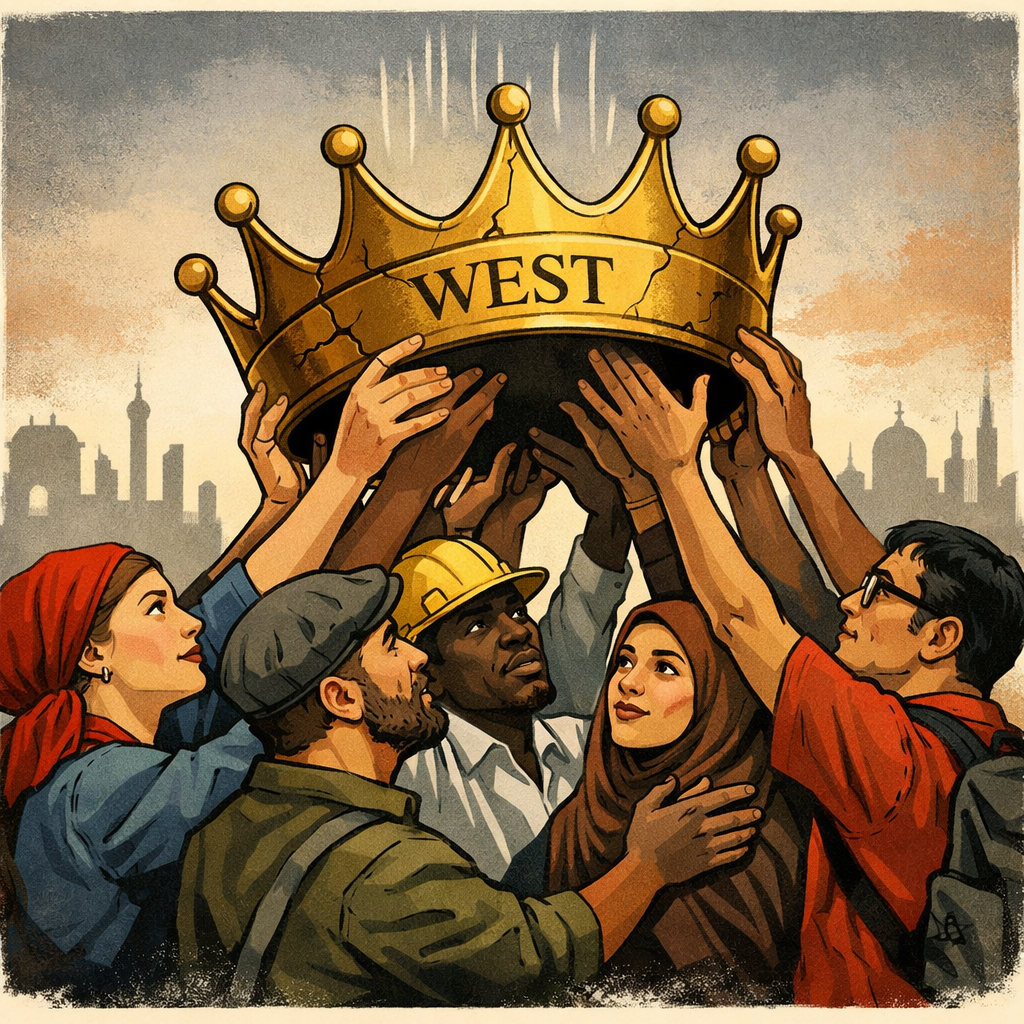
There is also a less obvious upside. Countries that remain relatively open tend to build broader networks. Migrant communities create links, commercial, cultural, and intellectual, that extend far beyond formal diplomacy. In a world where influence flows through connections as much as through institutions, that is no small advantage.
Of course, none of this suggests that migration should be left unmanaged. Poorly handled, it creates its own tensions. But treating it primarily as a problem risks overlooking one of the West’s more durable strengths. Managed sensibly, it can be an asset, not just economically but strategically.
Letting go of old assumptions
The deeper shift is psychological. For a long time, Western countries have operated on the assumption that they could shape the system largely on their own terms. That assumption is fading. The question is what comes next.
A more workable approach might involve a bit more humility. Less setting the agenda, more sharing it. More listening, less lecturing. Influence would still matter, but it would often be indirect, exercised through partnerships rather than imposed from above. That may feel like a loss of status. It may even be one. But it could also be a way of staying relevant in a system that no longer bends so easily.
This is not a clean break or a dramatic turning point. It is a gradual rebalancing, uneven and sometimes uncomfortable. It will not produce a neat end state. But it does open the door to a different kind of order, one shaped less by dominance and more by negotiation.
Whether the West manages this transition well is an open question. It will depend on its willingness to adapt without retreating, to accept limits without losing confidence, and to recognise that some of the tools it has long treated as problems, immigration among them, may, in fact, be part of the solution.