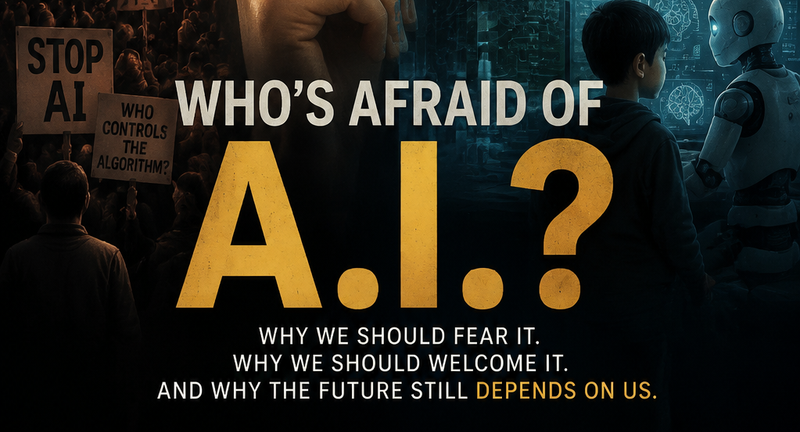
Who's Afraid of A.I.?
"Now I am become Death, the destroyer of worlds." J. Robert Oppenheimer, recalling the Bhagavad Gita after the Trinity test
By David A. Williams
Edward Albee's Who's Afraid of Virginia Woolf? was never really about Virginia Woolf. It was about illusion, the lies people tell themselves to avoid confronting uncomfortable truths and the fear that reality might be less reassuring than the stories we construct around it. Artificial intelligence presents us with a remarkably similar dilemma. We spend endless hours debating whether AI will replace jobs, write novels, win wars, or one day surpass human intelligence, yet these questions may be disguising a more unsettling one. Whose afraid of A.I.? Or, more precisely, who's afraid of what artificial intelligence reveals about ourselves? Every age produces a technology that becomes a mirror. Steam reflected industrial society. Television reflected mass culture. The internet reflected globalisation. AI reflects something far more intimate. It reflects the human mind itself. That is why it fascinates us. That is also why it frightens us.
The anxiety surrounding artificial intelligence is remarkable because it is shared by both its fiercest critics and many of its creators. Stephen Hawking warned that the development of full artificial intelligence "could spell the end of the human race." Geoffrey Hinton, one of the architects of modern neural networks, left Google so he could speak openly about the risks of the systems he helped build. Elon Musk has repeatedly described advanced AI as "summoning the demon," while Yoshua Bengio has argued that humanity should proceed with profound caution before creating machines whose behaviour may exceed our capacity to predict. Rarely has a technology inspired warnings from those most responsible for inventing it. Usually inventors celebrate progress while critics sound the alarm. AI has produced the unusual spectacle of the engineers joining the protest.
History, however, offers a useful corrective to panic. Every revolutionary technology has arrived carrying prophecies of catastrophe. The printing press threatened religious authority. The steam engine was accused of destroying the natural order. Electricity appeared mysterious, dangerous and almost supernatural. Even Alan Turing's famous question, "Can machines think?", posed in 1950, was less an engineering problem than a philosophical provocation. Turing understood that intelligence was never simply about calculation. It was about language, imagination, uncertainty and deception. His famous imitation game was designed not to prove that machines had become human, but to expose how uncertain our own definition of intelligence had always been.
Perhaps that uncertainty explains why AI occupies such an unusual place in the public imagination. We speak about it as though it possesses intentions, ambitions and even desires. Headlines routinely claim that AI "decides," "believes," "lies" or "hallucinates." These are comforting metaphors because they allow us to treat the machine as though it were another political actor. Yet artificial intelligence has no aspirations. It wakes each morning wanting nothing. The objectives belong to us. It optimises according to goals established by human beings, corporations and governments. Every algorithm is therefore a political document disguised as software. When an AI system allocates electricity, approves a mortgage, identifies a military target or recommends a prison sentence, it is executing values that someone, somewhere, decided were important. The machine is not making moral choices. It is enforcing them.
This was the insight that Hannah Arendt might immediately have recognised. Writing after the horrors of the twentieth century, she observed that the greatest dangers often emerge not from monstrous individuals but from ordinary systems operating without reflection. Her idea of the "banality of evil" was never an argument that evil was trivial. It was an argument that bureaucracy can become detached from moral judgement. Artificial intelligence introduces the possibility of bureaucracies operating at machine speed. Decisions that once required deliberation may increasingly become automated processes. The danger is not that AI becomes tyrannical. It is that humans cease asking whether optimisation is always the same thing as wisdom.
Jacques Ellul anticipated something equally important decades before the first large language model appeared. In The Technological Society, he argued that modern civilisation increasingly organises itself around technique, the relentless pursuit of efficiency above all other values. Once efficiency becomes the supreme objective, political, ethical and cultural questions gradually become secondary. Artificial intelligence represents the logical culmination of Ellul's argument. Machines do not optimise for justice, beauty or dignity unless those qualities are explicitly encoded, and even then they struggle because such concepts resist mathematical definition. Left to itself, AI naturally pursues measurable outcomes. Civilisation, however, depends just as much upon immeasurable ones.
Martin Heidegger pushed the argument even further. His concern was never with technology itself but with the way technology changes how human beings perceive reality. He warned that modern technological thinking encourages us to view everything as a resource waiting to be ordered, managed, and exploited. Forests become timber inventories. Rivers become hydroelectric capacity. Human beings become labour inputs. Artificial intelligence extends this logic into the realm of cognition. Knowledge becomes data. Conversation becomes tokens. Creativity becomes prediction. Intelligence becomes optimisation. The danger, Heidegger argued, is not that machines dominate humanity but that humanity begins seeing itself through the logic of the machine.
There is an irony here that deserves far more attention than it receives. Public debate assumes AI threatens human uniqueness because machines are becoming more intelligent. The opposite may prove true. Intelligence is becoming abundant. Judgement is becoming scarce. We already outsource memory to search engines, navigation to smartphones and social interaction to recommendation algorithms. Artificial intelligence may not reduce our capacity to think, but it may steadily reduce the occasions on which independent thought is required. Sydney J. Harris captured the problem with extraordinary foresight when he observed that "the real danger is not that computers will begin to think like men, but that men will begin to think like computers." The sentence feels less like an aphorism today than a diagnosis.
Yet despair would be an equally serious mistake. Every technological revolution has enlarged human possibility as well as human risk. Artificial intelligence promises extraordinary advances in medicine, scientific discovery, education and engineering. It may help accelerate new drugs, improve climate modelling, optimise electricity systems and democratise expertise on a scale previously unimaginable. Never before has so much accumulated knowledge become accessible to so many people so quickly. A student in Nairobi, Newcastle or Nuuk can consult tools whose analytical capabilities would have astonished the greatest universities only a generation ago. Properly governed, AI could become history's greatest instrument for expanding human capability.
The real political question therefore lies elsewhere. It concerns power. Who owns the models? Who controls the data? Who defines the objectives? Who determines the acceptable balance between efficiency and resilience? These questions increasingly resemble constitutional questions rather than technological ones. Democracies have traditionally relied upon disagreement, negotiation and occasionally inefficient compromise. Algorithms excel at optimisation. Optimisation is indispensable in engineering. It is less reliable as a philosophy of government. There will come moments when elected societies deliberately choose outcomes that are slower, more expensive or less efficient because they value accountability, equality or national resilience more highly than mathematical perfection. The coming contest may not be between humanity and machines. It may be between optimisation and democracy.
No figure understood the moral burden of technological achievement better than J. Robert Oppenheimer. Watching the first atomic explosion, he recognised that scientific triumph and ethical responsibility are inseparable. Nuclear physics did not merely transform warfare. It transformed politics, diplomacy and humanity's understanding of itself. Artificial intelligence carries a similar significance, although its revolution is likely to be quieter and more pervasive. It will not arrive in a single blinding flash. It will arrive one algorithm, one workplace, one hospital, one courtroom and one electricity grid at a time, until eventually we struggle to remember how decisions were ever made without it.
So who's afraid of A.I.? Perhaps the answer is that we should all be, but not for the reasons most commonly given. We should fear the temptation to surrender judgement because machines are faster. We should fear the concentration of cognitive power inside a handful of corporations. We should fear confusing prediction with wisdom and efficiency with civilisation. Above all, we should fear forgetting that intelligence has never been humanity's defining characteristic. If it were, the cleverest societies would always have been the wisest. History suggests otherwise.
The true measure of civilisation has never been intelligence alone. It has been what societies choose to do with it. Artificial intelligence is forcing us to ask questions that philosophy has wrestled with for centuries. What is freedom? What is responsibility? What is truth? What is a good society? Machines cannot answer those questions because they are not engineering problems. They are human ones. In that sense, the future of AI may ultimately depend less on the quality of our algorithms than on the quality of our civilisation.
Edward Albee's title challenged audiences to abandon comforting illusions. Artificial intelligence presents the same challenge. It asks whether we possess the confidence to remain authors of our own future even as we build machines capable of writing parts of it for us. That is not a technological test. It is a civilisational one.
Sources and quotations used
Stephen Hawking, interview with the BBC (2014): "The development of full artificial intelligence could spell the end of the human race."
Elon Musk, remarks at the MIT AeroAstro Centennial Symposium (2014): AI is "summoning the demon."
Geoffrey Hinton, interviews with The New York Times , BBC and CBS following his departure from Google (2023), discussing his concerns about advanced AI.
Henry Kissinger, Eric Schmidt and Daniel Huttenlocher, The Age of AI: And Our Human Future (2021).
Sydney J. Harris, widely attributed quotation: "The real danger is not that computers will begin to think like men, but that men will begin to think like computers."
Author's note: All analyses, interpretations, and opinions in this article are original. They are based on the publicly available facts contained in the sources above but do not reproduce or reflect the analysis or editorial positions of those sources.