When the Grid Starts Thinking: AI, Energy, and Denmark’s Quiet Revolution
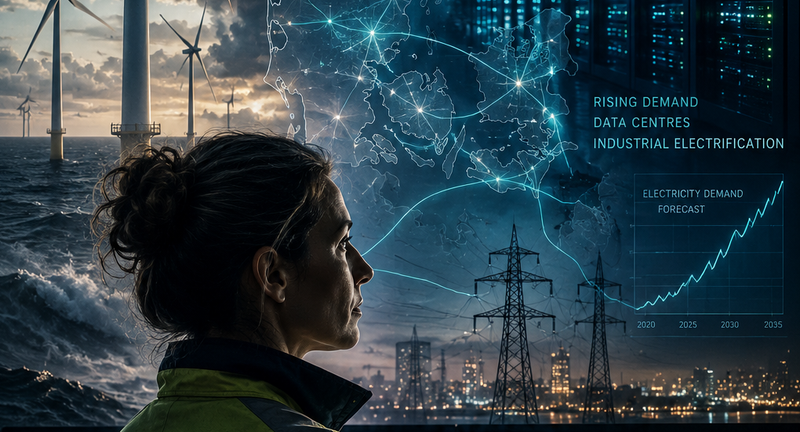
Something unusual is happening in Denmark’s energy system, but it is not unfolding in the dramatic way people expect. There are no rolling blackouts or sudden breakthroughs. Instead, something quieter is taking shape: intelligence is beginning to influence how electricity is used, while electricity is reshaping how intelligence operates.
David A. Williams
AI and energy are usually treated as separate domains. One is innovation and productivity, the other is turbines, cables, and climate targets. On the ground, they are converging into a single system.
Compute becomes an energy actor
Data centres are no longer passive infrastructure. In practice, they behave more like industrial plants, with shifting and often unpredictable demand patterns.
In Denmark, this shift is especially significant. The system is small, highly electrified, and heavily dependent on wind power. Rising AI workloads do not only increase total demand. They change its timing, volatility, and intensity.
This creates a structural mismatch. Wind is variable. AI compute is elastic but spiky. The grid must now balance two different kinds of uncertainty at once.
Energy systems are becoming behavioural systems
Energy planning has traditionally been treated as an engineering discipline. What is emerging in Denmark looks closer to behavioural coordination.
Demand is no longer just households and factories. It includes model training, distributed computing, and workloads that shift across borders based on price and carbon intensity.
The result is a new kind of feedback loop. Cheaper green energy attracts more compute. More compute increases demand for green energy. That demand accelerates grid expansion.
The grid is no longer balancing only physics. It is balancing decisions made by software systems responding to incentives in real time.
The political question behind capacity
Public debate often reduces the issue to whether Denmark can produce enough electricity for AI growth. That framing is incomplete.
The more difficult question is how society allocates a resource when intelligence itself becomes energy intensive.
Denmark’s green transition was built on a stable assumption: electrification would be predictable. AI disrupts that assumption by introducing industrial-scale volatility.
At forums like Folkemødet, the discussion is beginning to surface in practical terms. Who gets priority on the grid when compute competes with heating, transport, and industry? Should AI workloads be designed to follow wind availability in the same way heavy industry follows logistics constraints?
Denmark as a rehearsal system for Europe
Denmark is increasingly functioning as a small-scale test environment for Europe’s combined energy and AI future.
Its size allows faster iteration on offshore wind integration, interconnectors, and digital grid management. These are not just climate policies. They are early experiments in coordinating electricity systems with computational demand.
The underlying shift is not only decarbonisation. It is the replacement of predictable consumption with adaptive, algorithm-driven consumption patterns.
In that sense, Denmark is stress-testing a future where energy systems must serve both physical infrastructure and digital intelligence simultaneously.
The dissolving boundary
The familiar distinction between AI as software and energy as hardware is beginning to blur.
AI is becoming infrastructure. Energy is becoming informational.
The grid is evolving into something more than a distribution network. It is becoming a coordination layer between human demand, industrial systems, and machine-driven optimisation that constantly recalculates what should run, when, and why.
The quiet shift beneath the wind
Seen from a distance, Denmark’s transformation is not about scarcity or abundance. It is about coordination under rising complexity.
The country is no longer building an energy system only for human needs. It is building one that must also accommodate systems that make their own demands.
The deeper uncertainty is not whether AI will consume too much electricity. It is that it will change the meaning of “too much” altogether.
That is not a crisis yet. It is a structural transition already underway, hidden in the ordinary rhythm of a grid that is slowly learning to think.
Source: https://program.folkemoedet.dk/events/2026/34949/datacentre-hvordan-faar-danmark-stroem-nok-til-ai https://program.folkemoedet.dk/events/2026/32373/ai-tsunami-eller-en-storm-i-et-glas-vand
Subscribe to the LinkedIn Newsletter: Sphere Magazine