The Welfare-State Firewall: How Denmark is Quietly Rewiring AI Into the State Itself
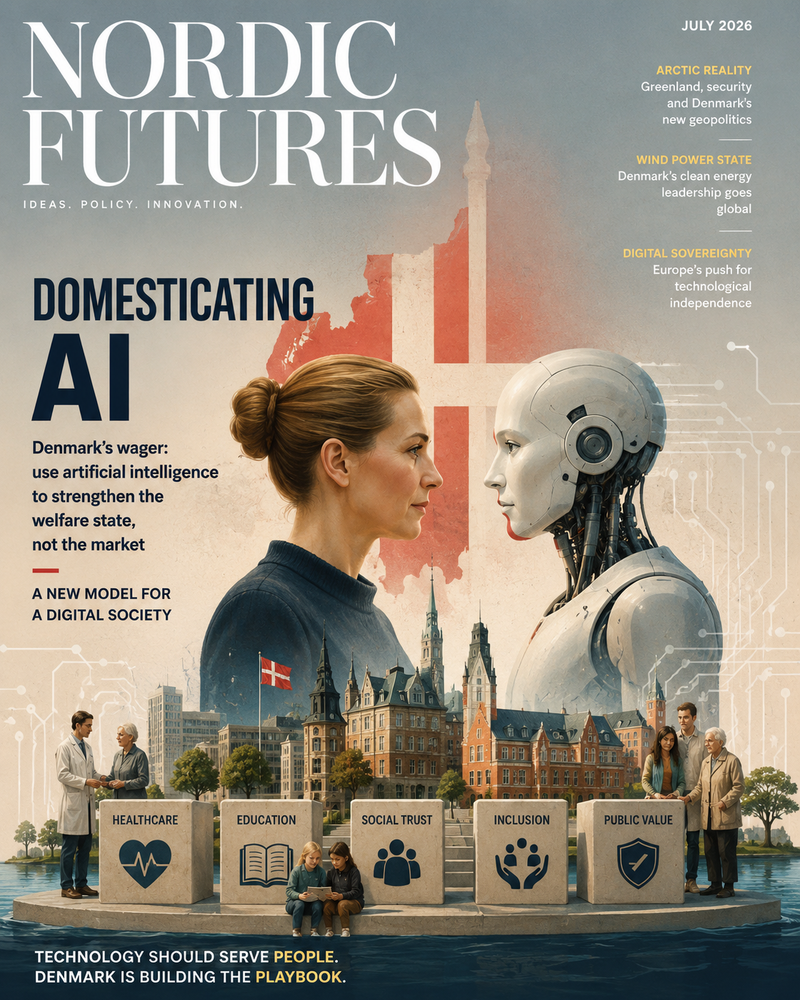
Denmark is not treating artificial intelligence as another wave of digital innovation to be regulated at the margins. It is doing something more structural and, in a sense, more ambitious. AI is being absorbed into the machinery of the welfare state itself, folded into institutions that already define the relationship between citizen and government. In that process, algorithmic systems stop looking like external tools supplied by markets and start behaving like extensions of constitutional infrastructure. The result is a subtle but important shift: social policy becomes a form of AI governance, and AI governance becomes a matter of state continuity.
By David A. Williams
Most discussions about AI in Europe tend to orbit the same set of questions. How do we regulate Big Tech without strangling innovation? How do we keep up with the United States and China? How do we translate productivity gains into something politically defensible? Denmark sits slightly outside that frame. It is not building a competitive platform ecosystem, nor is it trying to replicate Silicon Valley dynamics inside the public sector. Instead, it is domesticating AI inside welfare institutions themselves, so tightly integrated that the public sector becomes the primary operating environment. That changes the logic of control. It is no longer about regulating technology at the border. It is about embedding it so deeply into governance that the state becomes both the user and the constraint.
This creates what might be called an anti-platform state. In contrast to models where private platforms scale into de facto infrastructure, or where state and platform power fuse into a single apparatus, Denmark is trying to prevent AI systems from becoming independent economic power centers at all. Core functions such as taxation, healthcare administration, identity services, and municipal decision-making remain institutionally anchored. Procurement becomes a quiet but decisive lever of control. If AI enters public life, it does so on terms defined by the state, not by vendor ecosystems. The effect is not dramatic or visible in the way frontier model competition is, but it is structurally significant. It limits the ability of any single technology provider to gain systemic leverage over governance itself.
There is a defense dimension to this that is often underplayed. In highly digitized welfare states, civil infrastructure is no longer just administrative plumbing. It becomes a resilience layer. Systems that handle health records, benefits distribution, taxation, and identity verification are also systems that, if disrupted, would affect national stability within hours. That makes them dual-use by default. For NATO planners and security analysts, the boundary between domestic service delivery and national defense posture begins to blur. AI systems embedded in welfare institutions are not just efficiency tools. They are part of the operational fabric of continuity of government, and therefore part of the threat model.
For investors and industry participants, Denmark hints at a different kind of market formation. These are not open, fast-scaling platform markets in the American sense. They are regulated-by-design ecosystems where adoption is gated by state integration and compliance requirements. Innovation still happens, but it tends to move through procurement cycles, institutional pilots, and long feedback loops rather than pure market expansion. That produces slower diffusion, but also greater stability and clearer incumbency advantages for those already aligned with public sector requirements. Over time, this may sharpen a divide between growth-oriented AI markets and state-anchored AI markets across Europe.
The paradox underneath all of this is hard to avoid. The more deeply AI is embedded into welfare systems, the more efficient and seamless those systems become, but also the more dependent the state grows on them. What begins as domestication risks becoming entanglement. The state limits the autonomy of AI as an economic force, yet simultaneously elevates its importance as infrastructure. In trying to keep AI subordinate, it may be turning it into something closer to a constitutional utility.
Seen from this angle, Denmark is not simply regulating AI. It is absorbing it. Quietly, incrementally, and without the drama of geopolitical competition narratives, it is turning social policy into a control surface for algorithmic governance. Whether that becomes a model for Europe or a cautionary example depends on how well this balance holds between control and dependence.
The question is not whether this approach is effective in the short term. The question is whether a welfare state that runs on embedded intelligence can remain meaningfully sovereign over the systems it now depends on. And that is where the conversation should probably begin.