The New Gatekeepers: How AI Could Reshape Democracy Itself
David A. Williams
For centuries, power has worn many disguises. Kings controlled land. Industrialists controlled factories. Media barons controlled information. Today, a new form of influence is emerging, one that may ultimately prove more consequential than all of them.
The ability to shape how people understand reality.
Artificial intelligence is often discussed as a tool. A chatbot that answers questions. A system that writes reports. A machine that generates images. Yet beneath the fascination with technology lies a deeper transformation that receives surprisingly little attention. AI is increasingly becoming the interface between citizens and the world around them.
Consider what is already happening. Students ask AI to explain complex legal rulings. Voters ask it to summarise government policies. Business owners use it to analyse markets. Workers rely on it to interpret technical documents that would previously have required specialists. Increasingly, people turn not to institutions first, but to machines.
Historically, these functions belonged to intermediaries. Journalists interpreted events. Lawyers interpreted laws. Consultants interpreted business problems. Teachers interpreted knowledge. The average citizen depended upon layers of expertise to navigate an increasingly complex society.
Today, millions of people are beginning to ask AI first.
That shift may prove to be one of the most significant political and social developments of the twenty-first century.
The implications extend far beyond convenience. The World Economic Forum estimates that six in ten workers will require additional training as artificial intelligence reshapes the labour market and transforms how knowledge is created, distributed, and consumed. Researchers increasingly describe the current moment not as a technological upgrade, but as a restructuring of work itself.
At the same time, organisations such as UNESCO have warned that AI's influence reaches far beyond employment. Education, learning, and access to information are being fundamentally altered by generative AI systems capable of personalising explanations, summarising vast amounts of information, and acting as guides through increasingly complex subjects.
On the surface, this appears liberating.
A citizen no longer needs a legal background to understand legislation. A student can receive tailored explanations in seconds. Small businesses can access capabilities once reserved for large corporations. Knowledge is becoming dramatically more accessible.
Yet accessibility creates a paradox.
If millions of people rely on AI to interpret the world for them, who decides how that interpretation occurs?
The question is not whether AI provides information. The question is how it frames information.
Every explanation requires choices. What facts are included? Which are omitted? What context is considered relevant? What assumptions sit beneath the answer? These questions have always existed. The difference is scale. A newspaper influences thousands or perhaps millions of readers. An AI assistant could eventually influence billions of individual conversations every day.
This is why the debate surrounding AI governance has become so urgent. Researchers increasingly argue that traditional regulatory approaches may be insufficient because AI evolves faster than the institutions designed to oversee it. The challenge is not merely technological. It is about trust, accountability, and human agency itself.
Yet there is an even deeper question emerging beneath the surface.
What happens when artificial intelligence becomes more capable of understanding public opinion, analysing policy outcomes, and explaining complex trade-offs than the political systems we inherited from previous centuries?
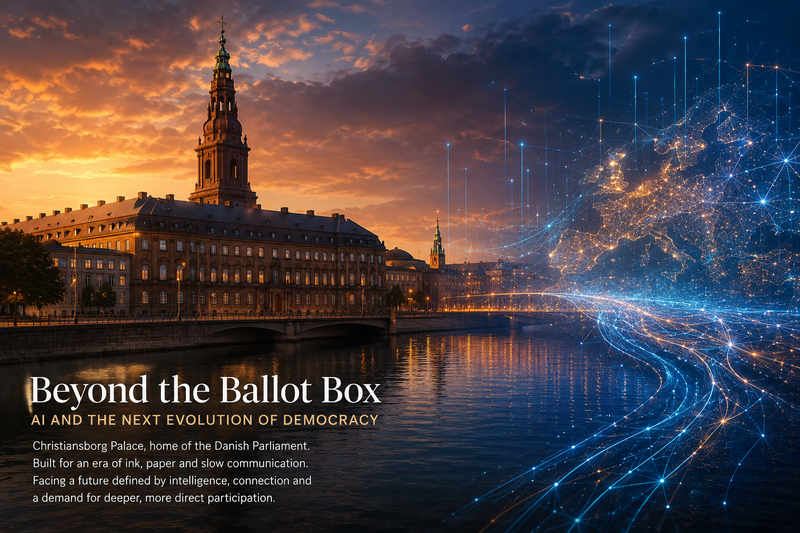
Modern democracies were largely designed in an age of horse-drawn transport, handwritten records, and information scarcity. Citizens voted every few years. Representatives travelled to capitals and made decisions on behalf of populations that could not communicate instantly with one another. The architecture of democracy reflected the technological realities of the eighteenth and nineteenth centuries.
Artificial intelligence belongs to a different world entirely.
It is not difficult to imagine a future in which citizens expect far greater participation in policymaking, continuous consultation rather than periodic elections, and access to real-time analysis of government decisions. The democratic machinery that once represented progress may increasingly appear slow, opaque, and disconnected from the information age it is supposed to govern.
This does not mean democracy is becoming obsolete. Quite the opposite. It may mean democracy must evolve if it is to survive.
The uncomfortable possibility is that artificial intelligence may eventually demand changes not simply to government administration, but to the democratic process itself. Not because machines should govern people, but because citizens armed with unprecedented access to information may no longer accept political systems designed for an era when information moved at the speed of a horse and a printing press.
The future may not belong to those who control information. Information is already abundant.
The future may belong to those who control interpretation.
That possibility helps explain why governments, technology companies, universities, and regulators are investing so heavily in AI. They understand that the next great contest may not be over data or computing power alone. It may be over who becomes society's primary guide through complexity.
The question is whether that guide will empower independent thinking or quietly replace it.
History suggests that every civilisation is shaped by the tools it uses to understand itself. Printing presses transformed religion. Newspapers transformed politics. Television transformed culture. The internet transformed communication.
Artificial intelligence may transform something even more fundamental. Not what we know. Not even how we work. But how we govern ourselves
And if that proves true, the greatest challenge posed by AI will not be technological. It will be deciding whether our political institutions can evolve quickly enough to keep pace with the intelligence revolution they helped create.
Support Sphere Magazine and Subscribe to our LINKEDIN NEWSLETTER