The Ally, the Market, and the Machine: Denmark's Real Balancing Act Isn't China. It's the United States
By David A. Williams
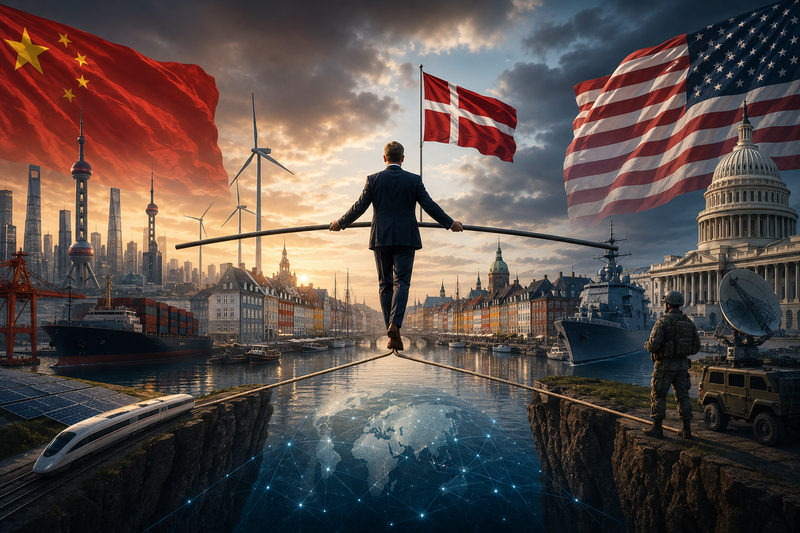
When Chinese Foreign Minister Wang Yi met Danish Foreign Minister Lars Løkke Rasmussen in Copenhagen on 3 July, the official language was familiar. The two countries reaffirmed cooperation in trade, shipping, green transition, research, innovation and healthcare. On its face, it looked like another carefully managed diplomatic engagement between a European nation and the world's second-largest economy. Yet the real significance of the meeting lies elsewhere. Denmark's most difficult strategic calculation is not how far it should engage China. It is how it can continue doing so while remaining one of Washington's closest security partners in an era when artificial intelligence has erased the traditional boundary between commerce and national security.
The old assumptions are disappearing with remarkable speed. For decades, governments could distinguish between economic policy and security policy. A pharmaceutical partnership was a pharmaceutical partnership. A shipping agreement was a shipping agreement. Scientific collaboration was generally viewed as a public good. That distinction no longer survives contact with the AI economy. The same computing systems that optimize container traffic can improve military logistics. Medical imaging algorithms can refine computer vision technologies used in autonomous systems. Advances in quantum research, advanced materials, and biotechnology increasingly serve both civilian industries and defense applications. The phrase "dual-use technology" is becoming almost redundant because almost every strategically valuable technology now has both commercial and military implications.
This is where Denmark occupies an unusually important position. Despite its relatively small population, it sits at the center of several industries that have become strategically indispensable. Danish companies help move a significant share of global maritime trade. The country is a leader in offshore wind energy, pharmaceutical innovation, industrial automation and digital infrastructure. Copenhagen also plays a growing role in Arctic security, Baltic defense and NATO logistics. These are not simply successful industries. They are assets that increasingly determine geopolitical influence.
China recognizes this reality. Beijing's interest in expanding cooperation with Denmark is neither surprising nor unique. Chinese diplomacy across Europe continues to seek partnerships that maintain access to advanced industrial economies while strengthening scientific cooperation and preserving commercial ties. Denmark offers expertise in shipping efficiency, green technologies, and life sciences that align closely with China's long-term industrial ambitions. Official statements from both governments emphasized mutual benefit, sustainable development, and expanded research cooperation. Those priorities are entirely consistent with China's broader strategy of maintaining economic engagement with Europe despite growing geopolitical tensions.
The greater pressure, however, comes from the opposite direction. Washington's expectations of its allies have evolved significantly during the past decade. Successive American administrations have moved beyond concerns about tariffs or trade deficits. The focus now rests on technological resilience, supply-chain security, and strategic dependence. The United States increasingly expects NATO allies to reduce exposure to Chinese technology in areas considered critical to national security. Telecommunications, semiconductors, cloud computing, artificial intelligence, critical minerals, advanced manufacturing and sensitive research collaborations have all become subjects of closer scrutiny. For allies such as Denmark, decisions once regarded as commercial are now evaluated through the lens of alliance security.
Artificial intelligence accelerates this shift because AI depends less on individual inventions than on ecosystems. Algorithms improve through access to vast datasets, computing infrastructure and specialized expertise. Shipping networks generate valuable logistics data. Smart energy systems produce detailed information about critical infrastructure. Healthcare partnerships create enormous volumes of medical and biological data. Research collaborations build intellectual capital that extends far beyond published scientific papers. Every new connection potentially strengthens the broader AI capabilities of whichever ecosystem benefits most from the collaboration.
This changes the political calculation in subtle but profound ways. Denmark is not choosing between friendship with the United States and friendship with China. It is attempting to preserve economic openness without creating strategic vulnerabilities. That requires an increasingly sophisticated form of statecraft. Policymakers must decide not only which investments to welcome but also which data flows to permit, which research partnerships to encourage, which technologies to protect and which supply chains require diversification. The challenge is less about blocking cooperation than understanding where legitimate commercial engagement gradually becomes strategic dependence.
European policymakers increasingly describe this approach as "de-risking" rather than decoupling. The distinction matters. Few European governments advocate severing economic ties with China. China remains one of the European Union's largest trading partners, while European firms continue to rely on Chinese manufacturing capacity, consumer markets and industrial supply chains. At the same time, the EU has expanded foreign investment screening, introduced new economic security measures and strengthened export controls in sensitive technologies. The objective is to reduce vulnerability without abandoning global commerce. Denmark's diplomacy reflects precisely this balancing act.
Business leaders face an equally complex landscape. Decisions about research collaboration, cloud providers, semiconductor procurement or AI partnerships now carry implications that extend beyond quarterly earnings. Investors increasingly assess geopolitical exposure alongside financial performance. Corporate boards find themselves discussing export controls, cyber resilience and national security legislation alongside revenue forecasts and market expansion. What was once considered political risk has become operational risk.
For defense planners, the implications are equally significant. Military strength increasingly depends on civilian infrastructure. Ports, energy grids, satellite networks, digital communications and AI-enabled logistics form the backbone of modern deterrence. Protecting these systems requires cooperation between governments and private industry on a scale rarely seen before. Denmark's experience illustrates how economic competitiveness and national security have become deeply intertwined rather than separate domains.
Journalists also face a new responsibility. Diplomatic announcements that once appeared routine now require interpretation through multiple lenses. A memorandum on healthcare research may have implications for biotechnology policy. Shipping agreements may influence critical infrastructure resilience. Cooperation on green technology may intersect with supply-chain security and AI-driven energy management. Reporting on international affairs increasingly demands fluency in economics, technology and defense simultaneously.
The Copenhagen meeting therefore represents something larger than another bilateral diplomatic engagement. It offers a glimpse into the emerging architecture of twenty-first century geopolitics, where alliances are measured not only by defense treaties but also by technological ecosystems, industrial resilience and control over strategic data. Denmark's choices are becoming Europe's choices. The question is no longer whether countries can trade with geopolitical competitors. The question is how they can do so while preserving technological sovereignty and maintaining the trust of their closest security allies.
Artificial intelligence has dissolved the boundary between commerce and national security. Every trade agreement is now also a technology agreement. Every research partnership is a security partnership. Every logistics network is potentially an intelligence network. Denmark's engagement with China is therefore not simply a diplomatic story. It is a preview of the strategic choices every European nation will face as economic openness collides with technological sovereignty.
The real test of Denmark's foreign policy will not be whether it can maintain productive relations with Beijing or sustain its alliance with Washington. It will be whether it can continue to convince both that these objectives remain compatible. As AI reshapes the foundations of economic power, security and innovation, that may prove to be one of the defining strategic challenges of this decade. The question for policymakers, investors, business leaders and defense professionals is no longer whether this balancing act exists. It is whether any European country will be able to maintain it for much longer.
Sources: People's Daily (Xinhua); the official Danish Government statements on foreign affairs; the European Commission's Economic Security Strategy; the European Commission's Joint Communication on the European Economic Security Strategy (2023); the European Commission's guidance on outbound investment and foreign direct investment screening; the 2025 NATO Summit Declaration; the 2025 Annual Threat Assessment of the US Intelligence Community.