Public Trust May Determine the Future of Military AI ...even in Denmark
David A. Williams
A new international study suggests that public support for military uses of artificial intelligence depends heavily on how people view AI in general. Researchers Andreas Jungherr, Antonia Schlude and Adrian Rauchfleisch surveyed 9,000 people across nine countries and found that attitudes toward AI often shape opinions on its role in national defence.
The study examined public opinion in countries including China, Germany and the United States, along with several other European nations. Across the board, respondents who believed AI would benefit society were more likely to support military AI applications. Those who held more sceptical views of the technology tended to oppose its use in defence settings.
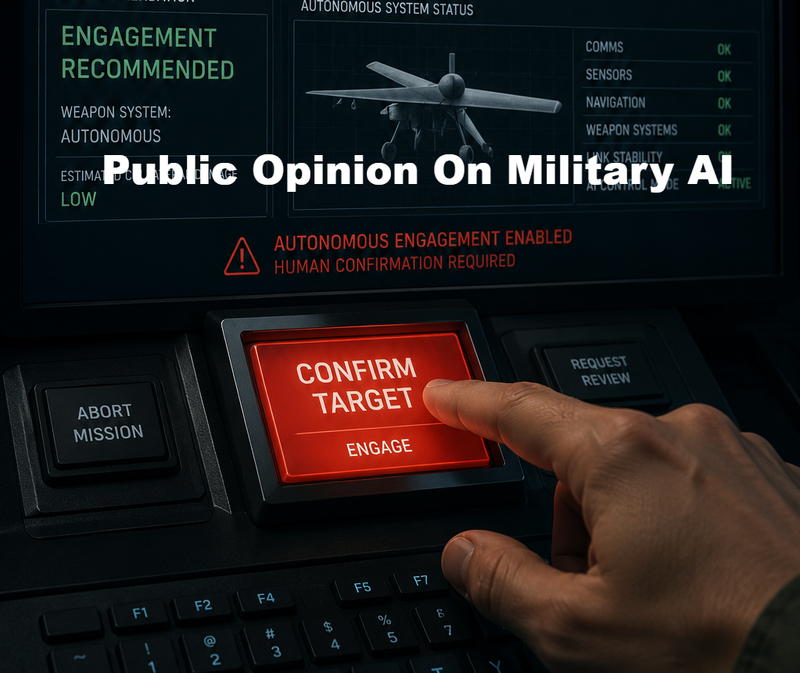
The strongest concerns centred on autonomous weapons. While respondents were often willing to support AI systems that assist military personnel with intelligence gathering, surveillance or operational planning, support fell sharply when AI was given the ability to make lethal decisions without direct human involvement.
The findings offer an important insight into the global debate over military AI. Public acceptance appears to be driven less by specific defence technologies and more by a broader level of trust in artificial intelligence itself. In other words, the battle for public confidence may begin long before AI reaches the battlefield.
Although Denmark was not among the countries surveyed, the research carries important lessons for smaller nations. Denmark shares many characteristics with the European democracies included in the study, making it a useful case for considering the wider implications.
For countries with limited military scale but strong digital capabilities, AI may prove most valuable as a force multiplier rather than a replacement for human decision-making. Denmark, for example, could benefit from AI-enhanced maritime surveillance, cyber defence, intelligence analysis and logistics support. These applications can strengthen national security while keeping humans firmly in control of critical decisions.
The study also raises a strategic question for policymakers. Could smaller nations gain an advantage by becoming leaders in trustworthy AI rather than pursuing fully autonomous military systems? If public trust is a decisive factor in adoption, nations that emphasise transparency, accountability and human oversight may find themselves better positioned than those focused solely on technological capability.
One aspect that could strengthen future reporting on this issue is a deeper examination of the difference between AI that assists and AI that decides. The research suggests this distinction is central to public acceptance and may become one of the defining questions of defence policy over the coming decade.
As governments invest billions in artificial intelligence, the debate is evolving. The question is no longer whether military organisations will use AI. It is how much authority societies are willing to grant it, and where they insist that human judgment must remain the final safeguard.
Source: Andreas Jungherr, Antonia Schlude and Adrian Rauchfleisch, "Beyond Killer Robots: General AI Attitudes and Public Support for Military AI in Nine Countries", arXiv, 2026.
Subscribe to the Sphere Magazine LinkedIn Newsletter