JACK AND THE CLOUDSTALK
A MODERN FAIRY TALE ABOUT ARTIFICIAL INTELLIGENCE
Inspired by conversations with vendors and speakers at the Computerworld Cloud & AI Festival 2026 in Copenhagen, Sphere presents an AI fairy tale for grown-ups, reimagining Jack and the Beanstalk as a battle between an intrepid young AI entrepreneur and technology Titans determined to control artificial intelligence, its infrastructure and the future itself.
By David A. Williams
ONCE UPON A TIME, which is to say next Thursday, when yesterday’s code had already become obsolete, there lived a young entrepreneur named Jack.
Jack owned three things: an elderly laptop, a company valued at considerably less than its unpaid electricity bill, and an idea that every important investor had assured him was impossible.
His company was called LittleMind.
LittleMind had been founded on Jack’s belief that artificial intelligence should not require cities of computers, private power stations and artificial lakes of cooling water. He believed a machine could learn from carefully selected knowledge rather than swallowing the entire internet, and that intelligence should become more efficient as it improved, just as children eventually learnt to tie their own shoes without requiring an additional power station.
There was only one problem.
Jack had not invented it yet.
He possessed the theory, the company name and a collection of increasingly urgent final demands from his creditors. What he lacked was the machine that could prove he was right.
The Titans of Artificial Intelligence, meanwhile, had machines everywhere.
They lived above the clouds in enormous data centres connected by a glittering infrastructure known as the Cloudstalk. Its roots spread beneath oceans, cities and power grids. Its trunk was woven from fibre-optic cables, transmission lines, cooling pipes, server racks, investment funds and government contracts. Every hour it grew wider. Every minute it climbed higher.
At its summit stood three castles belonging to the American Titans: OpenMouth, Anthropoid and GarbageBin.
The Titans had advanced from "simple" AI and were now building AGI, or artificial general intelligence. Ordinary artificial intelligence could perform particular tasks, such as translating languages, finding patterns or composing an apology from a politician who was not sorry. AGI was supposed to do almost any intellectual task a human being could do, but faster, more cheaply and without asking for holidays. Nobody knew whether it truly existed, when it might arrive or whether the Titans would recognise it before their marketing departments announced it.
Nevertheless, they had persuaded the world that only giants could build it.
They bought mountains of computer chips. They diverted rivers for cooling. They signed contracts for electricity that had not yet been generated. They told governments that whoever controlled AGI would control the future, and then offered to protect the future by owning it themselves.
Whenever a smaller company tried to climb the Cloudstalk, the Titans issued a solemn warning.
“Artificial intelligence is becoming dangerously powerful,” they declared. “Development must be slowed. New systems must undergo deeper external evaluation. Only organisations with sufficient experience, infrastructure and responsibility should be permitted to continue.”
By a remarkable coincidence, the only organisations considered sufficiently experienced, sufficiently well equipped and sufficiently responsible were the Titans.
Their warnings were not entirely false. Powerful machines could cause real harm. They could deceive, discriminate, manipulate and place dangerous capabilities in irresponsible hands. But the Titans had discovered that a genuine danger could also make an excellent castle wall. Safety became the golden lock on a gate for which they alone possessed the key.
Jack recognised the trick because poverty provides an excellent education in power.
One morning, a letter arrived from the Ministry of Responsible Progress.
LittleMind was ordered to suspend its research until it could afford twelve independent safety assessments, a national-security audit, an energy-impact study and an age-verification system ensuring that no child could ask its chatbot an unauthorised question.
This surprised Jack, since LittleMind did not yet possess a working AI, never mind a chatbot.
He went to the ministry to explain and found its entrance guarded by a smiling machine embedded in the wall.
“Please confirm that you are over eighteen,” it said.
“I am twenty-four.”
“Please provide your passport, tax records, medical history, and a live scan of your face.”
“Why do you need my medical history?”
“To protect your privacy.”
Jack returned home without entering the building.
That evening, while searching for investors, he received an invitation printed on gold-coloured paper. It contained only an address and seven words:
THE GOOSE IS SMALLER THAN THE CASTLE.
The address led him beneath the city, through an abandoned railway tunnel and into a workshop no larger than a village bakery. Inside stood a narrow man with silver hair, bright green spectacles and a waistcoat covered in tiny embroidered feathers.
“My name is Gilder Ganse,” he said. “Some call me the Golden Goose.”
“Because you lay golden eggs?”
“Because other men grow rich by sitting on my work.”
Ganse studied Jack for a moment, then nodded towards a black box scarcely larger than a suitcase.
“I have what you are looking for.”
“You do not know what I am looking for.”
“You are looking for a way to make intelligence smaller without making it stupid.”
Jack stared at him.
Ganse opened the black box.
It contained a new kind of computing architecture that moved information only when necessary and reused heat, memory, and electrical power with extraordinary efficiency. A task requiring a hall of conventional servers could be performed by several of Ganse’s machines in the back room of an ordinary office.
Jack walked around the box twice, as though expecting the missing data centre to be concealed behind it.
“This cannot be real.”
“That,” said Ganse, “is what people say when reality arrives before their investment strategy is ready for it.”
“Why haven’t you sold it?”
“I tried.”
“What happened?”
“The Titans offered me three billion dollars.”
Jack nearly dropped the machine. “And you refused?”
“They did not want the invention. They wanted its disappearance.”
Ganse explained that the Titans’ power rested not only on their models but on the belief that intelligence required colossal infrastructure. Their castles were valued in trillions because investors assumed every future mind would need more chips, more land, more water and more electricity. If Ganse’s invention worked at scale, much of that infrastructure would become a monument to expensive assumptions.
“The Titans have built their cloudstalk so high,” he said, “that they can no longer admit the sky might be reached by stairs.”
Jack finally understood why Ganse had summoned him.
“You have the invention,” he said.
“And you have the company.”
“I have a name printed on some unpaid invoices.”
“Sometimes,” Ganse replied, “that is how companies begin.”
They made a bargain. Ganse would provide the technology. Jack would take it into the world. If they succeeded, intelligence would no longer belong only to those who could afford a private power grid.
LittleMind released its first working system three months later.
It matched the Titans’ best models on many useful tasks while consuming a fraction of the energy. Hospitals could run it locally without sending confidential records abroad. Schools could use it without surrendering children’s conversations to distant corporations. Small countries could train systems in their own languages and keep their knowledge within their own borders.
For one glorious week, the world celebrated.
Then the Titans became concerned about safety.
They warned that small, efficient systems might fall into the wrong hands. They demanded licensing rules, compulsory monitoring and minimum capital requirements. Their advisers appeared before parliaments to explain that democracy could survive only if advanced intelligence remained under the supervision of a few responsible companies.
Newspapers owned by Titan investors published investigations into Jack’s childhood. A photograph emerged of him cheating at chess when he was nine. Experts questioned whether Ganse’s machines might overheat, destabilise the energy market or enable children to complete homework without experiencing sufficient misery.
The richest of all the Titans, OpenMouths Cornelius Crown, summoned Jack to his castle at the top of the Cloudstalk.
Crown’s daughter, Princess Ada, received him at the gate. She was called a princess because her father owned enough politicians to qualify as minor royalty.
“You should turn back,” she whispered. “My father intends to buy your company.”
“It is not for sale.”
“Then he intends to destroy it.”
“Does he always get what he wants?”
“Until now.”
In the great hall, Crown sat smiling beneath a chandelier made from obsolete computer chips. Behind him, an artificial golden goose generated financial forecasts and laid a polished metal egg every time the company’s share price rose.
“I admire you, Jack,” Crown said. “You have climbed remarkably high for someone with so little beneath him.”
“You mean money?”
“I mean protection.”
Crown offered him fifty billion dollars for LittleMind and Ganse’s invention. Jack refused.
“One hundred billion.”
“No.”
“Then you leave me no choice. Your system is unsafe.”
“You called it brilliant yesterday.”
“Brilliance is no defence against danger.”
“Nor is danger an excuse for monopoly.”
Crown smiled. “Do you really believe you can defeat us with clever words?”
“No,” said Jack. “I intend to use business acumen.”
Crown frowned. “What is that?”
“Knowing how money, timing, human vanity, and cunning work together.”
Crown laughed mockingly
“Understanding that powerful men usually guard the front door because they cannot imagine anyone studying the foundations.”
For the first time, Crown’s sarcastic smile disappeared.
“You insignificant little thief,” he said. “You think one clever machine makes you my equal? I can close every market to you. I can have your licences withdrawn, your investors frightened away, and your name made poisonous before breakfast. By tomorrow, no minister will admit to knowing you. By the end of the week, no bank will touch you.”
His voice rose until it filled the great hall and rattled the chandelier of obsolete chips. The artificial golden goose stopped laying eggs.
“You will sell to me,” Crown screamed, “or I will bury you beneath the future!”
Jack looked past him at the castle’s glowing walls, its endless cables and the vast Cloudstalk holding everything above the earth.
“No,” he said quietly. “You have mistaken the future for the infrastructure you built to control it.”
Then he turned and walked out.
Crown’s threats followed him through the corridors. His lawyers shouted warnings from the balconies. His advisers promised investigations, injunctions and ruin. As Jack descended the Cloudstalk, messages began arriving on his phone. Two investors had withdrawn. A bank had frozen LittleMind’s credit. Three newspapers were preparing stories questioning his judgement, his character and, rather surprisingly, the legitimacy of a cancelled parking ticket issued to his mother six years earlier.
Jack kept climbing down.
He had told Crown what business acumen and cunning meant. Now he had to prove that he possessed them.
Over the following weeks, while Crown’s lawyers drafted regulations and his lobbyists polished their warnings, Jack began speaking quietly to the people who kept the Titans’ castles in the sky: electricity companies, chip manufacturers, pension funds, governments and data-centre operators.
He did not ask them to believe in a revolution. He showed them their bills.
Electricity companies saw how much generating capacity had been promised to data centres that might never be completed. Governments discovered that they could build sovereign AI systems without borrowing billions or surrendering their national data. Pension funds learnt how much of their members’ savings rested on the assumption that artificial intelligence would always require larger castles and taller Cloudstalks. Businesses realised that they could own compact systems instead of paying the Titans rent forever.
Jack offered each of them something more valuable than another enormous promise.
He offered them a way out.
One by one, they signed.
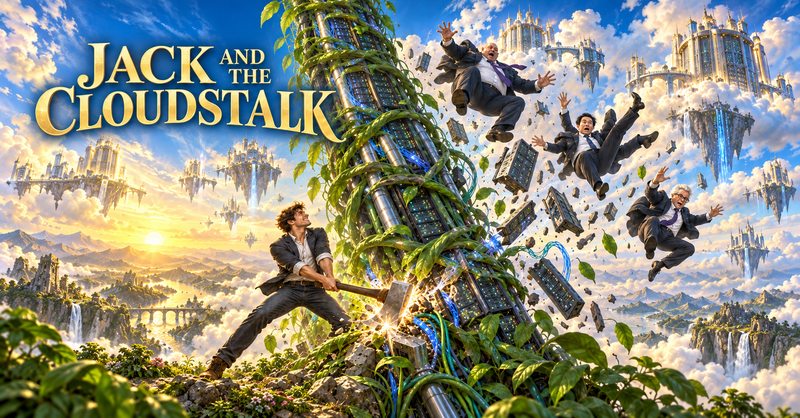
Then Jack raised his metaphorical axe.
It was not made of iron. Its blade was a patent licence. Its handle was a network of small companies. Its edge consisted of transparent safety standards that applied equally to giants and newcomers. Every time the Titans demanded a reasonable safeguard, Jack accepted it publicly and built it into LittleMind. Every time they proposed a rule designed merely to exclude competitors, he revealed who had drafted it and who stood to profit.
He did not destroy safety. He separated safety from privilege.
The first swing cut through the Titans’ claim that only vast models could be powerful.
The second cut through their control of computing infrastructure.
The third cut through the illusion that their castles were worth whatever numbers appeared on the artificial goose’s golden eggs.
At last the Cloudstalk trembled.
Data-centre projects were cancelled. Chip orders shrank. Investors began asking why systems costing billions were being beaten by machines that could operate in municipal basements. The stock market looked down, experienced a sudden attack of common sense and screamed.
The Titans’ castles fell through the clouds.
They did not crash into the earth, for in modern fairy tales the very rich are protected by golden parachutes. But trillions vanished from their valuations, which was considered almost the same thing.
Cornelius Crown survived with only three houses, one island and a severely reduced private air force. He moved into his smallest palace and spent his evenings watching Jack’s company succeed on a television too old to recognise his face.
Princess Ada, meanwhile, left the castle before it fell. She had studied computing in secret and understood Ganse’s invention almost as well as its creator. When Jack offered to rescue her, she declined.
“I do not require rescuing,” she said. “I require voting shares.”
So Jack married her, although only after she had negotiated half the company and placed Gilder Ganse in charge of a foundation that licensed the technology cheaply to schools, hospitals, and poorer nations.
LittleMind became the largest and most beneficial-to-society artificial general intelligence company in the world, distributing its huge profits like its technology, back to the people it served. Jack became famous, Ada became formidable, and Ganse continued working beneath the city, where he insisted the best inventions belonged in rooms with low ceilings because they discouraged men from imagining themselves as gods.
As for the Titans, they never stopped warning that artificial intelligence was too dangerous to be controlled by ordinary people.
Perhaps they were right.
But whenever they said it, the people remembered the privately owned Cloudstalks and asked a question that no Titan enjoys answering:
“Dangerous to whom?”
And they all lived intelligently ever after, which was not quite the same as happily, but proved far more useful.
THE END
Copyright © 2026 David A. Williams / Sphere Magazine