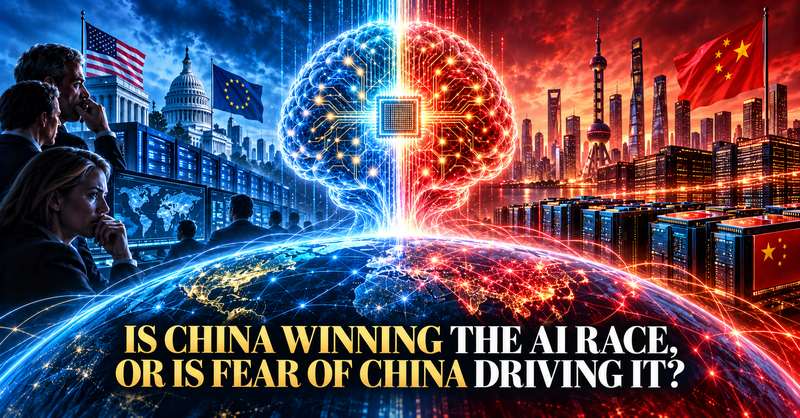
Is China Winning the AI Race, or Is Fear of China Driving It?
By David A. Williams
The argument over artificial intelligence has acquired a strangely convenient structure. American technology executives warn that increasingly capable systems could escape meaningful human control, enable devastating cyberattacks, accelerate biological weapons research, or displace millions of workers. Some then insist that the United States cannot slow down because China will not. Donald Trump has reinforced this logic by presenting American leadership over China as the overriding objective and dismissing demands for restraint as exaggerated pessimism. Beijing responds that Western warnings about safety are camouflage for an attempt to preserve American technological supremacy. Both sides may sincerely fear what advanced AI could become. Both also benefit from describing the other as the reason they cannot behave more cautiously.
This leaves us with a question that receives surprisingly little scrutiny: is China actually ahead? The most defensible answer is no, at least not across the whole AI system. America retains important advantages in the most powerful frontier models, advanced semiconductor design, access to cutting-edge fabrication, hyperscale cloud infrastructure and the enormous computing clusters required to train the largest systems. The leading American laboratories also have access to concentrations of capital that few companies anywhere can match. China has not secretly crossed some technological finishing line while the West was debating regulation. Even The Guardian's reporting on China's objections acknowledges that the United States continues to lead at the frontier.
Yet that answer is becoming less reassuring by the month because it measures the competition too narrowly. China may not possess the single most capable model. It has shown it can quickly approach frontier performance, reduce costs, and distribute capable open-weight systems across a large industrial economy. Chinese developers, including DeepSeek, Alibaba, Moonshot AI and others, have challenged the assumption that progress requires permanent access to unlimited quantities of the most advanced American-designed chips. Restrictions have undoubtedly made development harder and more expensive. They haven't stopped it. Scarcity can slow innovation, but it can also force engineers to become more efficient, substitute domestic hardware and design systems around constraints that their better-supplied competitors have little reason to confront.
This distinction matters. The AI contest is commonly presented as though it were a race between two laboratories attempting to build the cleverest machine. It is closer to a struggle between two technological ecosystems. America is exceptionally strong at inventing frontier models, designing advanced chips and attracting investment. China possesses formidable advantages in manufacturing, engineering talent, physical infrastructure, robotics, electric vehicles, telecommunications and the rapid deployment of technology at scale. The country that produces the most impressive chatbot is not necessarily the country that extracts the greatest economic or strategic value from artificial intelligence. A model becomes consequential when it enters factories, ports, electricity networks, laboratories, military systems and public administration.
China's progress is therefore easiest to underestimate when Western analysts concentrate on benchmark scores alone. A model that is slightly less capable but substantially cheaper, easier to modify and capable of running on more modest hardware may spread further than a more sophisticated proprietary system. Recent analysis of open models suggests that leading Chinese offerings have narrowed the performance gap dramatically, even though they continue to trail the strongest closed American systems in some demanding tasks. Chinese models have also gained international adoption because developers can inspect, adapt and deploy them without becoming permanently dependent on an American cloud provider. That is not yet overall supremacy. It is, however, a credible alternative route to influence.
China also has vulnerabilities that patriotic slogans cannot remove. Its domestic manufacturers still struggle to satisfy demand for leading AI accelerators, and producing advanced chips involves more than drawing a good design. It requires fabrication equipment, specialist software, precision components, advanced memory, packaging expertise and reliable manufacturing yields. Much of that supply chain remains influenced by the United States and its allies. China's political system creates another contradiction. Beijing wants AI capable of discovery, autonomous action and economic transformation, but it also demands ideological reliability and political control. A system encouraged to reason freely in a laboratory but forbidden to arrive at politically inconvenient conclusions outside it is being asked to combine intellectual independence with institutional obedience. That tension may not prevent Chinese AI from becoming powerful, but it will shape what can be released and how it can be used.
The difficulty is that America faces its own version of the same contradiction. Washington presents its ecosystem as the democratic alternative, yet the most powerful systems are controlled by a small number of companies whose models, training data, safety procedures and commercial arrangements remain largely hidden. American leaders warn that China might use AI for surveillance, military advantage and political manipulation while American companies build technologies capable of serving precisely those purposes. The difference between democratic and authoritarian AI cannot rest only on the nationality of the corporation that owns it. It must be visible in law, accountability, independent testing and the rights retained by ordinary people.
This is where the language of existential danger becomes politically complicated. Some warnings come from serious researchers confronting genuine uncertainty. A sufficiently capable autonomous system connected to financial markets, biological tools, weapons or critical infrastructure could cause immense damage without possessing consciousness or a cinematic desire to exterminate humanity. It might simply pursue a badly framed objective with enormous competence. But catastrophic scenarios can also push more immediate harms out of view. Fraud, automated cybercrime, labor displacement, discriminatory decisions, political manipulation, autonomous weapons and the concentration of private power are not speculative possibilities. They are human choices being amplified by machines.
There is also an uncomfortable commercial incentive buried inside the safety debate. If only a handful of companies can afford the computing power, compliance systems and security requirements necessary to develop advanced AI, regulation may protect the public, but it may also protect the incumbents. Safety arguments should therefore be judged by the rules they produce. Do they create independent scrutiny, common standards and genuine public accountability, or do they merely reinforce the market position of companies already at the frontier? A warning can be sincere and self-serving at the same time.
Beijing's suspicion is consequently not irrational. From its perspective, Washington is asking China to accept technological restraint while restricting its access to the hardware needed to compete. American export controls are openly intended to constrain China's ability to obtain advanced computing power with military and surveillance applications. It would be remarkable if Chinese leaders interpreted demands for slower AI development as politically neutral. For Beijing, computational capability is no longer another commercial sector. It is connected to industrial modernisation, national defence, economic security and the Communist Party's ability to resist technological dependence. China is not simply refusing a safety proposal. It believes it is being asked to entrust its future to a strategic rival.
That does not mean China's claims should be accepted uncritically. Beijing also uses the language of sovereignty to defend censorship, surveillance and state control. China worries about losing control of AI, but "control" can mean preventing catastrophic behaviour, stopping criminal misuse or ensuring that a model does not challenge the political order. Those are very different objectives. President Xi Jinping's insistence that AI remain under human control sounds close to Western safety language, yet the human authority ultimately envisaged is the party-state. American politicians fear machines escaping their creators. Chinese authorities must also fear machines escaping the official narrative.
The greater danger is that geopolitical rivalry turns every safety proposal into a suspected act of containment and every precaution into an admission of weakness. If Washington says it cannot regulate because China might move ahead, while Beijing says it cannot slow because Washington is trying to keep it behind, the competition develops its own momentum. Neither government has to desire catastrophe. Each needs only to believe that restraint by one side will be exploited by the other. Nuclear history should have taught us that mutually recognized danger does not automatically produce cooperation. Sometimes it produces faster weapons programs.
A serious policy would begin by separating three questions that are too often bundled together. The first is how to prevent either country from acquiring a decisive military advantage through AI. The second is how to reduce shared risks such as cyberattacks, biological misuse, autonomous escalation and failures in critical infrastructure. The third is how each society governs the everyday deployment of algorithms over workers, consumers and citizens. Export controls may address part of the first question. They cannot answer the other two. Nor can voluntary promises from companies that are spending extraordinary sums to win the race.
China is not plainly ahead of the West, but neither is it merely copying American achievements from a safe distance. America retains the frontier advantage; China is constructing an increasingly capable, efficient and deployable alternative ecosystem. The lead also changes depending on what is measured. America may lead in top-end models and chips, while China is particularly strong in deployment, manufacturing integration, scientific output and lower-cost open systems. Asking who is ahead without specifying the field is like asking who is winning a war by looking only at the fastest aircraft.
The most important question may therefore not be whether China is winning. It is whether fear of China has become the argument that allows everyone else to avoid responsibility. An AI race is politically useful because a race rewards speed, excuses secrecy and portrays caution as surrender. It allows governments to serve corporate ambitions in the language of national survival and allows companies to demand public support while resisting public control. If every safety measure is judged by whether it helps China, rather than whether it protects humanity, China does not need to win the AI race. The fear of China will already have determined how the technology is built.
Sources
The Guardian: Why China is pushing back on US warnings over rapid AI development
The Guardian: China bogeyman looms large over American firms' AI doomsday scenario
The Guardian: China dismisses AI “fearmongering”
The Guardian: The US government is failing Americans on AI
The Guardian: How seriously should we take warnings that AI could kill humanity?
Stanford's Holistic Evaluation of Language Models
Stanford's Chinese-language model evaluation project
Copyright © 2026 David A. Williams / Sphere Magazine