Have Nordic Countries Just Lost Their Biggest AI Advantage?
David Williams
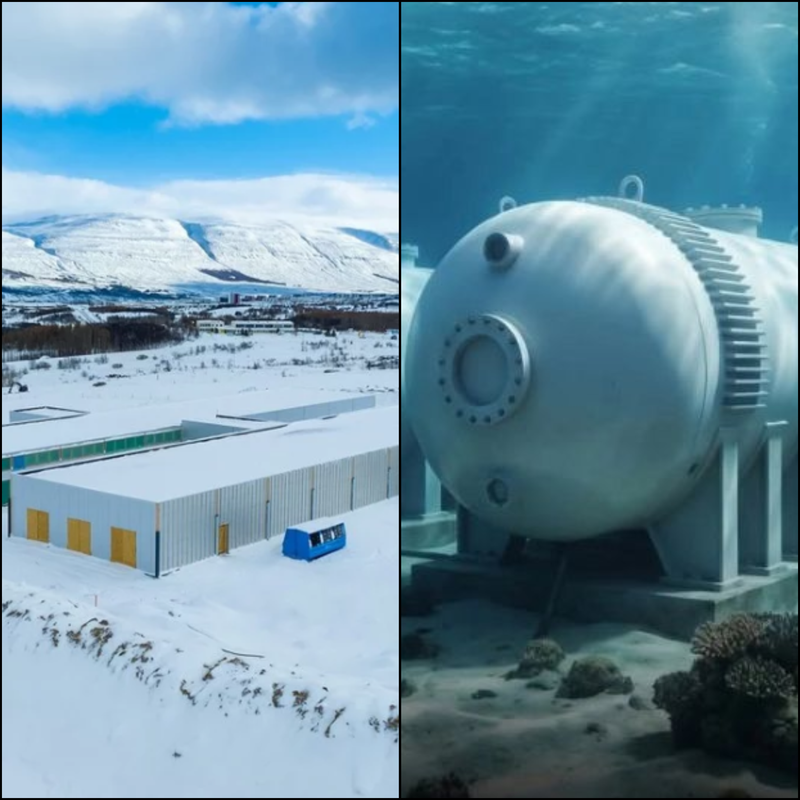
Countries such as Iceland, Norway, Sweden, Finland, and the Kingdom of Denmark, with Greenland's immense Arctic expanse, have long been regarded as possessing a natural advantage in the age of artificial intelligence. Their cold climates offer a simple but valuable asset: inexpensive cooling for the vast data centers that power AI systems. As demand for AI computing explodes, governments and investors across the Nordic region have increasingly viewed geography itself as a strategic resource.
For years, many analysts have assumed that the future geography of AI infrastructure would naturally favour the Nordic world.
But what if that advantage is beginning to disappear?
As China accelerates its push to become a global leader in artificial intelligence, engineers are increasingly looking beneath the ocean's surface rather than toward colder climates. New underwater data centers operating off the coasts of Shanghai and Hainan are using the sea itself as a giant natural cooling system, potentially transforming the economics of AI infrastructure and challenging long-held assumptions about where the industry's future will be built.
At first glance, the idea sounds almost futuristic. Yet, underwater data centers are not a recent invention. The concept has been under serious investigation for more than a decade, most notably through Microsoft's Project Natick. More broadly, engineers have explored the use of oceans, lakes, and other large bodies of water for industrial and computational cooling since the 1990s as computing power, energy consumption, and heat generation steadily increased.
The reason is straightforward. Artificial intelligence requires enormous computational power. Every calculation performed by a computer generates heat, and that heat must be removed efficiently if systems are to operate reliably. In conventional land-based data centers, cooling systems often account for between 40 and 50 percent of total energy consumption. Chinese developers claim that by placing sealed server modules on the seabed, cooling requirements can be reduced to less than 10 percent, dramatically lowering operating costs and reducing overall energy consumption.
Such gains could have profound implications. If oceans can provide efficient cooling almost anywhere in the world, the strategic importance of naturally cold regions may prove less decisive than many policymakers currently assume. The future location of AI infrastructure may ultimately be determined less by climate and more by access to coastlines, renewable energy, telecommunications networks, political stability, and capital investment.
In other words, a technological solution may be emerging that partially neutralises one of the Nordic region's most celebrated natural advantages.
Yet this technological breakthrough comes with important environmental questions.
This is a fascinating trade-off between energy efficiency and ecological risk. While underwater data centers significantly reduce cooling costs, the long-term environmental impact on marine ecosystems will require rigorous, independent evaluation before large-scale adoption can be responsibly justified.
The principal concern is thermal pollution. Every watt consumed by a data center ultimately becomes heat. Although the ocean possesses an immense capacity to absorb and disperse thermal energy, scientists still need to understand how continuous localised warming might affect fish populations, breeding cycles, microbial communities, nutrient flows, and sensitive marine habitats over periods measured in decades rather than years.
The challenge is not whether data centers will literally heat the world's oceans. They will not. Rather, the question is whether persistent thermal anomalies surrounding concentrated installations could alter ecological dynamics on a local scale in ways that remain poorly understood.
However, the reality may be considerably more nuanced than some of the more dramatic warnings suggest.
Far from "boiling the ocean in case global warming was not enough," some researchers and engineers believe future generations of underwater data centers could actively minimise their environmental footprint. By harnessing natural underwater currents and tidal flows, facilities may be able to generate renewable electricity to power highly efficient chillers capable of returning surrounding water temperatures close to their natural state. Such systems could substantially reduce thermal impact while preserving the cooling advantages that make subsea installations attractive in the first place.
There is also growing interest in integrating data center infrastructure with marine habitat enhancement. Rather than existing as sterile industrial objects, the external surfaces of subsea modules could be designed as artificial reefs. Barnacles, shellfish, corals, sea anemones, and countless other marine organisms readily colonise submerged structures. With careful engineering, parts of these facilities could potentially become thriving habitats that support biodiversity rather than diminish it.
Early observations from experimental underwater installations suggest that marine life adapts surprisingly quickly to such structures. While this does not guarantee ecological benefit, it demonstrates that the relationship between advanced computing infrastructure and marine ecosystems may be more complex than a simple narrative of industrial damage.
None of this means the environmental concerns should be dismissed. History is filled with technologies that initially appeared harmless, only for unforeseen consequences to emerge years later. The lesson is not that underwater data centers are inherently safe or inherently dangerous. Rather, it is that their long-term effects remain insufficiently understood and therefore require careful scientific scrutiny.
What is becoming increasingly clear is that the rise of artificial intelligence is forcing humanity to rethink not only how we build computing infrastructure, but where we build it. For decades, geography seemed to favour colder nations. Today, advances in underwater computing suggest that engineering innovation may be capable of overcoming what once appeared to be immutable climatic advantages.
If that proves true, the future of AI may not belong exclusively to countries blessed with cold weather. It may instead favour those capable of combining advanced computing, renewable energy, marine engineering, environmental science, and long-term strategic planning into a coherent vision.
The real significance of China's underwater data centers, therefore, extends far beyond cooling technology. They represent an early glimpse into a future where the boundaries between digital infrastructure and the natural world become increasingly intertwined.
The question is no longer whether humanity can place data centers beneath the sea. The question is whether we possess the wisdom to do so in a way that advances technological progress while preserving the ecosystems upon which all progress ultimately depends. If we succeed, underwater data centers may come to be viewed not as an environmental compromise, but as one of the most elegant engineering solutions of the AI era. If we fail, they may become yet another reminder that innovation without understanding often carries costs that only become visible when it is too late.
Support Sphere Magazine and Subscribe to our LINKEDIN NEWSLETTER