Europe Is Financing Its Own Digital Subordination
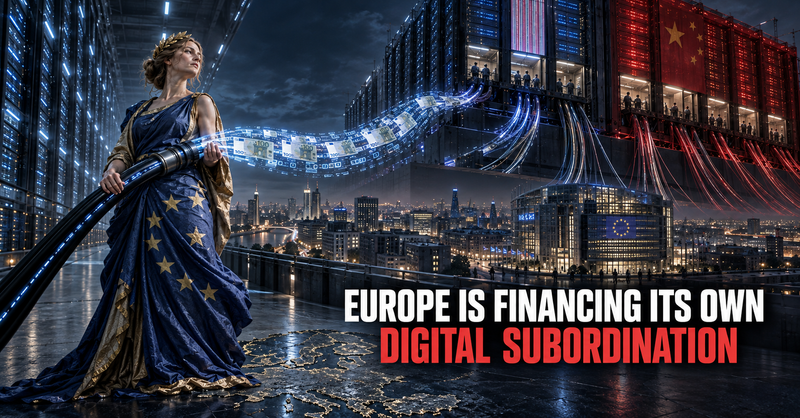
Europe's savings, electricity and industrial data are helping to build an artificial-intelligence system that it will neither own nor control. Christine Lagarde's warning that Europe could become dangerously dependent on American and Chinese computing exposes a disturbing possibility: Europe may regulate AI according to its values, only to use it according to someone else's terms.
By David A. Williams
Europe is not simply losing the artificial intelligence race. It is helping to finance the countries that are beating it. European savings flow into American technology companies, European businesses purchase American computing services, European data helps foreign systems become more capable, and European electricity increasingly powers data centers whose most valuable assets remain under foreign ownership. The continent then congratulates itself on writing the world's most sophisticated rules for a technology largely created elsewhere. This is not digital sovereignty. It is dependence dressed up as control
Christine Lagarde, President of the European Central Bank, has now described the scale of that dependence with unusual bluntness. The United States hosts about 75 per cent of the world's AI computing capacity, while Europe possesses only 5 per cent. American companies produced 59 notable AI models last year and China produced 35. France and Britain produced one each. These are not merely disappointing figures in an international technology league table. They reveal where the power to organize the next economy is accumulating. Europe has governments, universities, engineers, capital and an enormous internal market, yet the intelligence through which its companies and public institutions will increasingly understand and manage the world is being designed somewhere else. European Central Bank
We are accustomed to thinking of imports as physical objects. A country buys a car, a turbine or a machine, takes possession of it and continues using it. Artificial intelligence is different because it remains a relationship with its supplier. Its capabilities can be improved, restricted, censored, repriced or withdrawn. Access may depend upon licenses, cloud infrastructure, semiconductor exports and political decisions taken beyond Europe's jurisdiction. An imported locomotive could not wake up one morning and refuse to run because its manufacturer objected to the buyer's tax policy. An imported intelligence system can effectively do precisely that. The railway remained where it had been laid. AI remains attached to whoever controls the model, the computing infrastructure and the legal conditions under which it operates.
That difference creates a form of power Europe has never encountered before. Lagarde envisages AI screening goods at borders, selecting tax returns for investigation, dispatching trains, monitoring hospital patients and clearing bank payments. It will not simply advise the economy. It will become embedded in its nervous system. Once that happens, a restriction on access could reach several sectors at the same time. A future dispute about digital taxation, NATO spending, trade with China, Greenland, competition law or the regulation of American technology companies would therefore take place beneath an unspoken threat: how much economic disruption could Europe endure if access to essential models, chips, updates or cloud services suddenly became conditional?
Europe could, in other words, become digitally occupied without surrendering a centimeter of territory. Its flags would continue to fly, its elections would still take place and its parliaments would continue passing laws. Beneath those visible institutions, however, a growing share of economic and administrative life might depend upon privately controlled systems operating under foreign authority. This would not resemble an old empire with soldiers, governors and customs posts. It would be quieter and far more efficient. Dependence would be written into procurement contracts, cloud architecture, software licenses and technical standards. Nobody would need to order Europe to comply. The credible possibility of interruption might be enough.
This is why Lagarde's warning that foreign governments could acquire unprecedented leverage should be taken literally. Europe has previously endured dependence on Russian gas, Chinese industrial components and Middle Eastern oil, but the damage caused by losing any one of those inputs, however painful, remained concentrated in identifiable parts of the economy. AI dependency would be horizontal. It could pass through banking, logistics, public administration, defence, medicine, research and manufacturing at once. The supplier would not merely influence what Europe could buy. It could influence how quickly Europe could think, coordinate and respond. The Guardian
The trap is that Europe cannot simply refuse the technology. ECB estimates suggest that rapid AI adoption could raise European productivity by as much as 4 per cent over a decade. That would be transformative for a continent whose workforce is expected to contract by more than one million people annually over the next 25 years. Aging societies must somehow finance pensions, hospitals, defense and the energy transition with fewer workers. Artificial intelligence may be one of the few technologies capable of making arithmetic bearable. Europe therefore faces a brutal choice. Adopt AI slowly and become safer but poorer, or adopt it quickly and become more productive but more dependent. Neither amounts to sovereignty.
Europe's regulatory instinct may make this dilemma worse. Rules governing safety, privacy and accountability are necessary, particularly when AI enters hospitals, government departments and critical infrastructure. But regulation is not neutral when one side of the market already dominates. Compliance costs that a trillion-dollar American corporation can absorb may prevent a European challenger from surviving long enough to compete. Regulation intended to restrain foreign giants can therefore become a protective wall around their existing market power. Europe risks building a system in which it writes the rules, American companies supply the intelligence and China supplies enough competition to frighten Washington. The continent becomes the referee of a contest in which it has barely fielded a team.
The physical cost of changing that position is formidable. Europe's data center capacity gap is projected to grow more than sixfold within a decade. Lagarde estimates that closing it could cost as much as €600 billion, including semiconductors, although the ECB describes that figure as an upper bound based upon the cost of computing-intensive facilities. Yet money is only part of the problem. AI requires grid connections, transformers, cooling systems, land, chips and vast quantities of reliable electricity. Sovereign computing is therefore not a fashionable branch of technology policy. It is an energy question, an industrial programme, a capital-markets challenge and ultimately a decision about who is entitled to consume scarce electrical capacity.
This is particularly important for Denmark. The country possesses strong digital institutions, political stability and access to renewable electricity, making it attractive to international data-centre developers. But hosting foreign-owned servers is not the same as owning sovereign computing capacity. Denmark could provide the land, infrastructure, grid reinforcement and public legitimacy while the strategic control, intellectual property and profits remain abroad. A data center may create investment and some employment, but those benefits must be weighed against what else could have used the electricity. If Danish companies, hospitals, universities and public institutions receive no guaranteed access to the resulting computing power, Denmark may be exporting electricity in its most politically convenient form while calling it digital development.
Every future data center proposal should therefore face a more demanding test. Who owns the computing capacity? Which institutions receive priority in a crisis? Can Denmark guarantee continued access if relations with the supplier's home government deteriorate? Where is sensitive data processed, and under whose law? How much renewable generation and grid capacity will be committed, and what strategic benefit will Danish society receive in return? The old question asked how many jobs a project would create. The new one must ask how much national agency it creates. A building filled with foreign-owned servers may stand on Danish soil without becoming meaningfully Danish infrastructure.
The most perverse aspect of Europe's position is that it already possesses much of the money required to change it. Euro-area households hold around €440 billion in American technology companies, while European households save approximately €1.4 trillion each year. American hyperscalers are now borrowing in European debt markets to finance their AI expansion, potentially increasing financing costs for other borrowers. European capital helps build American computing power, European companies then rent access to it, and European pension funds bear the consequences if the valuations of those companies collapse. Europe is paying for the factory, buying the product and accepting the financial risk without controlling the machinery.
This resembles an earlier age in which European savings helped finance the American railways. The crucial difference is that the tracks remained in the United States and strengthened the economy built around them. Today, the infrastructure is even more powerful because it does not merely transport goods. It organizes knowledge, automates decisions and accelerates invention. Europe could once again provide the capital while another continent captures the productive system it creates. History does not always repeat itself, but capital has an excellent memory for where it receives the highest return.
The answer is not complete technological self-sufficiency. No country controls the entire AI supply chain. China dominates parts of the rare-earth supply, Taiwan manufactures the most advanced chips, the United States leads in frontier models and Europe retains extraordinary strategic importance through ASML's lithography technology. Real sovereignty means possessing enough domestic capacity, credible alternatives and indispensable technologies that dependence cannot be converted into obedience. Europe does not need the world's best model for every task. It needs European systems capable of running its essential economy, secure domestic infrastructure on which those systems can operate and reliable access to frontier computing for pharmaceuticals, finance, science and defence.
That will require choices that European politicians have so far preferred to avoid. Strategic data centers may need priority access to electricity, but not every data center can be declared strategic merely because its owner uses the language of AI. Pension capital may need to be channeled towards European technological growth, but citizens will rightly demand competitive returns. European procurement rules may need to favor resilience and domestic capability, even when a foreign service is initially cheaper. Regulation may need to distinguish between controlling dangerous uses and burying emerging European firms beneath compliance costs. Sovereignty is expensive because dependency is deceptively cheap, at least until the moment it is exploited.
Europe cannot claim technological autonomy while its savings finance American platforms, its electricity powers foreign-owned infrastructure and its most important institutions depend upon intelligence that can be repriced, restricted or withdrawn from abroad. It may regulate what AI is permitted to do within Europe, but ownership will determine who ultimately sets the conditions. Unless the continent converts its capital, scientific strength and energy resources into computing power it genuinely controls, digital sovereignty will remain an impressive phrase describing a dependency managed from Washington and Beijing.
The argument Europe now needs is not whether AI should be allowed to transform society. That transformation is already under way. The real question is who will own the intelligence through which European society is transformed. We once measured national power in factories, ports, oilfields and armies. It must now also be measured in computing capacity, electrical supply, model ownership and the right to keep essential systems running. A server hall is no longer merely a warehouse containing machines. It is a reservoir of economic agency. Europe has reached the point at which failing to build one future means renting another.
Sources
Christine Lagarde, “A New Age of Capital: Growth, Sovereignty and AI”, European Central Bank, 14 September 2026.
Dan Milmo, "Europe must build own AI or risk getting cut off by US or China, says ECB's Lagarde", The Guardian , 14 September 2026.
The ECB's €600 billion figure is explicitly presented as an upper-bound estimate. It combines the European Commission's projected 19-gigawatt data-centre capacity gap for 2036 with an estimate of the capital cost of GPU-dense AI facilities.
Copyright © 2026 David A. Williams / Sphere Magazine