Denmark Stops Fighting AI and Starts Teaching With It: A Lesson the World May Soon Follow
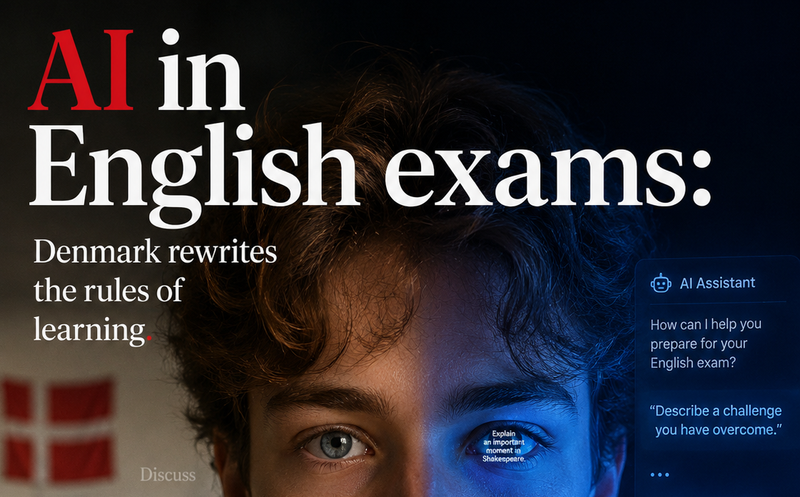
According to a report published by AACRAO Edge, Denmark will allow students to use artificial intelligence tools when preparing for English oral examinations from 2026. While students will still be assessed on their own speaking abilities during the examination itself, the preparation process will formally acknowledge a reality that many education systems continue to resist: AI is already part of modern learning.
David Williams
For years, schools and universities around the world have treated artificial intelligence as a problem to be controlled. New rules have been written, detection software has been deployed, and educators have struggled to determine where legitimate assistance ends and academic dishonesty begins.
Denmark appears to have reached a different conclusion.
Rather than attempting to build higher walls around examinations, policymakers are asking whether students should instead learn how to use these tools responsibly, critically and effectively. It is a subtle shift in thinking, but one that could have profound implications for education far beyond Denmark's borders.
The move is particularly significant because it recognises a simple truth. Artificial intelligence is not a passing trend. It is rapidly becoming embedded in workplaces, public services and everyday life. Today's students are entering a world where the ability to work with AI may be as important as the ability to use a search engine, spreadsheet or calculator.
Seen through that lens, Denmark's decision appears less radical and more realistic.
There are clear advantages. Language learners can use AI to practise conversations, refine pronunciation, explore different viewpoints and receive instant feedback on grammar and vocabulary. A student in a small town can access a sophisticated language partner at any hour of the day. In theory, this could help level the playing field and create more opportunities for independent learning.
The policy also reflects an emerging understanding that education should not merely teach knowledge. It should teach judgement.
The most valuable skill in an AI-driven world may not be generating information but evaluating it. Students must learn when AI is useful, when it is wrong and when human reasoning should take precedence. Those are skills that cannot be developed by simply banning the technology.
Yet enthusiasm should be tempered with caution.
Language acquisition has traditionally relied on repetition, persistence and independent effort. Critics will argue that easy access to AI-generated answers could weaken those foundations. If students become accustomed to outsourcing thinking, creativity or problem-solving, education risks producing learners who can operate technology but struggle to think without it.
There are also concerns about equality. Not all students have access to the same digital tools or levels of technological confidence. If AI becomes a standard part of preparation, governments and schools will need to ensure that access does not become another source of educational disadvantage.
Perhaps the most important question concerns assessment itself.
What exactly should schools measure in an age when information is instantly available? For generations, education systems rewarded memorisation and recall. The internet began shifting the focus towards information retrieval. Artificial intelligence may now force a third transformation, one that prioritises critical thinking, interpretation and intellectual independence.
That challenge extends far beyond English examinations.
It touches every subject, every classroom and every educational institution wrestling with the implications of technological change. The debate is no longer about whether students will use AI. In many cases, they already do. The debate is about whether schools will teach them how to use it wisely.
This is why Denmark's decision deserves international attention.
The country is effectively conducting a live experiment in educational adaptation. It acknowledges that artificial intelligence is here to stay and attempts to build a framework that embraces its benefits while preserving the human skills that matter most.
Success is far from guaranteed. The balance between technological assistance and intellectual development will be difficult to achieve. But if Denmark gets it right, it may provide a blueprint for education systems worldwide.
The real test will not be whether students perform better in English oral examinations.
It will be whether they emerge as more capable thinkers, better communicators and more discerning users of technology. In an age increasingly shaped by artificial intelligence, that may be the most important lesson of all.
Subscribe to the LinkedIn Newsletter: Sphere Magazine