Denmark’s Quiet AI Revolution: Can a Small Nation Really Lead Europe’s AI Future?
David Williams
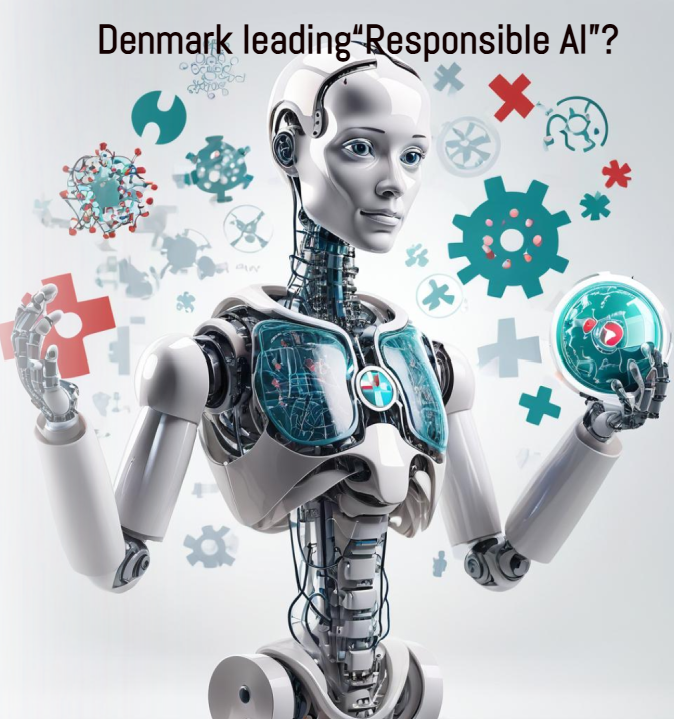
Denmark has spent years building a reputation as one of Europe’s most digitally advanced societies. Now it is trying to claim something even bigger. The country wants to become Europe’s leading force in what politicians and technology firms increasingly call “responsible AI.”
That phrase appears constantly in Danish policy papers and industry reports. But behind the language lies a serious national strategy. Denmark knows it cannot compete directly with the United States or China in building giant AI models or dominating the global tech economy. Instead, it is trying to lead in another way. Through regulation. Through public trust. Through coordination between government and private industry.
A recent report by Netcompany argued that Denmark is helping “pave the way for fast and easy implementation of responsible AI across Europe.” The report links Denmark’s ambitions closely to the EU AI Act, the European Union’s new legal framework for artificial intelligence. According to Netcompany, the Danish model could become an example for the rest of Europe.
That ambition is real. But it also raises a difficult question. Can Denmark actually become an AI leader, or is it simply becoming very good at managing technologies created elsewhere?
The Danish government has been laying the groundwork for years. Its national AI strategy, launched in 2019, focused heavily on ethics, public confidence, and human-centred technology. According to the European Commission’s AI Watch programme, Denmark’s strategy emphasised the responsible use of artificial intelligence in healthcare, transport, energy, and public administration.
The language matters. Danish policymakers rarely speak about AI in the aggressive terms used in Silicon Valley or Beijing. There is little talk of domination or disruption. The focus instead is on trust, accountability, and social stability.
That reflects something deeper in Danish political culture. Denmark has long relied on high institutional trust and close cooperation between the state and private industry. AI is now being folded into that same model.
This year Denmark expanded that effort through a national Digital Taskforce for Artificial Intelligence. Reporting from Regulations.ai describes the initiative as an attempt to accelerate AI adoption across government while making sure systems comply with both GDPR and the EU AI Act. In simple terms, Denmark wants AI systems that are not only powerful, but governable.
Private companies are central to the project. Netcompany has become one of the loudest advocates for a European model of AI deployment. The company argues that democratic oversight and rapid technological development do not have to be opposites. That idea appears repeatedly in its public material.
Still, Denmark’s position needs to be understood realistically.
There are different kinds of AI leadership emerging in the world right now.
The United States leads in frontier AI development. Companies like OpenAI, Google, Anthropic, and Meta control enormous computational resources and attract vast investment capital. China is building its own state-backed AI ecosystem with similar scale and ambition.
Denmark cannot compete on that level. No European country really can at the moment.
Instead, Denmark is trying to become a leader in institutional AI. That means building the systems, standards, legal frameworks, and administrative tools that allow artificial intelligence to function inside democratic societies.
It is a very European form of ambition.
The country has invested in infrastructure, including the Gefion AI supercomputer backed by the Danish Centre for AI Innovation. But compared with the massive computing clusters being built in the US and China, Denmark’s technical capacity remains modest. The real Danish advantage lies elsewhere. In digital administration. In efficient public systems. In social trust. In the ability to coordinate government and business without constant political paralysis.
In some ways Denmark may end up playing a role similar to Switzerland in finance. Not the biggest power, but a country trusted to shape standards and institutional frameworks.
Whether that is enough remains uncertain.
Supporters of the EU AI Act believe Europe can shape global norms through regulation in the same way GDPR reshaped global conversations about privacy. Denmark appears determined to become one of the first countries capable of turning those legal principles into functioning systems.
But critics see another possibility. They worry Europe could become highly skilled at regulating technologies invented elsewhere while falling behind in innovation itself.
That concern appears increasingly in business forums and technology debates. Smaller companies especially have warned that compliance rules under the EU AI Act may become expensive and difficult to navigate. Some fear regulation could slow European startups while American and Chinese firms continue advancing rapidly.
This is the central tension in Denmark’s strategy.
Responsible AI governance may create trust and political legitimacy. Those are important strengths. But they do not automatically produce technological supremacy.
There is also a philosophical issue underneath all this. “Responsible AI” sounds reassuring, but the meaning remains contested. Researchers and policy experts disagree on what true responsibility actually requires. Transparency? Human oversight? Sustainability? Explainability? Democratic accountability? Probably all of them.
Denmark is trying to build a system where those principles can coexist with rapid AI adoption. That is an ambitious experiment. Perhaps one of the most ambitious in Europe.
Still, artificial intelligence is becoming more than just another technology sector. It is increasingly tied to economic power, military competition, and geopolitical influence. In that environment, Denmark is unlikely to become an AI superpower in the conventional sense.
But perhaps that was never the point.
Denmark’s real gamble is that in a future shaped by opaque algorithms and declining public trust, societies may eventually value credible governance as much as raw technological muscle.
If that happens, Denmark could become something unusual. Not the country that builds the world’s dominant AI systems, but one of the countries that helps decide the rules under which those systems operate.
That would still be a form of power. Quiet power, perhaps. But power nonetheless.
Sources referenced in this article include reporting and material from Netcompany, the European Commission AI Watch programme, and the Danish Centre for AI Innovation.
Support Sphere Magazine by subscribing to the FREE LinkedIn Newsletter
For more AI news, subscribe to the newsletter