Algorithmic Childhood: When Social Media Becomes a Public Health Risk, could AI Become the Silent Enforcer?
David Williams
There are political statements that do more than spark debate. They shift the ground underneath it. The remarks attributed to Denmark’s Prime Minister, Mette Frederiksen, sit in that category.
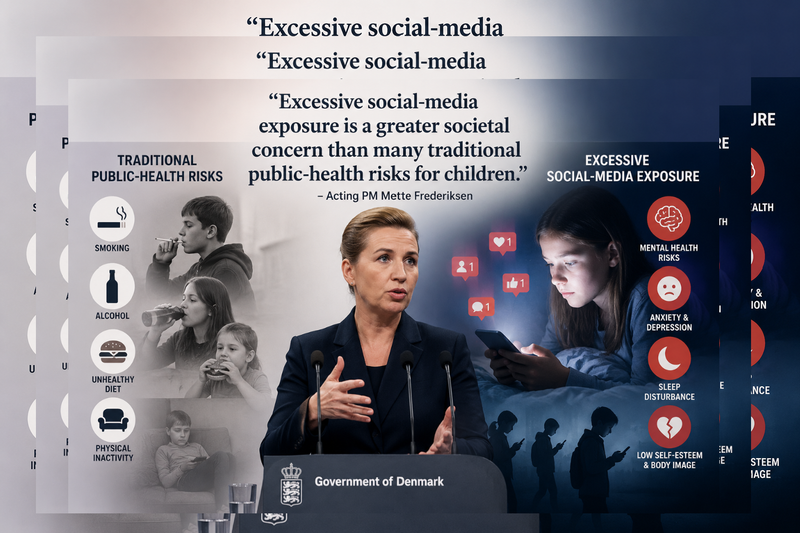
According to reporting from the Moneycontrol report (https://www.moneycontrol.com/news/trends/something-wrong-with-us-denmark-pm-says-she-d-rather-let-children-smoke-than-use-social-media-13937297.html), Frederiksen suggested that excessive social media use among children may now represent a greater societal concern than traditional public health risks such as smoking.
It is a striking comparison, and deliberately so. Smoking belongs to an older policy world: measurable harm, clear causality, visible consequences. Social media does not behave in that way. Its effects are layered, psychological, and often only visible over time, shaped by systems that adapt faster than the rules meant to contain them.
That leaves an uncomfortable question hanging in the air. If this is a public health issue, what does meaningful intervention even look like?
A shift already underway in Europe
Across Europe, the language around social media is quietly changing. It is no longer framed only as a question of personal responsibility or parenting choices. Increasingly, it is being treated as a question of design.
The European Commission describes social media systems as being built around engagement maximisation, where features such as infinite scroll, autoplay, and constant notifications are designed to keep users on platforms for longer (https://health.ec.europa.eu/inthistogether/healthy-screentime_en).
Other EU-level discussions go further, arguing that these outcomes are not accidental. They are the result of business models that turn attention itself into a commodity (https://www.investing.com/news/stock-market-news/eu-targets-social-media-to-protect-children-von-der-leyen-says-4679115).
Once you accept that framing, the responsibility starts to shift. It is no longer just about what families allow. It becomes about what systems are engineered to do in the first place.
The limits of parenting in a system that never stops
Much of the public debate still returns to parents. Set limits. Delay smartphones. Monitor usage. In principle, it sounds reasonable. In practice, it often collapses under the weight of how these platforms actually work.
A parent can set rules at home. But they cannot slow down an algorithm. They cannot redesign a recommendation system. They cannot switch off the notifications that arrive long after bedtime. And they cannot realistically compete with platforms built to capture attention at scale, minute by minute.
So the imbalance becomes obvious. One side of the equation is human, inconsistent, and local. The other is automated, continuous, and global.
That gap is where policy is now starting to look for answers.
Where AI enters the conversation, quietly but firmly
Artificial intelligence is increasingly appearing in this debate, though not in the dramatic way it is sometimes imagined. Governments are not seriously proposing that AI replace parents. But they are starting to treat AI as part of the infrastructure of enforcement.
The European Commission has already moved toward restricting harmful design practices and algorithmic systems, including recommendation engines that shape what users see online (https://www.cereport.eu/news/tech-and-science/91437).
At the same time, policymakers are exploring stricter age verification and enforcement mechanisms in digital environments that now include AI-driven systems (https://commission.europa.eu/topics/digital-economy-and-society/protect-our-children-also-online_en).
What is emerging is not a single bold idea, but a gradual shift in assumptions. If AI already helps decide what content is shown, then it is not such a big leap to ask whether AI could also help decide what should be slowed down, interrupted, or limited.
Not as a moral judge. More as a kind of boundary layer between the user and the system.
What that might look like in practice
In practical terms, AI-based protection would not be about making grand decisions over right and wrong. It would be far more subtle, and arguably more invasive in its own way.
It might involve systems that recognise when usage patterns start to look compulsive. It could pause recommendation feeds when late-night scrolling becomes habitual. It might soften or narrow content streams for younger users at certain times of day. It could even adjust how “intense” a feed becomes based on behavioural signals over time.
There is already academic thinking in this direction, arguing that AI systems should be designed with children’s safety and developmental needs as core constraints rather than optional features (https://arxiv.org/abs/2108.12166).
What matters here is not the technology itself, but what it represents. A shift from platforms maximising engagement to systems that are actively constrained by external rules about well-being.
The uneasy part no one fully owns yet
But once you start building systems like that, the questions multiply quickly.
Who defines what “too much” looks like? Who decides what counts as healthy engagement for a teenager versus a younger child? And what happens when the system gets it wrong, either by being too restrictive or not restrictive enough?
Because at that point, AI stops being just a tool. It becomes an interpreter of behaviour. And interpretation always carries bias, even when it is statistical rather than human.
So the responsibility does not disappear. It just moves somewhere less visible.
A debate still catching up with itself
Frederiksen’s comparison has resonance because it taps into something many policymakers are only beginning to articulate clearly: that digital environments may need to be treated with the same seriousness as public health risks.
Across Europe, there is growing attention on “addictive design” features such as infinite scroll and autoplay, and on how recommendation systems prioritise engagement over wellbeing (https://kelo.com/2026/05/12/eu-targets-social-media-to-protect-children-von-der-leyen-says/).
There are also renewed political pushes for minimum age thresholds for access to social media and AI systems (https://www.reuters.com/legal/litigation/european-lawmakers-seek-eu-wide-minimum-age-access-ai-chatbots-social-media-2025-11-26/).
None of these forms a finished policy. It is more like a direction of travel.
The question that refuses to settle
In the end, the debate keeps circling the same point without resolving it.
If social media is now seen as a potential public health risk in how it shapes attention, development, and behaviour, then what kind of intervention is appropriate?
Do we regulate platforms more tightly? Do we lean harder on education and parental responsibility? Do we set clearer age limits? Or do we quietly begin embedding AI systems that mediate what children can and cannot easily see?
And if that last option becomes part of the answer, then the question becomes even more uncomfortable.
Not whether machines can enforce limits. But whether we are ready for them to become part of the invisible structure of childhood itself.
For more articles like this, subscribe to the LinkedIn Newsletter