AI: The Magic Piece in Denmark’s Green Tripartite?
David Williams
When Denmark signed the Green Tripartite Agreement in 2024, it launched one of the most ambitious agricultural reforms in modern Europe. The deal introduced the world’s first carbon tax on livestock emissions, committed to converting huge areas of farmland into forests and wetlands, and promised major cuts to nitrogen pollution in Danish waters.
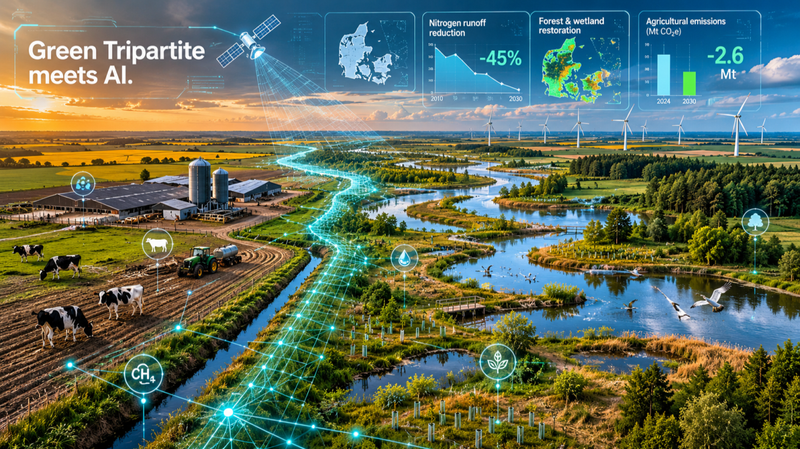
The numbers are staggering. Denmark plans to create 250,000 hectares of new forest, restore 140,000 hectares of carbon-rich lowland soil, and reduce agricultural greenhouse gas emissions by up to 2.6 million tonnes before 2030.
Acting Minister for the Green Tripartite Jeppe Bruus called it “the biggest change to the Danish landscape in over 100 years.”
But behind the political breakthrough lies a harder question. How do you actually manage a transition this vast?
Because the Green Tripartite is not just climate policy. It is a national coordination problem measured in emissions data, satellite imagery, soil chemistry, livestock tracking, and land-use monitoring. Thousands of farms must be measured, regulated, and transformed simultaneously while Denmark still maintains food production and rural livelihoods.
That is where artificial intelligence enters the picture.
The World Resources Institute described the agreement as “the world’s most comprehensive national effort to address the environmental challenges of agriculture.” Yet no human bureaucracy can manually monitor a project on this scale in real time.
AI systems already help farmers optimise fertiliser use, analyse crop health, predict yields, and monitor soil conditions. Applied nationally, those same technologies could identify where nitrogen runoff is most severe, where wetlands should be restored first, and which land conversions would produce the greatest climate benefit.
The agreement itself calls for “future-oriented, competitive, and sustainable food production” supported by investment in “climate technologies.” AI is never directly mentioned, but the entire framework increasingly points toward automated environmental management.
Researchers are already making the connection. An editorial from Aalborg University argued that “geographic data and analysis tools are key tools in the concrete implementation of the reform.”
The urgency is obvious. Nearly two-thirds of Denmark is cultivated farmland, making it one of Europe’s most intensively farmed countries. Decades of nitrogen runoff have damaged fjords and coastal ecosystems, contributing to severe oxygen depletion in Danish waters.
Acting Prime Minister Mette Frederiksen has framed the reforms as both an environmental necessity and an economic opportunity, promising “more nature, cleaner water, and a sustainable transformation of Danish agriculture.”
Critics remain sceptical. Rådet for Grøn Omstilling, a Danish environmental NGO, warned the agreement “fails by maintaining problematic animal production.” Researchers at Aarhus University have also cautioned that “2026 will be the reality test” for implementation.
AI could become the difference between ambition and execution.
Satellite systems powered by machine learning could track forest growth, monitor wetland recovery, estimate emissions farm by farm, and verify compliance automatically. Instead of relying mainly on self-reporting, regulators could monitor environmental change continuously across the entire country.
Denmark would not just be digitising agriculture. It would be building one of the world’s first AI-assisted environmental states.
Yet there is a paradox at the centre of this vision. AI itself consumes vast amounts of electricity and water. The green transition and the AI boom are accelerating at the same time, often competing for the same energy infrastructure.
There is also a political risk. Farmers may embrace AI tools that improve efficiency and reduce costs. They are less likely to welcome systems that feel purely designed for surveillance.
That tension may ultimately define the success or failure of the Green Tripartite.
Denmark has already created entirely new institutions to oversee the transition, including the Ministry for the Green Tripartite and a multi-billion-euro Green Land Fund. The next step may be creating the digital infrastructure capable of managing a transformation this complex.
If Denmark succeeds, it could become the global model for AI-assisted climate governance. If it fails, it may reveal the limits of trying to engineer environmental transformation through politics alone.
The Green Tripartite is ultimately an attempt to redesign the relationship between land, food, and climate responsibility. Delivering it may require more than policy.
It may require a machine mind capable of seeing the whole landscape at once.
Support Sphere Magazine and subscribe to the FREE LinkedIn Newsletter